|
|
|
|
European coltsfoot (Tussilago farfara) March 2018 Weed of the Month
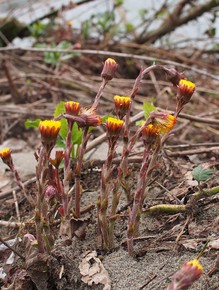 Just added to the Washington State Noxious Weed List in 2018, European coltsfoot (Tussilago farfara) is still new to many of us in the noxious weed world. However, this interesting species has been used as a medicinal plant in China and Europe for centuries, and is still commonly cultivated in medicinal gardens. It has been used to treat a wide range of ailments from respiratory diseases to wounds to inflammation. Unfortunately, European coltsfoot does contain toxic pyrrolizidine alkaloids that can cause liver damage. The plant shouldn’t be used as forage for livestock or used medicinally without medical oversight and careful monitoring.
European coltsfoot flowers in late winter to early spring on stems that appear to be leafless (but actually have small, clasping, scale-like leaves). The flowers are bright yellow and look a lot like dandelions, but on really stout stems. Find out more by clicking below.
|
|
|
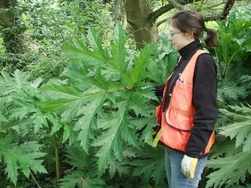 King County beginning seasonal battle against toxic and invasive plants.
More daylight and warming temperatures are close at hand, and that means King County greenspaces and backyards will soon start coming alive with vegetation – including unwanted invasive plants and noxious weeds. When a concerned resident contacted the King County Noxious Weed Program alarmed that she had seen giant hogweed growing in a greenspace by her house in southeast Seattle, she set in motion the County’s noxious weed response plan. Even if it turned out to be a false alarm, the risk of giant hogweed spreading and causing harm is high, so the county plan calls for a noxious weed specialist to check it out in person, educate the property owner and any residents, and ensure all hogweed plants get safely controlled. If people can’t control the hogweed by themselves, county staff will help. King County follows up on all reported sightings of noxious weeds such as giant hogweed that are regulated under Washington’s Noxious Weed Law.
|
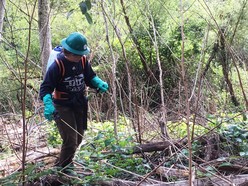 Noxious Weed Program's riparian team is hiring seasonal field assistants - apply by March 31.
The riparian noxious weed team has openings for 1-3 seasonal positions for 2018. Applications due on March 31, 2018. Applicants should email résumé and a short cover letter summarizing qualifications to Erin Haley at erin.haley@kingcounty.gov. These are short term temporary positions and will work full-time for approximately 5-6 months from late April to October. Salary is $22.59/hr and the positions are not benefit eligible.
The positions will primarily assist with the Invasive Knotweed Control Projects throughout King County under the direction of the Program’s Riparian Noxious Weed Control Specialists. Job duties include doing field surveys to map weeds along riparian corridors using GPS/GIS equipment on foot and using human and motor-powered watercraft and controlling weeds along river corridors, in flood plains and other locations. The job requires walking on uneven terrain, slopes, crossing moving water, moving through brush, and work in inclement weather. The job also includes communication with landowners, data entry, assisting with report and grant writing and assisting with special survey and control projects of the Noxious Weed Control Program. Click the link below for the complete job description and application instructions.
|
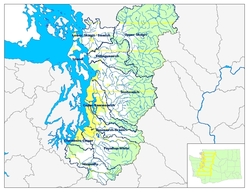 Puget Sound Knotweed Forum – Spring 2018 Meeting.
King County Noxious Weeds is hosting the 2018 Spring Meeting of the Puget Sound Knotweed Forum on Wednesday April 18 from 9:00 to 11:30 am at The Lodge at Beaver Lake – 25201 SE 24th St., Sammamish, WA 98075. The Knotweed Forum is an opportunity for people working on riparian restoration and knotweed control around Puget Sound to learn from each other and to increase their knowledge about shared issues and challenges. The April 18 agenda includes a panel on social media use featuring experienced users, a research report on effective topic strategies for framing the discussion of invasive knotweed control, a report on knotweed control in Vancouver BC, and highlights of a helicopter survey of knotweed on the Skykomish River. To RSVP or for more information, contact Justin Brooks at Justin.Brooks@kingcounty.gov or 206-477-0272. Click below to see the whole agenda and learn more about the Knotweed Forum.
|
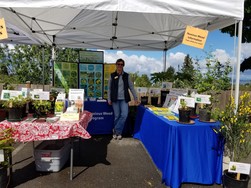 Celebrate Spring and Earth Month at Community Fairs – and find out about noxious weeds!
Our noxious weed information booth will be traveling around in March and April. Come visit us in Lake Forest Park, Shoreline, Sammamish and Duvall in the upcoming month. We always have lots of free booklets and fact sheets and of course the highlight of our booths, the weeds on display! Where else can you find noxious weeds labeled for your convenience and get your questions answered at the same time. Do you have a community event that could use some noxious weed education? Our calendar for the year is starting to fill in, but we have room for more so let us know if you have an event we should visit. Click below to go to our 2018 Events Calendar. Hope to see you soon!
|
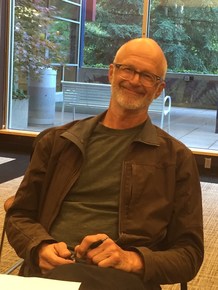 Passing the baton at the King County Noxious Weed Control Board (and a little Board history).
When Scott Moore decided to resign from the King County Noxious Weed Control Board at the end of 2017, it was bittersweet. Scott had served on the Board since 1998 and was Board Chair for many years, so there is no denying he had earned a break! However, during those 19 years, King County’s noxious weed program benefited hugely from Scott’s steady guidance, considerable expertise and great passion for the environment. All of us at the noxious weed program are very appreciative of Scott’s work helping to support our mission for so many years.
Fortunately for us, Alaine Sommargren has been appointed and confirmed to replace Scott in representing Weed District 1. With Alaine, we have gained another highly experienced and enthusiastic supporter of noxious weed control on the Board. Find out more about Alaine and delve into the history of the King County Noxious Weed Control Board by clicking below.
|
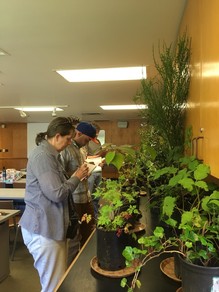 Learn how to save the wilderness from the scourge of invasive plants!
If hiking is your hobby and fighting invasive plants is your passion, you should consider Weed Watching! If you find yourself unable to look away from stinky bob along the hiking trail, or you can’t avoid noticing English ivy in the forest or knotweed on the river, then this is the perfect activity for you. King County is teaming up with Pacific Northwest Invasive Plant Council to offer two training classes for Weed Watchers (or the formal name – Citizen Science EDRR Volunteers). We will teach how to gather data – you can choose low-tech or high-tech – and how to identify the key invaders that public lands managers are working to control. Did you know that there are still forests in western Washington that are untouched by English ivy? Wouldn’t it be wonderful to keep it that way? Join us on May 7, 6:00-8:30 pm, at the Seattle Mountaineers or on June 3, 12:30-4:30 pm, in North Bend at the Snoqualmie District Ranger Station. Sign up and get more information by clicking on the link below.
|
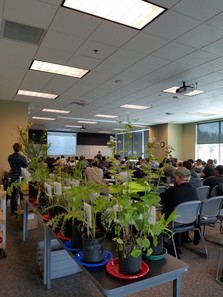 New evening noxious weed class added to our schedule for June 4.
Did you miss a chance to sign up for one of our spring noxious weed classes? There was a flood of interest in noxious weed education this spring and our April and May classes filled up quickly. Fortunately, we were able to add another session of our evening workshop on June 4 at the Renton Library, 6:30-8:30 pm. We will cover noxious weed and invasive plant identification and control. The agenda will be the same as the April 2 workshop, which is full, although we might have better weed specimens! There will be 2 WSDA pesticide recertification credits for the class. It is free and open to everyone!
|
|
|
Sasha Shaw, King County Noxious Weed Control Program
Please feel free to distribute this information freely and to contact me if you have any questions.
Thank you.
Sasha Shaw
King County Noxious Weed Control Program
sasha.shaw@kingcounty.gov
|
|


