|
Can’t access the links? Add “lnks.gd” to the allowlist of your content blocking software. |
|
|
Each year, employers, residents, and government agencies across Washington spend more money on health care.
Washington’s Health Care Cost Transparency Board (Cost Board) tracks how much our collective health care spending grows from year to year. It then compares this yearly increase against the state’s health care cost growth benchmark – a key indicator of affordability trends.
The Cost Board just released spending data for 2023. The data show that health care spending, per person, grew 6.2%. This growth rate was well above the benchmark (3.2%) for the second year in row, and it outpaced other key measures of affordability.
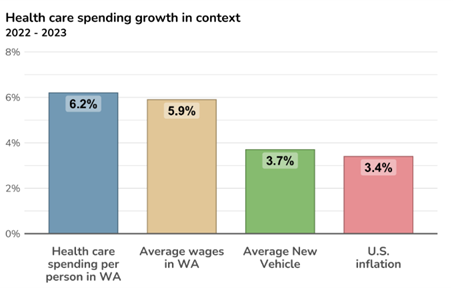 Data source: Cost Board 2025 Public Hearing.
|
|
|
When health care spending growth outpaces wage increases and inflation, it takes up a larger share of household, business, and government budgets. This decreases what we can be paid for other essentials, such as rent, employee wages, and public safety.
And it’s not just that health care affordability is heading in the wrong direction. Total spending per member, which is a major contributor to insurance premiums, is already high. As certain health care subsidies expire, the high cost of premiums means fewer Washingtonians can afford coverage. Taken together, this data is a clear signal that we need impactful solutions to slow spending growth.
|
|
|
Multiple factors drive up spending growth, including:
- Rapid rises in drug and hospital prices
- Underuse of primary care
- Consolidation of health care groups
Policies such as setting price limits on certain services (also called reference-based pricing) are a step toward slowing spending growth. Washington has already adopted reference-based pricing for hospital services in its public and school employee health plans.
Other policies in development include updating the state’s health plan to ensure health care facilities are built where they’re needed most and setting the framework for a complete list of health care providers, which could improve how we track provider consolidations.
The Cost Board has outlined additional strategies and priorities for policy action in its annual report. Advancing these solutions will help make quality health care more affordable for everyone in our state.
Explore the annual report for more context, additional data, and legislative recommendations.
Explore this year’s data trends presentation and report to see what aspects of health care are growing fastest.
|
|
|
|