|
Can’t access the links? Add “lnks.gd” to the allowlist of your content blocking software. |
|
|
Dear HCMACS Program partners,
Over the past month, our teams, partner agencies, and Epic have continued deep scoping work to shape the foundation of the Health Care Management and Coordination System (HCMACS). This work—mapping current processes, validating requirements, and refining our shared implementation plan—has brought us closer to a clear, actionable vision for the months ahead. The collaboration across agencies has been strong, and Epic’s ongoing engagement has helped ensure we are aligning the system design with the real-world needs of Washington’s programs, staff, and the people we serve.
We’re also pleased to share that Centers for Medicare and Medicaid (CMS) has approved our Implementation Advanced Planning Document (IAPD) update. This approval affirms the direction of our planning, supports our next steps with Epic, and positions us to continue advancing the program’s critical foundational work.
At the same time, we know teams are feeling the impact of the statewide hiring freeze and current budget constraints. These conditions have inevitably delayed some decisions, such as the timing of the request for proposal (RFP) apparent successful bidders (ASB) announcement. It has also slowed our ability to fill key roles that will be essential in future stages of the program. While these challenges are real, they have not stopped progress. Instead, they have reinforced the importance of careful prioritization, coordinated communication, and strong collaboration across all corners of the program.
We want to thank everyone for keeping work moving forward despite these pressures. Your clarity, adaptability, and commitment are what enable us to continue building momentum even when conditions tighten.
In the coming weeks, we’ll share more about next steps emerging from the scoping sessions, updated planning timelines based on the Washington State budget picture, and what to expect as we continue preparing for the phases ahead.
Sincerely,
Carrie Paykoc
HCMACS Executive Program Director
By Lisa Gosiaco, EHR OCM/Communications Manager and Rick Hansen, EHR Senior Technical Manager
This article originally printed in the November DSHS EHR newsletter.
If you work at Western State Hospital, Child Study & Treatment Center, Behavioral Health Treatment Center-Steilacoom Unit, or Eastern State Hospital, you may have noticed someone walking around with a notepad between September 29 and October 3, studying maps, and taking notes. That was Rick Hansen, DSHS’ EHR Senior Technical Manager, preparing each facility for the upcoming Epic Electronic Health Record (EHR) implementation.
Over five busy days, Rick visited roughly 50 wards, talking with staff, reviewing equipment, and mapping how everything connects. These site visits help ensure each location is ready to support the new Epic system when it goes live.
Rick has been part of EHR implementations for 18 years and joined the DSHS EHR project leadership team in July 2024. As a self-described “tech guy,” his focus is making sure the technical foundation supports clinical workflows and meets Epic’s standards.
What the Visits Covered
During his visits, Rick met with leaders and staff to learn how current technology supports daily clinical work and what improvements are needed. His main goals were to:
- Identify key equipment, such as computers and printers, in each clinical area
- Map out device locations and identify where new ones may be needed
- Plan for mobile technology like laptops and tablets that allow staff to work where needed
- Gather feedback from staff about what’s working well and where there are challenges
- Build a knowledge base to help all facilities prepare for Epic
After the visits, Rick compiled a detailed report on all available equipment, what needs replacement, and what still needs to be purchased. Every workstation and printer must be properly identified and secured before connecting to Epic — an important step for protecting patient information and maintaining system security.
Strengthening Our Wi-Fi Network
Rick also assessed Wi-Fi coverage throughout the facilities. Because Epic allows staff to use laptops, tablets, or handheld devices in a variety of locations—from nurse stations to treatment rooms—strong, consistent Wi-Fi is essential. Improving this access will help staff work more efficiently and stay connected wherever care happens.
Staff Optimism and Collaboration
Something Rick noticed during his visits was the positive support and optimism from staff about the EHR. He heard encouraging feedback from teams across IT, pharmacy, clinics, and nurse stations, many of whom shared excitement about the Epic rollout.
Rick’s findings—covering equipment needs, Wi-Fi improvements, and staff feedback—will guide the next steps in preparing our facilities to ensure a smooth and successful transition to Epic. Thanks to his work and the collaboration of staff across facilities, we’re one step closer to a more connected, efficient, and secure EHR system for DSHS.
|
|
|
HCMACS Program Executive Steering Committee Meetings
December 8
December 22
HHS Coalition Governance G2 Meetings: HCMACS updates monthly
December 12
HCMACS Weekly PMO Workgroup
Tuesdays at 9:30 a.m.
HCMACS Weekly Program Technical and Data Workgroup
Tuesdays at 1 p.m.
HCMACS Weekly System Integrator RFP Evaluation Workgroup
Tuesdays at 2 p.m.
|
|
HCMACS Weekly Budget Workgroup
Wednesdays at 3 p.m.
HCMACS Monthly Planning Committee Meeting
December 4
HCMACS Biweekly Communications Meeting
December 4
December 18
HCMACS Biweekly OCM Meetings
December 11
HCMACS Financial Leadership Meetings
Monthly
|
|
Live event captioning available
Communication Access Real-time Transcription (CART) services, or live closed captioning, are available for events, on demand. Scheduling CART services requires a three-week lead-time.
To request this accommodation, please submit a request as soon as possible to:
Matt Turner.
If you make your request less than a week in advance of the event, our language access manager cannot guarantee that a CART writer will be available.
|
|
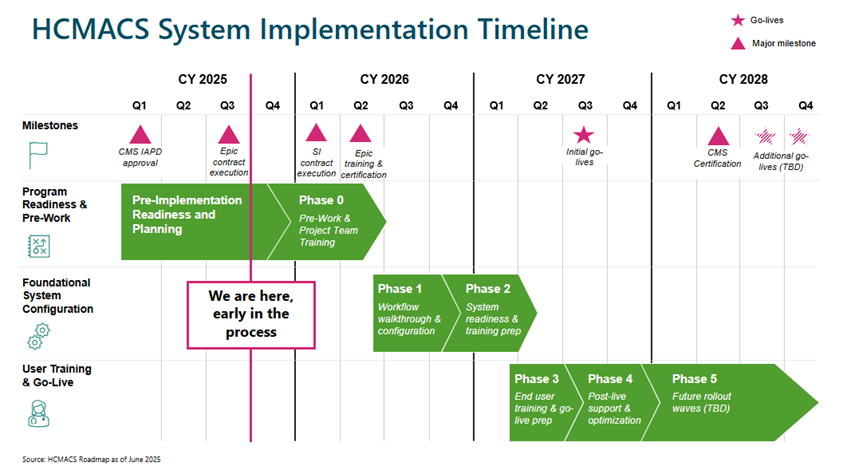 HCMACS Program and projects continue our pre-implementation efforts together. We are in Q4. An updated timeline graphic will be provided in the next newsletter.
Key milestones achieved this past month include:
- Centers for Medicare and Medicaid Services (CMS) approved the Implementation Advanced Planning Document (IAPD) update.
- ISG, our organizational change management (OCM) vendor, was onboarded, the workgroup kicked off, initial deliverables were received, and OCM assessment planning is underway.
What's coming next in January for training?
Overview of implementation in Olympia (January 6 - 8)
Epic and the HCMACS Program/Agencies will host overview of implementation training in January. The first two days are in person with hybrid options for clinical, project management, and technical leadership. The third day is virtual and is focused on an overview of project management tools for program/project management staff.
This training will focus on orienting three groups:
- Executives and sponsors
- Agency clinical, operational (e.g., revenue), and technical leaders
- HCMACS Program and Agency staff (e.g., project managers)
Training will include overview sessions for all participants, as well as breakout sessions for specific functional areas. Participants are encouraged to join us in-person in Olympia, and hybrid options will also be available for those unable to travel.
Training topics include:
- Overview of HCMACS and implementation schedule
- Guiding Principles and working norms
- Deep dive on Program governance
- Deep dives on clinical / operational / technical topics
- Program and Project management
- Open house sessions for continued discussion and Q&A
Over the coming weeks, Agency Project leads will be working with their teams to identify attendees, share invites for sessions, and coordinate travel approvals.
Program management office
The Program Management Office (PMO) continues to build structure that will support the HCMACS Program at scale, while managing the completion of essential pre-implementation readiness activities defined in the HCMACS Roadmap and Program Schedule. Recent highlights and upcoming priorities include:
-
Program Management Processes: The PMO is formalizing its program management functions in collaboration with agency leaders, WaTech partners, and the QA team, while refining the Program Management Plan with a near-term focus on governance, decision-making, vendor oversight, schedule integration, and financial management. With Jira now procured as the enterprise tool, the program is moving toward a unified source of truth by consolidating program, agency, and vendor schedules and workplans. At the same time, we are rolling out standard operating rhythms and practices including 5-day, 4-week, and 3-month planning cycles and agile epic-level deep dives to drive consistency, clarity, and execution across all projects.
-
Governance: for identifying and staffing the governance bodies that will be empowered to make decisions at the lowest level and configure the HCMACS System (see the HCMACS Governance One Pager for more). In January 2026, HCMACS will begin activating and convening a set of priority advisory councils and workgroups including:
- Behavioral Health (Advisory Council)
- Pharmacy (Advisory Council)
- Privacy and Compliance (Advisory Council)
- Digital Experience (Advisory Council)
- Facility Structure (Workgroup)
- Data Conversions (Workgroup)
- Purchased & Referred Care (Workgroup)
-
Training & Orientation: In the last month, a small team from the HCMACS Program attended Epic’s Overview of Implementation (OI) training. That group will serve as cadre for an HCMACS-hosted OI (in-person in Olympia / hybrid) from January 6-8, 2026. Our OI will focus on baselining program and agency staff, sponsors, champions, and governance members in the principles, structures, phases, and leading approaches for a successful Epic implementation.
SI RFP workgroup
Apparent Successful Bidders have been selected for three scopes of work. We are awaiting OFM approval to make the announcement and enter into contract negotiations.
Tech and Data workgroup
The Tech and Data workgroup has nearly finalized the scope for Wave 1 third-party applications and integrations while advancing data strategy and governance in partnership with WaTech. Security planning is underway to prepare for HCMACS RFP contract activities, including risk assessments. A separate Conversions workgroup was set up to meet throughout the month of November to work through the initial data conversion conversations.
|
|
|
The Budget workgroup is on track to completed Gate 4/10 budget work as planned. WaTech and OFM approved the HCMACS agency and program technology budgets for 2026 and created the consolidated view. The 2026 supplemental and 2027 decision packages were submitted in September and staff are fielding questions from Legislative Fiscal Committee staff. The Quarterly Legislative Fiscal Report was submitted on time in October. The Implementation Annual Planning Document (IAPD) update was approved by CMS in November. Together, these efforts mark steady progress toward alignment and readiness across agencies.
|
|
Department of Corrections
Site Visits Complete in December for DOC’s HCMACS EHR Readiness Planning
To see how each facility operates and to better understand what staff need to be successful when Epic goes live, the DOC project team set out to visit every DOC prison beginning in August 2025 and wrapping up on December 9. Ten sites were visited during that timeframe.
The purpose of the site visits was twofold:
- Assess the physical readiness for the upcoming Epic EHR implementation.
- Learn about daily operations to help guide the next phases of the project.
 |
|
A big thank you to all of the Health Services and IT staff who contributed to the EHR site visits during walkthroughs of the clinics, intake areas, pill lines, and more. Across the state, staff were welcoming, thoughtful, and engaged. Staff shared their expertise, answered detailed questions, and helped us understand what implementation will look like in real working environments.
|
We learned a lot from staff, and the feedback is already shaping how we move forward. These conversations not only helped shape how we are preparing for implementation, but they also affirmed the meaningful benefits an EHR will offer to incarcerated individuals and staff, including improved continuity across facilities and better access to up-to-date medical information. |
|
 |
Together, we are building a strong foundation for a smoother transition to Epic and a more connected health care experience for all involved.
If you have questions or comments, please direct them to the DOC Electronic Health Records Program Team.
Department of Social and Health Services
First published in the DSHS EHR Newsletter
By Marci Johnson, Revenue Cycle Manager, BHHA-ESH
The Revenue Cycle workgroup has been working on standardizing processes across BHHA facilities in the areas of coding/billing, encounter forms, and provider queries, in preparation for the EHR implementation. Standardization promotes a smooth transition from current processes and systems to the single state EHR.
Standardization efforts
When Epic is implemented, practitioners at ESH and WSH will be required to submit their own diagnostic codes, as coding is essential to Epic workflows. The practitioner will be able to select the most specific ICD/CPT codes that reflect the actual care provided, avoiding under- or over-coding. This will reduce denials due to incomplete or inaccurate coding and optimize reimbursement.
Revenue Cycle standardization efforts include:
- Provider queries - a standard query form to be emailed to provider for missing/additional information needed for billing.
- A standardized provider encounter form highlighting seven required elements needed for billing to ensure completion before form is turned in.
- Billing/Coding tracking sheets verifying that each admission/discharge is tracked and billed.
- Billing Compliance Auditing - a streamlined auditing process to ensure providers are meeting compliance requirements for Center for Medicare and Medicaid Services (CMS).
Next steps
Data and workflows that have been submitted previously during the readiness work with Multi-Care are being reviewed and updated. Recommendations for standardization are being made to ensure that we are capturing all billable revenue for BHHA facilities and have an easier path moving forward into implementation with Epic. Part D billing procedures are also being updated to be standardized in preparation of EHR. Training documents have been drafted for review and approval. A standardized provider encounter form has been drafted for review and approval, and the auditing process has already started at Western State Hospital.
Health Care Authority
The HCMACS Program and Epic are preparing the Community Connect business plan and EHRaaS offering this month for review and validation in January. Also in January, HCMACS Program and Epic, in coordination with the HCA Department of Behavioral Health and Recovery (DBHR) will communicate with and assess interest in prioritized clinic types. Communications with our interested Tribal partners will continue as we are able to provide more information into the EHRaaS offering as well as timeline and cost.
|
|
|
Thank you ALL for working to change how care is delivered in Washington!
|
|
|
Health Care Management and Coordination System (HCMACS) is an integrated, enterprise-wide Electronic Health Record (EHR) solution that will help unify care delivery across multiple state agencies, Tribes, public health institutions, and community-based providers.
Check out our Roadmap to learn more about the implementation and approach.
|
|
|
|
|