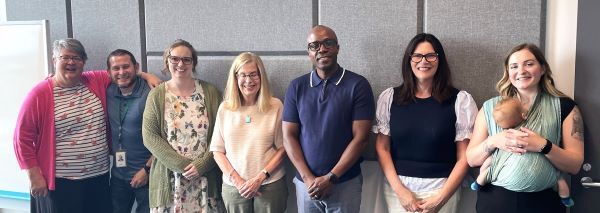
 Trainers receive training, too!
The FCS trainers and teammates participated in day-long technical assistance provided to us by Rutgers University staff Nora Barrett, Earle Leitch, and Joni Dolce. The popular and valuable training series on “Golden Thread” now has a toolkit that HCA trainers will use to provide Golden Thread training in the upcoming year and beyond.
Most planning conversations had a component of continuous quality improvement, and the Technical Assistance for next contract year will have that as a primary focus. For those who are fans of the "Hoarding" series: Earle will be back! Other previews of coming attractions include supervisor learning webinars and learning community, and training on how to develop a meaningful satisfaction survey.
Upcoming training opportunities forthcoming!
Becoming a person of integrity
We are proud to share a story on Isaac, a client who has journeyed through several of our programs on his road to recovery. Isaac has been through the Skagit Community Detox Center in Burlington, where he worked with Seth Peebles, the clinical manager, and the center’s staff. Isaac also met continuously with and was assisted by Shelly Miller, our FCS Supportive Housing supervisor, North Sound Region, and worked with Amber Morris, one of our Peer Bridgers. Key supports in Isaac's journey shared their stories about working with Issac.
I have had the privilege of working with Isaac as his Supportive Housing specialist for the past four years. During our time together, I’ve witnessed Isaac navigate the complex challenges of addiction, mental health struggles, homelessness and involvement with the criminal justice system. There were moments when Isaac showed real progress, staying sober and housed in various programs, but unfortunately, old patterns would often resurface, leading him back to homelessness and despair.
Isaac’s addiction continued to progress until it reached such a low point that, at times, all I could do was just keep showing up and simply be there –offering support, connecting him with treatment resources, sharing information on overdose prevention and handing out boxes of Narcan – just in case.
It felt as though there wasn’t much more I could do to help him get back on track, yet I refused to give up. I knew, from all our years of working together, that Isaac had a deep desire for something more in life, and that kept me going. I continued to provide resources, support, and most importantly, hope – always praying he would eventually accept it.
Despite being entrenched in his addiction, Isaac remained committed to meeting with me. He expressed time and again his desire to change and turn his life around. As his addiction worsened, his legal troubles also mounted, culminating in his participation in the Skagit Community Court program. It was during this time that Isaac received a pivotal ‘Nudge from the Judge’ – a final push to either pursue treatment and recovery or face prison time for the growing legal charges against him.
I will never forget the day Isaac said to me, "I’m done being a piece of trash. I want to be a man of integrity. I want to do the next right thing and hold myself accountable to living a higher standard than I ever have before."
This declaration marked a significant shift. Shortly after, Isaac found a 12-step sponsor to support him during and after treatment, and he made the decision to move into the Rise Recovery Housing Program, which specializes in supporting individuals involved with the criminal justice system, including participants in Skagit County’s Drug Court and Community Court programs. -Shelly Miller, FCS Supportive Housing supervisor
I have seen Isaac at high moments and low moments where I was concerned for his safety and wellbeing. When Isaac is well, he is engaging in services and building his peers up around him. However, I have also seen him extremely dysregulated and feeling isolated from family and friends.
Isaac has it in him to live a happy and healthy life; a life that includes engaging in the recovery community. It brings my great joy to know he is stable, happy, housed and in recovery. Thank you, Shelly, for continuing to advocate for him. I know every time I have seen him in detox, I was pleased to know he was alive and that Pioneer staff did not give up on him – or anyone – and continues to offer a chance for change.
Isaac was determined to break free and made the decision to request a long-term treatment program that could address both his addiction and mental health issues, hoping this would give him a better chance at sustained recovery. He also enrolled in Pioneer’s Peer Bridger services, that provides clients with extensive support during their transition out of treatment and into the community. -Seth Peebles, Skagit Community Detox clinical manager
I started working with Isaac when he came into our Skagit Community Detox Center. When I meant Isaac, he had just been released from jail and shared how hopeless and defeated he felt. I explained the Peer Bridger program and reminded Isaac that if he was interested in having a peer and was willing to participate, I could walk this journey with him. Isaac then started crying and we sat and talked about his recovery journey. I also shared some of my story and of how I felt the same way he did when I decided to change my life and began my own recovery in 2012.
Isaac shared that at one time he had been sober four years – then I saw a spark in his eyes. We began working together right away and Isaac made a plan to go to a 90-day treatment program. I visited Isaac weekly in treatment, and what a transformation! Each week Isaac had a new goal he reached and shared in meetings, and he went back on to his mental health medication. Now our visits were full of hope and how Isaac was meeting each goal.
Isaac completed a 90-day inpatient treatment, moved into clean and sober housing at Rise Recovery, finished his Intensive Outpatient Program and secured a sponsor. We then went to all of his community court cases, and he finally graduated from community court. His growth has been amazing, and he has been a joy to work with all this time. We have had many laughs and tears along the way. Isaac is now giving back and sponsoring others in the program. That ‘man of integrity’ and much more has been a true blessing to my recovery.
Now, approximately six months after completing treatment, Isaac remains stably housed at Rise Recovery House. He has secured a steady income and manages to pay his own rent each month. -Amber Morries, Peer Bridger who attended Isaac's court hearings and supported him in Intensive Outpatient Treatment and 12-step meetings
I have worked with Isaac for many years. There were many times we thought he would be just another statistic. To see him now is nothing short of a miracle! The change in his life is wonderful to see. -Randal Simmons, RISE Recovery Housing manager
Isaac has regained his driver’s license, purchased a car and obtained insurance. He has successfully completed the Community Court Program and resolved all of his legal cases, even those in other states. Isaac is now very excited about being in the process of getting enrolled in services at the Department of Vocational Rehabilitation for additional support and resources in reaching his career goals of becoming a diesel mechanic. Most importantly, Isaac is now a beacon of hope in the community, sharing his story and offering encouragement to others who are still struggling.
With FCS support, Isaac was able to achieve permanent independent housing- an important milestone after years of housing instability; couch surfing, nights outside, shelters and never having a place to call home.
When relapse led to serious challenges, strong advocacy from his FCS housing specialist helped shift a pending eviction into a mutual lease termination, protecting him from another major barrier on his record. Although he ultimately lost that housing, the support never stopped. Through treatment, jail, and homelessness, FCS stayed by his side. Today, Isaac has made the intentional choice to enter recovery housing—rebuilding stability with the goal of signing a lease for his own place again, and this time, keeping it.
Washington Health Care Authority (HCA) Foundational Community Supports (FCS) team invites you to a supported employment webinar with our FCS employment trainers.
Webinar: Thursday, July 10, 2025, 9 a.m.
Want to learn and have fun doing it? This webinar is both! The July Innovations in Career Services will be all about testing your knowledge of Individual Placement and Support (IPS) while having fun playing Jeopardy. Each question and answer will relate to different Individual Placement and Support fidelity principles. Test your knowledge, memory, come together to learn more about the evidence-based practice of supported employment with our network providers
Objectives
- Discover key principles of the IPS supported employment model
- Enhance your skills as an SE specialist through increased knowledge of IPS principles
- Interact with colleagues from other agencies to build a base for collaboration
Washington State Health Care Authority (HCA) Foundational Community Supports (FCS) is hosting this information webinar to provide transition assistance program and health related social needs housing transition service updates.
Webinar: Friday, July 11, 2025, from 10 a.m. to 11:30 a.m.
We’re excited to announce the addition of CMS Medicaid HRSN Housing Transition Navigation Services and funds into the TAP Program. Join us to learn more about what this means for you, your organization and communities.
Health-related social needs (HRSN) are a person’s unmet social needs that can lead to or cause poor health outcomes. Some outcomes include unstable housing, homelessness, and nutrition insecurity—all of which are more common in Medicaid communities—specifically communities of color and disenfranchised and under resourced communities.
Objectives
- Brief review of TAP background; historically as well as most recent changes
- Provide brief HRSN orientation as it relates to TAP
- Updates to TAP policies and increased funding
- Discuss availability of state general funds and HRSN funds
Washington Health Care Authority (HCA) Foundational Community Supports (FCS) team is hosting this new engagement-focused webinar
Webinar: Thursday, July 17, 2025, from 8:30 to 10 a.m.
This webinar will provide participants with essential knowledge related to engaging participants when they cease to engage and participate in services. We will discuss the IPS principle of Assertive Engagement, as well as building rapport, “readiness”, and other key concepts used to understand and improve engagement.
This training is ideal for employment specialists, case managers, and mental health professionals who want to increase the follow-through and participation of individuals in services.
Objectives
- Learn about concepts that impact follow-through and attendance
- Identify underlying issues that may impact engagement
- Develop individualized approaches to enhance engagement
Washington Health Care Authority (HCA) and the Foundational Community Supports (FCS) team invite you to join us in our monthly topical webinar with supported employment trainers Dawn Miller and Darren Paschke
Webinar: Thursday, July 24, 2025, at 9 a.m.
What does work mean to you? Is work an important part of your quality of life? Employment is proven to improve our quality of life, support obtaining basic needs, and to significantly improve longevity of life (by as much as 25 years according to some studies).
We get a great deal of support from colleagues and supervisors, often speaking of our “work family”. Envision this for the people you serve.Once a person considers themselves recovered, then what? We are trying to influence the health care system to embrace employment as a step towards being integrated, recovery focused, and respectful of the choice of participants.
This presentation will make the case for the importance of employment as an integral part of behavioral health recovery and maintaining recovery. It will also highlight the importance of bringing stakeholders together as a more powerful voice to decrease stigma related to the ability of people to be successfully employed. Bringing stakeholders together substantially enhances the quality of services provided by creating wrap-around services.
Objectives
- Change the system to move away from treating people with disabilities differently and toward helping them achieve what we all want. Move the balance from “professional” and “client” to people working together for a common purpose
- Provide examples of stakeholder collaboration as a means of enhancing service delivery toward recovery for individuals
- Discuss the importance of employment as part of recovery
Washington Health Care Authority (HCA) Foundational Community Supports (FCS) team is partnering with Advocates for Human Potential to bring you a new supported employment June training webinar. This reoccurring series includes three virtual 90-minute technical assistance calls.
Webinar: Tuesday, June 24, 2025, from 1 p.m. to 2:30 p.m.
This webinar, Navigating the Role of a Supervisor, will cover the essential skills and strategies required for effective supervision. A supervisor not only manages daily operations but also plays a critical role in shaping team dynamics, fostering a productive environment, and ensuring employee development. Transitioning from being an employee to a supervisor requires adjustments in mindset and leadership approach. Supervisors must develop various competencies such as leadership, communication, conflict resolution, and time management.
The presentation focuses on key responsibilities, including motivating teams, resolving conflicts, managing performance, and ensuring compliance with legal and ethical standards. Supervisors are also encouraged to continuously improve their skills and leadership styles to meet the evolving needs of their teams.
Through practical advice, real-world examples, and interactive activities, the session aims to equip participants with the tools they need to be confident and effective leaders
Objectives
- Understand the role and key responsibilities of a supervisor
- Recognize challenges in transitioning from employee to supervisor
- Motivate and engage employees effectively s to employment, with real-world examples from the FCS program
|