|
Where mission
and heart meet behavioral health, from the very start. |
|
Can’t access the links? Add “lnks.gd” to the allowlist of your content blocking software. |
|
Welcome to the April 2025 issue of Prenatal - 5: Grow & Thrive - HCA’s monthly newsletter about our behavioral health work in the early years of life. We hope that this newsletter helps build shared awareness of HCA’s efforts in this area and provides a centralized place to stay up to date on what’s new and happening. |
|
Want to know what has HCA been doing for IECMH? The IECMH at HCA brief describes our work over the last year to support IECMH efforts across the state. Read the brief to find out what we’ve achieved and what we’re doing around:
- Workforce development
- Access to services
- Person-centered systems
- Value-based financing
- Cross-system alignment
In March, a delegation of staff from HCA and the Department of Children, Youth, and Families (DCYF) attended the national Zero To Three IECMH Finance and Policy Project convening. HCA and DCYF staff had the chance to learn from national subject matter experts on topics such as:
- addressing Fetal Alcohol Spectrum Disorders (FASD) through IECMH services
- navigating the funding landscape for IECMH & child welfare
- meeting IECMH needs through Certified Community Behavioral Health Clinics (CCBHCs)
- fiscal mapping for the IECMH continuum
HCA staff also presented at the convening on Using Medicaid Data to Advance IECMH and Increasing Developmentally Appropriate Assessment using the DC:0-5. Both presentations highlighted the importance of demystifying complex systems, building shared language, and learning from ongoing implementation and evaluation.
The convening provided the opportunity for inter-agency learning, discussion, and coordination around IECMH finance and policy approaches in Washington state. HCA will continue to host inter-agency workgroup meetings and explore ways to align efforts to support young children and their families.
Children under the age of six on Apple Health for Kids with or without premiums will now receive continuous eligibility through their sixth birthday month, regardless of changes in household income, if they were eligible in the month of application. Continuous eligibility helps increase access to health care services, including mental and behavioral health.
|
|
|
May 21-32, 2025 | 9 a.m. to 1 p.m. each day: Last chance for a DC:0-5 training this state fiscal year! This 12-hour training is designed to support mental health professionals in developing in-depth knowledge of the approach and content of DC:0-5, understanding the multi-axial system, and utilizing the approach and system in their work with children birth through age five.
Would you like a streamlined and personable assessment of child and/or family mental health? Toxic stress underlies most mental health diagnoses and exacerbates virtually all of them. This 3-hour, interactive online training will help you better understand the root of the problem by introducing you to the Neuro-Relational Framework’s stress assessments.
This training will be offered twice, with one offering tailored specifically for those who supervise mental health professionals.
- May 6, 2025 | 9 a.m. to noon (tailored specifically for supervisors)
- May 22, 2025 | 9 a.m. to noon
|
|
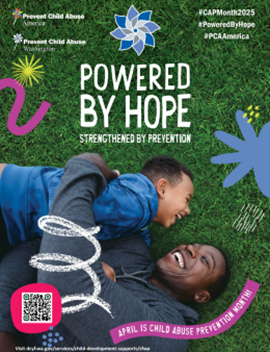
Families and children can find love and support in many ways. Child Abuse Prevention Month in April is a time to celebrate and lift-up the places and people in your community that celebrate the importance of children and their families. Strengthening Families Washington, a program within the Department of Children, Youth & Families (DCYF), supports communities that work with families to build Protective Factors and support parents.
Protective factors
Parenting is hard and there is no one way to parent. Research has found that five Protective Factors reduce stress and promote the well-being of ALL families. Everyone has stress, but when families increase Protective Factors, they build and draw on natural support networks within their families and communities.
The five Protective Factors are:
-
Parental resilience: Parents can overcome hard times.
-
Social connections: Parents have people who know and support them.
-
Knowledge of parenting and child development: Parents know where to go to find out about parenting skills and their child’s development.
-
Concrete supports: Parents know where to turn for help with things like food, housing, transportation, childcare, and medical care.
-
Social and emotional development: Parents know how to help their children form close relationships and communicate their feelings.
Answer our Ask the Reader question to share how your work impacts the Protective Factors!
Programs & initiatives
Strengthening Families Washington supports families through various initiatives designed to strengthen protective factors, including:
- Home visiting programs
- Perinatal mental health programs
- Family resource centers, concrete goods, and diaper banks
- Tribal fatherhood supports
- Parenting groups and supports
- Public awareness campaigns
Promotional materials
To celebrate and spread awareness about Child Abuse Prevention month, Strengthening Families Washington has a variety of free promotional items:
Get Involved
Whether it’s a parent spending quality time with their child, a childcare provider offering support and resources, or a neighbor providing a meal to reduce family stress, small actions make a big difference.
If you’re interested in opportunities to collaborate with Strengthening Families Washington, or want to learn more about our programs, subscribe to receive monthly updates or contact Strengthening Families.
|
|
|
It’s Child Abuse Prevention month, and this month’s Spotlight is about Strengthening Families Washington, so our question is:
How does your work impact the Protective Factors?
To participate, click the link below, which will take you to a Menti poll site. Once you’ve completed the poll, you can click ‘View the Results’ on the next screen to see how other readers voted. Tune in next month to see the final results!
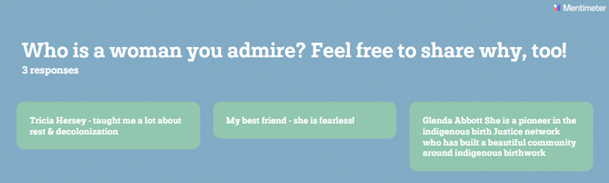
Last month's results
|
|
|
You can find earlier editions of this newsletter on our IECMH webpage, under IECMH updates.
Prenatal – 5: Grow & Thrive is also a spin-off newsletter of HCA’s Prenatal – 25: Thrive newsletter, which focuses on behavioral health for the entire age span of pregnancy to early adulthood. If you missed it, check out the most recent edition of the P-25 Thrive newsletter.
|
|
Did someone forward you this email? Subscribe to get the Prenatal – 5: Grow and Thrive e-newsletter each month.
If you have any questions about this newsletter, please email us.
|
|
|
|
|