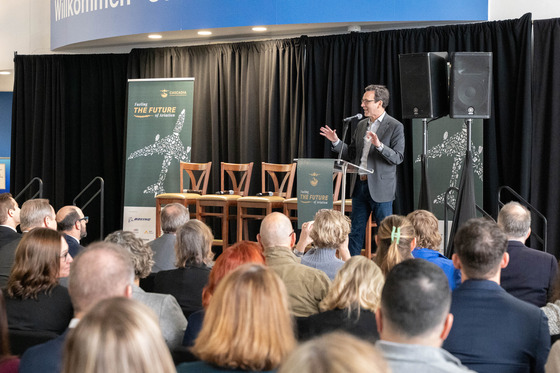
 Governor Ferguson speaking at Cascadia Sustainable Aviation Accelerator in January 2025
OLYMPIA – Washington’s sustainable aviation fuel (SAF) industry has unlocked a new tax credit that will attract investment and meet growing demand for locally produced jet fuel, Governor Bob Ferguson announced today.
Aviation is widely considered to be one of the most difficult sectors to decarbonize. Washington is charting a path forward by developing low-carbon alternatives, benefitting the environment, public health, and the economy. Sustainable aviation fuels are made from sources like agricultural crops, waste products, or synthetic materials.
The new tax credit gives Washington the strongest set of sustainable aviation fuel incentives in the country. Washington’s tax credit offers $1 per gallon for jet fuels that generate at least 50% lower greenhouse gas emissions compared to conventional jet fuel and up to $2 for fuels with even lower emissions. Washington’s industry recently reached the milestone needed to unlock this credit — the ability to produce at least 20 million gallons of sustainable aviation fuel annually in Washington. The Department of Ecology confirmed this week that this threshold had been met.
“Aerospace has long been a cornerstone of Washington’s economy, supporting generations of good-paying jobs and driving innovation across our state,” said Governor Ferguson. “It’s also in our DNA to make big bets on bold ideas, which is what we’re doing with sustainable aviation fuels. Between our long history of aviation innovation, our intentional investments into the sector and our climate-forward policies, we’re making sure Washington is the best state in the country to produce sustainable aviation fuels.”
“Washington is leading the way by investing in clean technologies and lowering emissions,” said Casey Sixkiller, Ecology’s director. “This tax credit will support our state’s aerospace industry and put us in the pilot’s seat for the future of aviation. It’s good for the climate and for business.”
Washington has made major investments in the SAF industry over the last two years. State funding is helping to build SkyNRG’s new production facility in Walla Walla and establish Washington State University as a global leader in sustainable aviation fuel research. The state also funded the formation of the Cascadia Sustainable Aviation Accelerator, which carries out research and streamlines access to infrastructure, energy, partners, and financial capital.
"Sustainable aviation fuel works today,” said Jake Gentry, Executive Director of the Cascadia Sustainable Aviation Accelerator. “The challenge has been making it affordable at commercial scale, and this credit goes a long way toward closing that cost gap. Washington state built the aviation industry, and this type of investment positions us to lead in the next chapter of sustainable aviation. We thank the Governor, Ecology and the Legislature for their leadership.”
Thanks to state investment and incentives, several new sustainable aviation fuel startups have recently built factories in the state or are considering doing so. In June, Governor Ferguson joined sustainable aviation fuel startup Twelve to celebrate the opening of the company’s one-of-a-kind facility in Moses Lake that combines carbon dioxide with water and clean electricity to make fuel.
In Washington, demand for sustainable aviation fuel is growing each year as the state continues to set air travel records. Demand also is growing globally. According to the International Council on Clean Transportation, sustainable aviation fuel is expected to rise to more than half of global jet fuel use by 2050. Combined with other incentives, the tax credit sets Washington apart in a fast-growing global marketplace. Washington is the only state in the country that offers a sustainable aviation fuel tax credit and has a clean fuel standard, which allows fuel producers to earn revenue when they make transportation fuels with lower greenhouse gas emissions. Producers can also take advantage of the federal Renewable Fuel Standard.
Additional Voices of Support:
Alaska Airlines Managing Director of Sustainability, Ryan Spies:
"As a longtime industry leader in advancing sustainable aviation fuel, Alaska Airlines knows SAF is the best technology available today to meaningfully reduce aviation’s carbon emissions. Washington’s position as a global aerospace leader, combined with strong partnerships across industry, academia and government, makes the state uniquely positioned to lead in SAF, and policies like the SAF tax credit can help accelerate production and adoption while supporting clean energy jobs and economic growth. We appreciate the leadership of Governor Ferguson and state lawmakers in advancing this important work and remain committed to working together to ensure these policies achieve our shared objectives."
Boeing Vice President of Sustainability, Allison Melia:
"Sustainable aviation fuel is one of the most powerful levers to reduce aviation emissions - cutting lifecycle carbon by up to 80% versus conventional jet fuel - and the alternative jet fuels tax credit is a critical step to scale SAF here in Washington. Boeing was a strong advocate for passage of the tax credit legislation, and we applaud Governor Ferguson and the Legislature for their leadership on the issue. Boeing has supported SAF testing and approvals since 2008 and together with our airline customers and partners in Washington and around the globe, we are committed to increasing SAF supply and affordability to drive responsible industry growth, jobs and trade."
Climate Solutions Aviation & Maritime Policy Director, Kurt Ellison:
“It's great to see SAFs takeoff, especially because the moment drop-in fuels are put to use, we see immediate benefits to human health, clean air, and reducing climate pollution. Washington has a long history of innovative aerospace and climate policy. Today is another important step in continuing that leadership."
###
|