Director's Note - Get Out to Vote!
Voting has been one of the most powerful tools for 2SLGBTQIA+ Washingtonians to advance civil rights in our state, at both local and state levels. The results of elections have consequences, most frequently, those consequences impact those most marginalized.
We are very fortunate to have one of the most highly effective and safe voting system in the nation. The offices of the Secretary of State and Attorney General have fought tirelessly to protect it from federal efforts to undermine and disrupt the ability to vote in Washington.
Creating a voting plan is helpful to make sure you get your ballot in on time. Ask your family members and friends if they have a plan to vote. Voting early is best to guarantee your vote is counted. Whether you are a regular voter, someone that votes periodically, or voting for the first time; the right to vote is foundational to a functional democracy. Every vote counts.
 Lisa Keating, Executive Director - Washington State LGBTQ Commission
Important Updates Regarding Gender Affirming Care and Apple Health:

Effective October 13, 2026, Centers for Medicare & Medicaid (CMS) is banning federal funding for certain gender affirming services for minors age 18 and younger. This rule impacts drugs and procedures used to treat clients with a gender dysphoria diagnosis. Apple Health (Medicaid) will continue to cover medically necessary gender-affirming care for minors age 18 and younger using state-only funding. The care and services that clients receive will not change. The Health Care Authority (HCA) does not anticipate that clients will experience disruptions in care.
HCA is changing how it pays for the impacted services to implement the federal rule. The two major changes include:
- HCA will no longer seek federal reimbursement for these services.
- Managed care organizations (MCO) will no longer be the payer for the impacted gender-affirming drugs and procedures. HCA will now reimburse these services through fee-for-service. HCA already reimburses surgical procedures through fee-for-service. The impacted gender-affirming drugs and procedures will move to the same payment mechanism. HCA is working with MCOs to implement this change effective October 13, 2026.
For Providers:
HCA will continue to cover medically necessary gender-affirming procedures and drugs for Apple Health clients age 18 and younger through fee-for-service. HCA covers medically necessary care for clients with a gender dysphoria diagnosis through the client’s MCO, such as mental health care and well-child checkups.
Claims:
Providers must submit claims for professionally administered drugs on the Drugs excluded from MCO responsibility list and inpatient procedures for clients age 18 and younger through ProviderOne. Providers must not submit claims to the client’s MCO.
- Claims handling varies slightly by claim type. For example, for a client age 18 and younger, providers must submit the entire claim for gender-affirming care delivered in outpatient hospital settings through ProviderOne when the claim includes gender-affirming medication administration.
- Refer to the appropriate billing guide for details.
- See the Drugs excluded from MCO responsibility list to identify the drugs, prior authorization status, and billable setting.
Prior Authorization:
HCA will allow existing MCO prior authorizations if the provider is contracted with HCA. HCA is working with MCOs to obtain client-specific authorization information. Going forward, any required prior authorization must be submitted to HCA. See the Apple Health Preferred Drug List (PDL) for requirements for prior authorization of drugs. HCA currently requires prior authorization for these types of gender-affirming care:
- Surgeries, which are rare for minors
- Hair removal
- Some drugs
Pharmacies:
Pharmacies have been notified to bill fee-for-service for drugs affected by this federal rule. Pharmacies should refer to HCA’s fax broadcast, the Prescription drug program billing guide, Drugs excluded from MCO responsibility list, and Apple Health PDL.
Contact:
|
Hoja informativa sobre atención medica de afirmación de género:
|
A partir del 13 de octubre de 2026, los Centros de Servicios de Medicare y Medicaid (CMS en inglés) prohibirán la financiación federal para ciertos servicios de afirmación de género para menores de 18 años o menos. Este reglamento afecta a los medicamentos y procedimientos utilizados para tratar a pacientes con un diagnóstico de disforia de género. Apple Health (Medicaid) seguirá cubriendo la atención médica necesaria para la afirmación de género de menores de 18 años o menos, utilizando solo fondos estatales. La atención y los servicios que reciben los pacientes no se verán afectados. La Autoridad de Atención Médica (HCA en inglés) no prevé interrupciones en la atención.
La HCA está modificando la forma en que financia los servicios afectados para implementar la normativa federal. Los dos cambios principales son:
- HCA ya no solicitará el reembolso federal por estos servicios.
- Las organizaciones de atención administrada (MCO en inglés) ya no serán las pagadoras de los afectados medicamentos y procedimientos de afirmación de género. HCA ahora reembolsará estos servicios a través de pagos por servicio. Actualmente HCA reembolsa los procedimientos quirúrgicos a través de pagos por servicio (“fee-for-service” en inglés). Los afectados medicamentos y procedimientos de afirmación de género pasarán a ese mismo mecanismo de pago. La HCA está trabajando con las organizaciones de atención médica administrada (MCO) para implementar este cambio, que entrará en vigor el 13 de octubre de 2026.
Proveedores:
La HCA continuará cubriendo los procedimientos y medicamentos de afirmación de género médicamente necesarios para los beneficiarios de Apple Health de 18 años o menos a través del sistema de pago por servicio. La HCA seguirá cubriendo la atención médicamente necesaria para los beneficiarios con un diagnóstico de disforia de género a través de la MCO correspondiente, incluidos los servicios de salud mental y los chequeos médicos preventivos para niños y adolescentes.
Reclamos:
Los proveedores deben presentar las reclamaciones a través de ProviderOne para los medicamentos administrados por profesionales que figuran en la lista de medicamentos excluidos de la responsabilidad de las MCO, así como para los procedimientos hospitalarios para pacientes internados de beneficiarios de 18 años o menos. Los proveedores no deben presentar reclamaciones a la MCO del beneficiario.
- El proceso de gestión de reclamaciones varía ligeramente según el tipo de reclamación. Por ejemplo, para un beneficiario de 18 años o menos, los proveedores deben presentar la reclamación completa por la atención de afirmación de género brindada en un entorno hospitalario ambulatorio a través de ProviderOne cuando la reclamación incluya la administración de medicamentos de afirmación de género.
- Consulte la guía de facturación correspondiente para obtener más detalles.
- Consulte la lista de medicamentos excluidos de la responsabilidad de las MCO para identificar los medicamentos, los requisitos de autorización previa y el entorno de atención en el que se pueden facturar.
Autorización Previa:
La HCA aceptará las autorizaciones previas existentes de las MCO, siempre que el proveedor tenga un contrato con la HCA. La HCA está trabajando con las MCO para obtener información sobre las autorizaciones específicas de cada beneficiario. En adelante, cualquier autorización previa requerida deberá presentarse a la HCA. Consulte la Lista de Medicamentos Preferidos (PDL) de Apple Health para conocer los requisitos de autorización previa de los medicamentos. Actualmente, la HCA exige autorización previa para los siguientes tipos de atención de afirmación de género:
- Cirugías, que son poco frecuentes en menores de edad.
- Depilación.
- Algunos medicamentos.
Farmacias:
Se ha notificado a las farmacias que deben facturar a través del sistema de pago por servicio (fee-for-service) los medicamentos afectados por esta norma federal. Las farmacias deben consultar el aviso enviado por fax de la HCA, la Guía de facturación del programa de medicamentos recetados, la Lista de medicamentos excluidos de la responsabilidad de las MCO y la Lista de Medicamentos Preferidos (PDL) de Apple Health.
Manténgase informado:
|
 My Day Shadowing Nathan Bays
by Desi Quenzer (any pronouns) 3rd Year LGBTQ+ Youth Advisory Councilmember, Yakima County
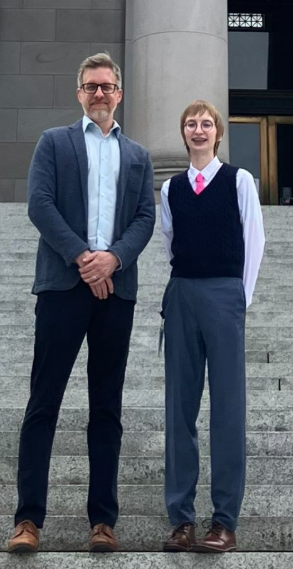
On Friday, September 18th, I had the privilege of shadowing Deputy Director of Federal Policy, Nathan Bays. Nathan and I met 2 years ago at the second annual LGBTQ+ Youth Advisory Council Summit. This year, at the third annual summit, the idea of shadowing him for a day came up, and I eagerly accepted. I have been involved in state government on and off in multiple capacities for several years now, and I am very interested in understanding the inner workings of state government. Getting to know people is one of my favorite parts of the work that I get to do as a councilmember. Prior to meeting Nathan, I wasn’t even aware of his role and how important it is to our state.
Nathan packed the day with meetings so I could learn not only about the work that he does but also meet other people and learn about their roles within state government as well. We had meetings with policy advisors in the Governor's office, state leaders working on disability and equity across government, former and current chiefs of staff, and with Governor Ferguson himself!
|
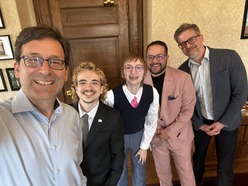
Everyone that I met with shared a little bit about what they do, as well as their journey leading up to working in state government. I met people working in roles that I didn’t even know existed! There is a place for almost every niche interest within government, from federal policy, to communications, women’s rights advocacy, LGBTQ+ advocacy, international relations, healthcare, transportation, and more. If you are passionate about something, you can make change. In hearing about everyone’s journey, I learned that there is no specific set of instructions for working in state government. In fact, most people I spoke with never planned on a career in state government. Many started out in an unrelated education or career path, and through their lived experiences, skills, and connections were able to obtain their current roles. Everyone offered such diverse perspectives and skillsets, I was amazed at the wealth of knowledge each and every individual I met with had. It was an honor to meet a handful of the people who work tirelessly behind the scenes to uphold our state’s values and protections for its constituents.
|

Before now, I had always said that although I love advocacy work and will continue to do it throughout my life, I could never do it as a career. I couldn’t see myself working in government because I didn’t think I’d ever have the qualifications, skills, or experience. However, that viewpoint has since been changed after getting to see first hand the diversity of people working in government. Most people I spoke with didn’t go to school or find jobs with the intention of working in legislation and policy. They simply did what they were passionate about at the time and worked their way up to where they’re at now.
It is so important now more than ever that young people get opportunities like this to learn and get involved in local and state government. Nearly all issues impact youth, which is why inspiring them to get involved and then taking the time to include them is so important. I hope more young people will get the same opportunity to learn about the diverse roles available in government and how our government functions, as well as meet the amazing assets we have doing the work. This experience also allowed me to build meaningful relationships within our state government as a councilmember and talk about some of the work that we are doing. I sincerely hope the youth advisory council and larger commission get the opportunity to work with some of these individuals in the future.
|
This experience for me was extremely inspiring, as a young person still trying to find their place in the world, during a time that leaves people feeling unsure of their future. Getting to meet some of the people who have dedicated themselves to securing our future, and hearing about the work that they are doing is a huge comfort for me that I wish others could experience. My biggest takeaway from the day is that anyone can work in state government, and be an agent of change, regardless of identity, education, career background, there is a place in government for everyone. My favorite part of this whole experience though was the time that I got to spend connecting with Nathan, who is so inspiring to me because he is so proud of the work that he gets to do and the people he works with. I am eternally grateful to Nathan for taking me under his wing and allowing me a glimpse into his role as the Deputy Director of Federal Policy. I am also thankful for the people who took time out of their day to meet with me, and the LGBTQ Commission which made this all possible. Truly a phenomenal experience!
|