ERDC News, Summer 2026
In this newsletter, we share this year’s latest dual credit reporting, announce a new dashboard focused on special populations, preview forthcoming updates to our data request processes, and more.
Did someone forward this newsletter to you? Subscribe here.
Annual dual credit reporting now available
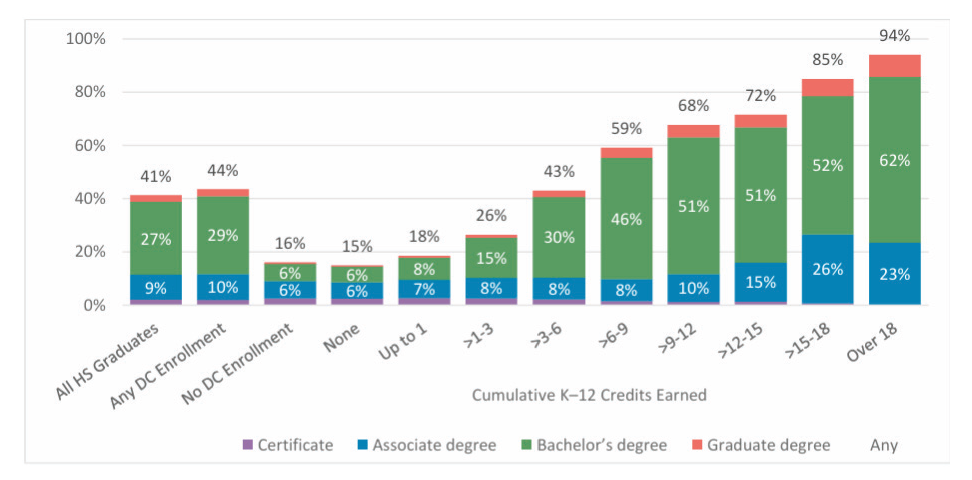 Within six years of high school graduation, 41% of students in the 2015-2019 cohorts obtain a postsecondary credential, regardless of whether they enroll in dual credit. Once a student earns more than 3 K-12 credits through dual credit courses, however, their rate of postsecondary credential earning surpasses the 41% rate, starting with 43% credential earning for those with >3-6 cumulative K-12 credits from dual credit and going up to 94% credential earning for those with more than 18 cumulative K-12 credits from dual credit. See Figure 17 in the 2026 annual report for more details.
Latest annual report published. Every year for the last five years, ERDC has produced reporting on dual credit, per requirements in RCW 28A.600.280. This latest report focuses on cumulative credits, course content, and postsecondary outcomes, with key findings including:
- Over a 10-year period, average cumulative K-12 credits earned across dual credit options increased from 4.7 to 7.7
-
Number of students enrolled in Running Start summer terms has grown substantially since 2022.
- Cumulative K-12 credits earned from dual credit contained primarily academic (versus vocational) content.
- Postsecondary education outcomes generally improved as K-12 credits from dual credit accumulated but then leveled off for some measures.
Dual credit dashboard updated. As part of our annual updates, the dual credit dashboard has also been updated with a new student cohort (2025) and a new student characteristics disaggregation, locale, which shows urban/rural designations.
New report on student- and school-level factors related to dual credit. This new report explores gaps in dual credit experiences across Washington’s student groups.
Insights. With five years of annual dual credit reporting at ERDC, we’ve summarized our findings into a short four pages of insights – explore this new way of understanding our dual credit portfolio now
New special populations dashboard
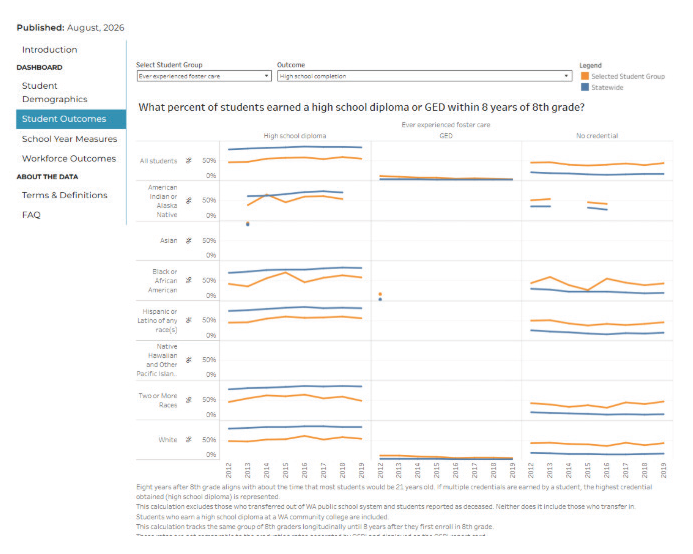 We have released a new dashboard displaying long-term education and workforce outcomes for students who experience foster care, homelessness, and institutional education. With this dashboard, you can compare outcomes like early learning participation, high school completion, and postsecondary degree across groups
ERDC updates
-
📊Do you request data from ERDC? Read on for updates related to the data request process.
-
Sharing your results when you use ERDC data. For all requesters required to share results with ERDC prior to publication, please use our new publication review request form, which streamlines the process. This new form also enables data requesters to notify ERDC when work created using ERDC data has been published so we can champion your work and add it to our Data in Action page. Review details about these improvements to the results sharing process.
- External researcher data request process changes coming in 2027. We know external researchers can face slowdowns in the data request process due to our required prioritization criteria. To address this, ERDC plans to institute changes to our process to make it more manageable for us and our data contributors, and more predictable and timely for researchers. Look for an announcement about these changes in early 2027. ERDC will also do focused outreach about these changes between now and the implementation.
-
💻Have you wondered about the difference between SOC, CIP, and NAICS codes? Read our new explainer on these codes and the kind of research they empower.
-
📓Two new research grants.
- 1) ERDC, in partnership with NORC at the University of Chicago and funded by the Gates Foundation, will leverage AI to extract key information from high school course catalogs, to compare course data across districts statewide and to explore how course‑level skills relate to student outcomes.
- 2) ERDC is a sub-awardee for a project led by the University of Washington and funded by Arnold Ventures to evaluate how dual credit participation affects postsecondary outcomes, determining which programs are most effective, and for which students, with the goal of expanding equitable dual credit access.
Coming soon
-
ERDC at WERA Winter Conference 2026. ERDC will present a pre-conference session on early learning and a breakout session on dual credit. We hope to see you there!
- More dashboards updating in late 2026 and early 2027, ahead of the next legislative session. Look for updates to the high school graduate outcomes, public four-year, and financial transparency dashboards during this time.
- National Student Clearinghouse (NSC) aggregate reports shared with OSPI and school districts. By the early new year, ERDC will provide another update of this postsecondary enrollment and completions data from NSC to OSPI and districts.

|