Supreme Court Issues Decision on West Virginia v. B.P.J. and Little v. Hecox, Upholding States with Transgender Sports Bans
Hear initial reactions from our Executive Director, learn more about this ruling and its implications in Washington state, and more in this special edition of our newsletter focused on the court's ruling upholding state's bans on transgender participation in sports.
Director's Note: Initial Thoughts and Reactions to Trans Sports Ruling
I have been vacillating between grief and rage since the SCOTUS ruling was released upholding the transgender sports bans in West Virginia and Idaho today. In the organization I worked for prior to joining the WA State LGBTQ Commission, I worked with young trans and nonbinary athletes from around the country, including youth in Washington state. We recognized that this issue was only going to escalate as more states passed sports bans. The most impactful way to change hearts and minds is through getting to know a trans person. These young leaders beautifully and bravely told their stories about why being a part of a team was an integral part of their lives. There are endless life lessons and skills young people learn through sports.
Every major youth leadership organization across this country teach the importance of these character qualities. As well as in social emotional curriculum taught throughout our schools in Washington. Collectively, we believe that character development for our young people is essential to becoming a successful, thriving adult. Sports are a powerful vehicle to learn and embody traits of a leader.
It is tempting to believe, and feel, that the work that has been done in vain or that it has been erased. That couldn’t be farther from the truth. Storytelling has lasting ripple effects that open doors, shift culture, drive policy change. On the last day of Pride month, let’s celebrate and lift up our young nonbinary and trans people. They need the adults around them now more than ever. Let’s help remind them that joy still exists, that their lives matter, and that they are not alone.
 Lisa Keating, Executive Director - Washington State LGBTQ Commission
Summary of the Ruling in West Virginia v. B.P.J. and Little v. Hecox
On June 30th, 2026, the Supreme Court released a highly anticipated decision regarding the ability for states to discriminate against and restrict transgender and intersex youth from participating in sports. The court ruled 6-3 in favor of states with bans on transgender youth in sports, dealing yet another blow to transgender and intersex rights in what has been a historical and devastating past several years in court for the trans community. Idaho and West Virginia were at the center of these two cases, and the case affirms the 25+ other states with similar bans. While this decision is not as narrow as it could be, it is devastating for 2SLGBTQIA+ people across the nation and sets deeply concerning precedents.
What we know:
-
This ruling does not invalidate Washington’s transgender and intersex-inclusive and equitable youth sports policy. This ruling says that states that do have restrictive and discriminatory policies towards transgender and intersex youth in sports (transgender and intersex sports bans) are not in violation of Title IX or the Equal Protection Clause of the U.S. Constitution. The court held that unlike other federal nondiscrimination statutes, Title IX is limited to “biological sex” discrimination.
- The Washington Law Against Discrimination still prohibits discrimination based on sex, gender identity and gender expression in public facilities. Students in Washington also have the right to use their correct name and pronouns.
-
Washington’s transgender inclusive sports policy is a historic and successful policy. The Washington Interscholastic Activities Association (WIAA) has allowed transgender athletes to play on teams consistent with their gender identity since 2007.[1] WIAA was the first state activities association to enact successful transgender inclusion policies and practices in sports and activities. This policy has served as a model for the nation.
-
This ruling is NOT a nation-wide ban on transgender and intersex athletes. It only affirms those states with transgender and intersex sports bans. While measures have been introduced in congress to enact such a ban, they have failed to advance through both chambers.[2]
-
Transgender sports bans create more danger for young people, including those who don’t play sports. According to Trevor Project peer-reviewed research, transgender and nonbinary youth living in states where transgender sports bans were enacted, like Idaho and West Virginia, reported up to a 72% increase in past-year suicide attempts compared to states without these laws, like Washington.[3]
-
Inclusive sports policies build vital communities for vulnerable young people and help all students develop important skills. A Human Rights Campaign analysis found that high school-aged transgender and non-binary student-athletes reported higher grades, lower levels of depression, and were less likely to feel unsafe at school than those who did not play sports.[4]
-
While the Court’s decision is narrowly dealing with sports, this case could have further consequences down the line. The Court declined to determine which level of scrutiny claims of anti-transgender discrimination should receive, which leaves other current rights and protections for transgender people outside of sports susceptible to attack.[5]
The Commission is engaging with national and local partners to better understand the impacts of this ruling on athletes in Washington state, including attending a free Rapid Response Webinar hosted by Seattle University featuring panelists from the National Center for LGBTQ Rights, Out & Equal, GLAD Law, and others.
Reactions from Washington State LGBTQ Youth Advisory Council
"Seeing today's Supreme Court ruling, especially during a month that is supposed to bring a vast and endless amount of joy to LGBTQIA+ individuals, it was especially heartbreaking to hear that the rights of so many youths are being taken away from them. To discriminate against a group of young people in such a way feels inhumane, disgraceful, and inequal. As a cisgender woman myself, who grew up playing sports in middle school and high school, such rulings do not protect cisgender women; instead, it alienates transgender youths and ostracizes them even further from society. During a time where we should spread ideals of love, togetherness, community, and protecting marginalized groups of people, this is the exact opposite news that the youth need to hear. To those allied and within the LGBTQIA+ community of any age and background, please consider showing extra love and care to trans youth across the nation- even if laws and those in power try to discourage us, we have the overwhelming power of love and support one another during these trying times." - Councilmember Ariyanna Fernandez (she/her/theirs), King County
"Every single body is different; every single body has different amounts of testosterone and estrogen whether you’re biologically female or male. If the main concern was transgender athletes having an unfair advantage against cisgender athletes, then the sole focus of this debate would not be transgender athletes, it would be estrogen and testosterone levels and other biological advantages. It’s the same argument used for gendered bathrooms, and it’s all rooted in misinformation and transphobia... This whole thing is infuriating and it’s a poorly veiled attempt to further ostracize a very small minority who are just trying to be themselves while doing what they love." - Councilmember Desi Quenzer (any pronouns), Yakima County
TOMORROW: "The Court Weighs In: Transgender Rights, Student Athletes, and the Future of Equal Protection" Free Webinar Hosted by Seattle University School of Law, Open to All
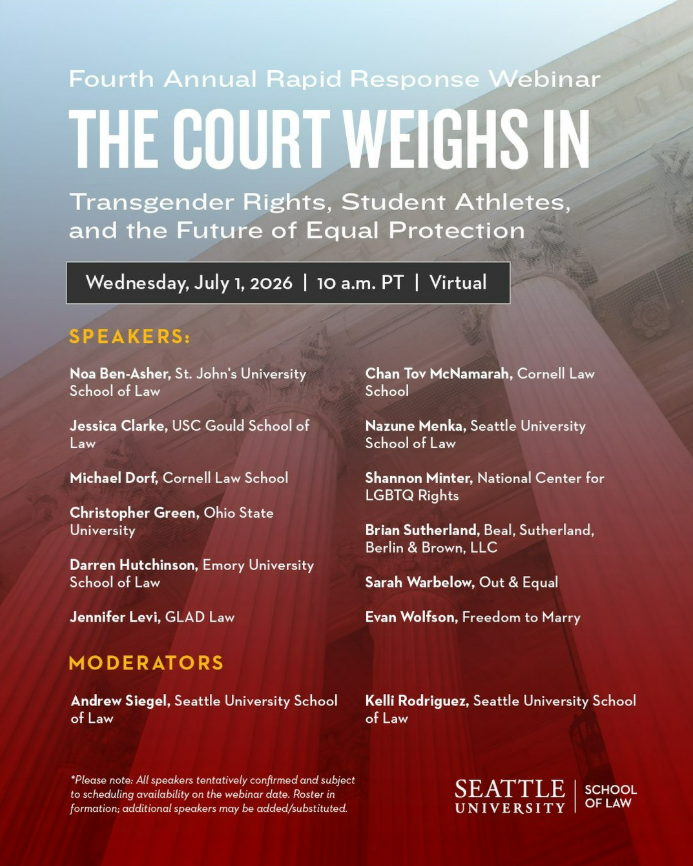 From Seattle University School of Law: The U.S. Supreme Court has ruled in Little v. Hecox and West Virginia v. B.P.J., upholding state laws restricting transgender athletes from participating in girls' and women's school sports. What does the decision mean for Title IX, schools, students, and equal protection law?
To help make sense of the decision, Seattle University School of Law is hosting its 4th Annual Rapid Response Livestream Event, bringing together leading legal scholars and practitioners for timely analysis shortly after the Court releases its opinion.
The discussion will be streamed live on YouTube and is open to all.
Our panel will examine:
- The Court's reasoning and legal analysis
- The implications for schools, athletic organizations, and government entities
- Broader constitutional and policy considerations
The livestream will take place on July 1, 2026, giving you an opportunity to hear expert perspectives while the ruling is still making headlines.
- July 1, 2026 | 10 a.m. to 12:30 p.m. PT / 1:00 to 3:30 p.m. ET
Please note that the Commission is not hosting this event. We thank Seattle University for bringing together these experts for this important discussion and look forward to being in attendance.
For more information, please visit: https://law.seattleu.edu/rapid-response-webinar/
Resources:
The Washington State LGBTQ Commission knows that news like this can be incredibly difficult and can leave our community feeling deeply isolated. Please extend care to one another, and seek help from any of the below resources if you or someone you know is struggling.
The Trevor Project:
The Trevor Project is the leading suicide prevention and crisis intervention nonprofit organization for LGBTQ+ young people. Hotline is available 24/7.
|
Trans Lifeline:
The Trans Lifeline is a grassroots hotline and microgrants non-profit organization for the trans community, by the trans community. Hotline hours: Mon-Fri 10AM-6PM PT.
|

LGBT National Help Center:
The LGBT National Help Center is an organization that provides vital peer support, community connections, and resource information through helplines and online chatrooms. Hotline hours: Mon-Fri 11AM-8PM, Sat: 9AM-2PM PT.
|
THRIVE Lifeline:
THRIVE Lifeline is a grassroots organization dedicated to changing the landscape of mental health support for people with intersecting marginalized identities and provides crisis support through THRIVE Lifeline. THRIVE is trans-led and operated. Hotline hours: 10:30PM Wed – 4:30AM Thurs PT.
Note: The Lifeline will be open the night of Tuesday, June 30 from 10:30pm – 4:30am (July 1) and will be closed the night of Wednesday, July 1
|
Call BlackLine:
Call BlackLine provides a space for peer support, counseling, reporting of mistreatment, witnessing and affirming the lived experiences for folxs who are most impacted by systematic oppression with an LGBTQ+ Black Femme Lens.
|
Native & Strong Lifeline:
The Native & Strong campaign was developed in partnership with the 29 federally recognized tribes in Washington and the Washington State Department of Health (WA DOH). Hotline is available 34/7
|
 |
|
988 Suicide & Crisis Lifeline:
The 988 Suicide & Crisis Lifeline provides free and confidential emotional support to people in suicidal crisis or emotional distress across the United States and its territories. Hotline is available 24/7.
|
|