Three types of assistance available for individuals
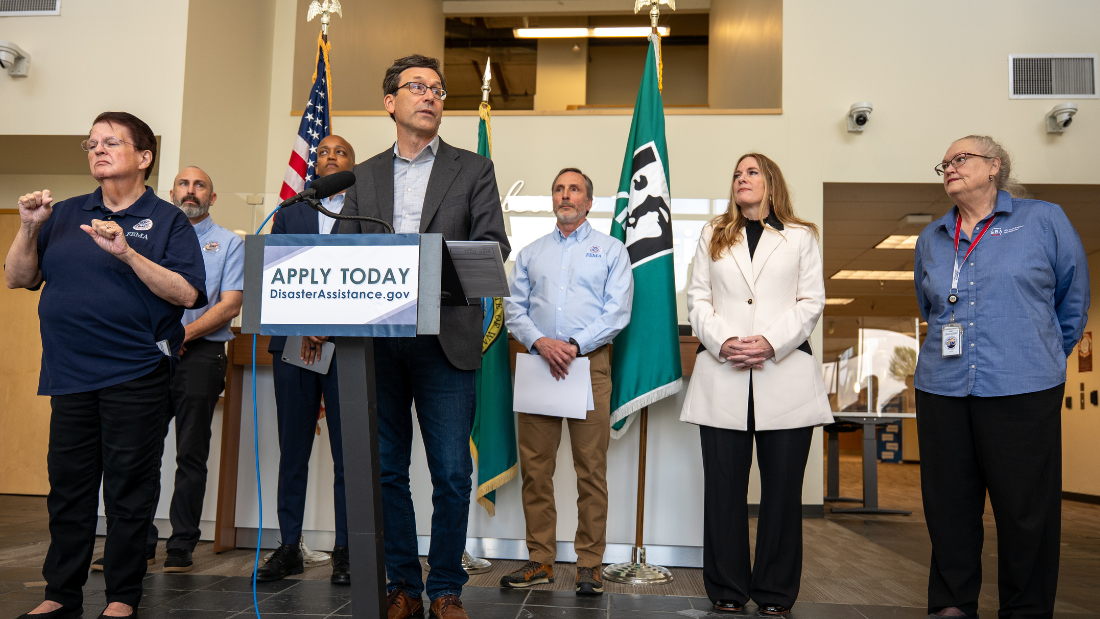 RENTON — Today Governor Bob Ferguson encouraged Washingtonians affected by December’s historic flooding to apply for federal assistance by the Wednesday, June 10 deadline — 3 weeks from today.
Gov. Ferguson joined John Harrison, FEMA’s federal coordinating officer, and King County Executive Girmay Zahilay at the FEMA Mobile Disaster Recovery Center in Renton to share information about applications with the public.
There are three types of federal assistance available to individuals: FEMA Individual Assistance, Disaster Unemployment Assistance, and low-interest loans for individuals and businesses from the Small Business Administration.
This assistance was unlocked following Governor Ferguson’s request for a Major Disaster Declaration by President Trump. Gov. Ferguson’s request to President Trump included a video with the voices of flood survivors. The entire Washington state congressional delegation and the leaders of all four state legislative caucuses sent their own bipartisan letters supporting the governor’s request. The president approved that request on April 11.
“I know firsthand how resilient Washingtonians are — but no one can recover from a disaster of this magnitude alone,” Governor Ferguson said. “That’s why we are pursuing all available assistance. If you were impacted by December’s historic flooding, help is available. Apply today.”
FEMA Individual Assistance
So far, FEMA has distributed $6.5 million in Individual Assistance to 715 households.
Individual Assistance funding can help with expenses that insurance does not cover, such as temporary housing or displacement assistance, home repair costs, personal property loss, and other disaster-caused expenses. These are not loans. Washingtonians do not have to pay that money back.
To apply, Washingtonians can:
- Visit DisasterAssistance.gov and apply online;
- Call 800-621-3362;
- Or, visit a Disaster Assistance Center — locations and schedules on DisasterAssistance.gov.
Individuals in the following counties may be eligible for FEMA Individual Assistance: Chelan, Grays Harbor, King, Lewis, Pacific, Pierce, Skagit, Snohomish, Thurston, and Whatcom.
Individuals in the following Tribal nations may also be eligible: Chehalis Indian Reservation, Tulalip Indian Reservation, Upper Skagit Indian Reservation, Samish Indian Nation, Squaxin Island Indian Reservation, Stillaguamish Indian Reservation, Swinomish Indian Reservation, Snoqualmie Indian Reservation, Sauk-Suiattle Indian Reservation, Shoalwater Bay Reservation, Puyallup Indian Reservation, Quinault Indian Reservation, Lummi Indian Reservation, Muckleshoot Indian Reservation, Nisqually Indian Reservation, and Nooksack Indian Reservation.
Disaster Unemployment Assistance
The federal Major Disaster Declaration also unlocked Disaster Unemployment Assistance. This is for people who lost their job, temporarily or permanently, because of the disaster, but did not qualify for regular unemployment.
This includes small business owners, people who don’t have enough hours in their base year to qualify for regular unemployment, or people who work in a field not covered by unemployment law, such as real estate agents.
For more information, and to apply, visit ESD.wa.gov or call 855-952-9988.
Workers in the following counties may be eligible: Chelan, Grays Harbor, King, Lewis, Pacific, Pierce, Skagit, Snohomish, Thurston, and Whatcom.
Workers from the following tribal nations may also be eligible: Confederated Tribes of the Chehalis Reservation, Lummi Nation, Muckleshoot Indian Tribe, Nisqually Indian Tribe, Nooksack Indian Tribe, Puyallup Tribe, Quinault Indian Nation, Samish Indian Nation, Sauk-Suiattle Indian Tribe, Shoalwater Bay Indian Tribe, Snoqualmie Indian Tribe, Squaxin Island Tribe, Stillaguamish Tribe of Indians, Swinomish Indian Tribal Community, Tulalip Tribes, and the Upper Skagit Indian Tribe.
Small Business Administration loans
The Small Business Administration offers low-interest Disaster Assistance Loans to homeowners, renters, business owners and non-profits.
SBA loans can be used for losses not covered by insurance or FEMA funding, for both individuals and businesses. These loans can cover physical damage to your home or business, as well as economic injuries to businesses to help cover costs and expenses the business would have been able to handle if the disaster did not happen.
To learn more, or apply, visit SBA.gov.
Individuals and businesses in the following counties may qualify for SBA loans: Chelan, Grays Harbor, King, Lewis, Pacific, Pierce, Skagit, Snohomish, Thurston, Whatcom, Cowlitz, Douglas, Island, Jefferson, Kitsap, Kittitas, Mason, Okanogan, San Juan, Skamania, Wahkiakum, and Yakima.
Individuals and businesses in the following tribal nations may qualify: Muckleshoot Reservation And Off-reservation Trust Land, Chehalis Reservation And Off-reservation Trust Land, Swinomish Reservation And Off-reservation Trust Land, Shoalwater Bay Indian Reservation And Off-reservation Trust Land, Squaxin Island Reservation And Off-reservation Trust Land, Upper Skagit Reservation And Off-reservation Trust Land, Nisqually Reservation, Quinault Reservation, Snoqualmie Reservation And Off-reservation Trust Land, Nooksack Reservation And Off-reservation Trust Land, Stillaguamish Reservation And Off-reservation Trust Land, Puyallup Reservation And Off-reservation Trust Land, Samish Tdsa, Lummi Reservation, Tulalip Reservation And Off-reservation Trust Land, and Sauk-suiattle Reservation.
Other federal assistance in Washington
Washington state was also approved for FEMA Public Assistance, which covers 75 percent of qualifying repairs to infrastructure. That includes the cost of removing debris, as well as repairing damage to public buildings, public utilities, water control facilities, parks, and more.
The timeline for approval varies by project. Preliminary approval takes approximately six months.
Jurisdictions will continue to work with FEMA and the Washington Emergency Management Division throughout the project to obtain final approval.
If FEMA approves all projects, EMD estimates that funding will total $182.3 million.
Because this is a reimbursement program, it will likely take four to six years to know exactly how much FEMA Public Assistance was distributed in Washington as a result of this disaster.
Washington state also applied for $36.6 million in Hazard Mitigation Grants, which would allow the state to build projects to help prevent damage from a future disaster. For example: The flood wall in Mount Vernon prevented its downtown from flooding.
That application was denied. Governor Ferguson filed an appeal with FEMA this week, asking them to reconsider this funding.
Storm impacts
The impacts from 18 days of storms were extensive. The following information highlights the severity of this disaster:
- Three of the state’s largest rivers (Skagit, Snohomish, and Cedar) reached their highest levels in recorded history.
- A total of 33 rivers exceeded flood stage, with 18 of those exceeding major flood stage.
- Approximately 3,891 homes were damaged statewide, with 440 homes being destroyed or sustaining major damage.
- The storm resulted in one fatality, 383 emergency rescues, and approximately 1,000 assisted evacuations.
- More than 100,000 people were ordered evacuated, including the residents of two entire cities.
- 34 state-managed transportation routes were severely impacted, including portions of two interstate highways and three U.S. highways.
- Amtrak Cascades rail service was suspended for four days between Vancouver, B.C., and Seattle, due to weather-related rail line disruptions.
- Approximately 450,000 customers experienced power outages during the disaster.
- At the peak, 15 emergency shelters were operating.
- One skilled nursing facility, with its 78 patients, was evacuated; two additional facilities closed due to flooding; one Level 3 facility sheltered in place for multiple days; and one facility operated on generator power for three days.
- Seven Tribal Nations issued emergency declarations and 13 counties issued disaster declarations.
- 20 county and Tribal emergency operations centers were activated.
###
|