In this newsletter, we announce numerous new publications (and new data!), share progress on the postsecondary data strategy, and spotlight recent data in action.
Did someone forward this newsletter to you? Subscribe here.
What's new: Occupational destinations, institutional education, dual credit access, and more in recent ERDC publications
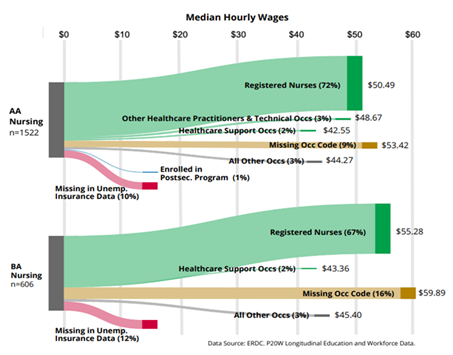
Did you know that high proportions of nursing graduates are employed in their field and earn high wages within a year of graduating? Discover more about this and other related findings in our latest occupational destinations briefs, created in collaboration with the University of Washington Evans School of Public Policy and Governance. These briefs use occupational code data (known as the Standard Occupational Classification, or SOC, codes) newly available in employment data ERDC receives from the Employment Security Department.
Plus, since the start of 2026, the ERDC team has put out more than half a dozen new publications on topics such as:
ERDC updates
☁️Cloud migration project underway. In February, we kicked off the ERDC Cloud Migration Project, marking the final phase of our journey to a modernized data system. This phase is expected to take around a year, as we transition our current data management tools, environment, and processes to a cloud-based environment.
📊Data requests subject to prioritization. Before submitting an ERDC data request, please review the current data request processing status and read about our priorities while we focus on modernizing our data system.
🆕Are you a new data contributor? Find resources, like manuals and lookup tables, for submitting data to ERDC.
📋Progress on the postsecondary data strategy. We've shared a progress report on the postsecondary data strategy, detailing the postsecondary data landscape, what we learned from feedback sessions, and what steps will take in 2026 to improve our postsecondary data.
ERDC data in action
In the latter half of 2025, Washington’s ethnic commissions presented reports to the Educational Opportunity Gap Oversight and Accountability Committee (EOGOAC) on closing opportunity gaps for students of color, building on work ongoing since 2008. For the latest studies, several commissions used ERDC data to examine their community’s educational opportunity gaps and to recommend strategies for closing them. Read more about their important findings in the following reports:
- Nguyễn, J., Halvorson, M. A., Ledesma, A., Lee, J. J., Tian, Z., Camacho, S. G., Beck, K. L., Seto-Myers, D. K., Diaz, T. P., Sun, M., & Spencer, M. S. (2025). Centering Asian diasporic voices & shaping policy: The educational experiences and wellbeing of Asian and Asian American youth in Washington schools. Washington State Commission on Asian Pacific American Affairs (CAPAA).
- Halvorson, M. A., & Camacho, S. G. (2025). Stories of educational wayfinding: Supporting the educational voyages of native Hawaiian & Pacific Islander students. Washington State Commission on Asian Pacific American Affairs (CAPAA).
- Le, L., Rueda, R. A. A., Chen, R. H., Johnson, J., & Arreguin, A. I. A. (2025). Hispanic and Latinx students educational opportunity gaps study. Washington State Commission on Hispanic Affairs (CHA).
To see all related reports, read EOGOAC’s 2026 Annual Report.

|