In this newsletter, we explore newly published work about dual credit, delayed enrollment, and CTE. We also share updates on data requests, data system modernization, projects we’ve presented on, conferences we’re attending, and more.
Did someone forward this newsletter to you? Subscribe here.
New publications available on dual credit, delayed enrollment, and career and technical education
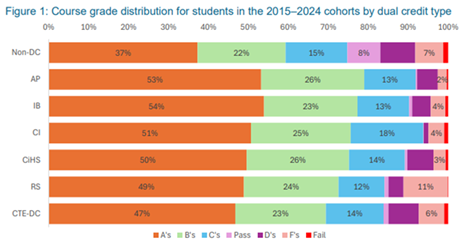
📚Dual credit students tend to earn high grades. Dual credit allows high school students to earn both high school and postsecondary credit from a single course. For some years now, ERDC has produced regular reports and annual dashboard updates on dual credit, to fulfill statutory requirements in RCW 28A.600.280.
Key findings in this year’s report include that students earn high grades even with the added rigor of dual credit courses (see figure below, which is Figure 1 in the report); those enrolled concurrently in College in the High School (CiHS), both for high school credit and for postsecondary credit, increased (likely due to removal of tuition fees via 2SSB 5048); and about one-fifth of high school courses are designated dual credit. The report also includes updates on recommendations made in prior reports.
🏫Delayed enrollment trends continue to shift after COVID-19. Delayed enrollment occurs when someone waits more than a year after high school to enroll in postsecondary education. This digest explores multiple trends, including increased delayed enrollment, long-term rates of delayed enrollment, and institution selection preferences for those who delay enrollment.
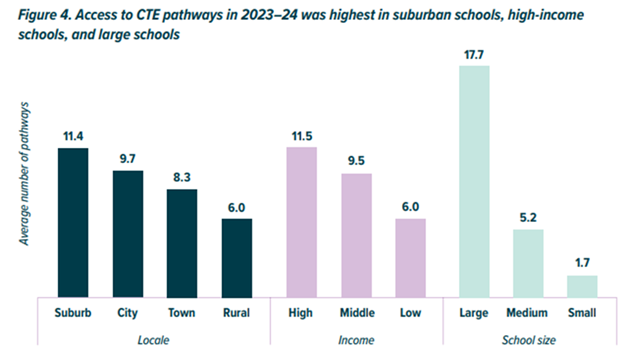
⚙️A decade-long study about career and technical education (CTE) access for three-quarters of a million Washington students is now available. This large, longitudinal study covers numerous CTE topics, including school and regional characteristics associated with CTE pathway offerings (see figure below, which is Figure 4 in the report), information about who participates in CTE, and relationships between CTE credit attainment and a variety of outcomes. To promote the numerous findings from this work, there’s a full report, an infographic, and a short “spotlight” report to review. These publications were produced under an agreement between the state of Washington Office of Financial Management (OFM) and Education Northwest.
Data request status
ERDC has resumed data request processing after a pause. However, requests will be managed based on prioritization criteria, which you can learn more about on our data request page.
P20W cloud modernization update
ERDC continues to move forward with P20W data system cloud migration activities and is currently evaluating vendor cost proposals. Taking about two years, cloud migration will primarily focus on data loading, validation, and modeling. Updating these processes will improve internal data accessibility but will not involve changes to data coming into ERDC.
Postsecondary data strategy
If you attended a postsecondary data strategy partner feedback session in August or September, thank you so much for your time and your insight! We are analyzing the feedback and plan to share a report on what we learned soon. If you missed the feedback sessions, slides and notes are available. Plus, our comment box is still open, and you are welcome to email Kaitlin Throgmorton with questions and comments.
Out and about
Over the last few months, ERDC has presented at numerous conferences, including at Washington Association of Career and Technical Administrators (WACTA), Society for Research on Educational Effectiveness (SREE), and Community of Innovation (COI). We've also shared our work with a variety of audiences, including Washington public school principals, Wyoming's statewide longitudinal education data system (SLEDS) team, Harvard University's Strategic Data Partnership (SDP), and the Education Opportunity Gap Oversight and Accountability Committee (EOGOAC). Learn more about where we’ve been and what we’ve been sharing in this news post.
Some ERDC staff will also be attending the Association for Public Policy Analysis and Management (APPAM) conference in November and the Washington Educational Research Association (WERA) conference in December. If you’ll be there, please say hello!
Did you know? ERDC leads several research groups
These include the Dual Credit Work Group, Early Learning Work Group, and P20W Research Group. Learn more about what these groups do on our new ERDC research group page.
Data in action
In each newsletter, ERDC aims to highlight how our data is used. While we make ERDC data available to numerous groups, including academic and nonprofit researchers, we also provide data to other state government agencies, sometimes even “giving data back” to agencies that contribute data to ERDC, so they can use the data for larger, longitudinal analyses. To showcase this kind of data use, below we feature two reports by ERDC partners and data contributors:
- Washington Office of Superintendent of Public Instruction (OSPI), which contributes K-12 public school data to ERDC, recently published its Running Start (RS) data report to the legislature, detailing recent enrollment changes, legislative changes to capacity and funding, details about who participates in the program, and future recommendations.
- Washington Student Achievement Council (WSAC), which contributes financial aid (restricted use) data to ERDC, recently published its 2025 Washington Transfer Efficiency Update report, detailing progress on key transfer efficiency measures, new transfer degrees, details about who transfers, and more.
See more ERDC data in action.

|