In this newsletter, we explore newly published reports on postsecondary enrollment and special education services, promote upcoming partner feedback sessions on our postsecondary data strategy, and share updates on National Student Clearinghouse data, data system modernization, and more. Did someone forward this newsletter to you? Subscribe here.
New publications available on postsecondary enrollment and special education
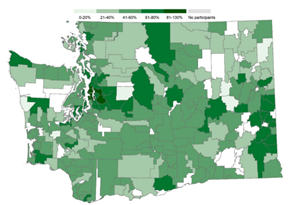
📍High school graduation and postsecondary enrollment rates vary by region. This data digest shows how these trends unfold across Washington state, answering questions about district differences in postsecondary institution types and pandemic-related enrollment decline and recovery.
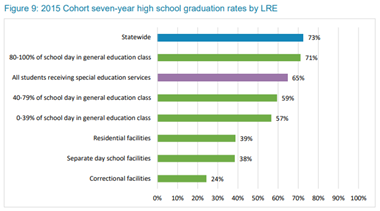
🎒What are the long-term education and employment outcomes for students receiving special education services in Washington public high schools? This report explores those outcomes, in response to RCW 28A.155.220 which directs ERDC to monitor them. One key finding: more than half of students receiving special education services spend 80% or more of their time in general education classes – and these students are more likely to graduate high school, enroll in postsecondary, and be employed than students who spend less time in general education settings. Discover more findings in the full report.
📋The annual state-funded public higher education enrollment report is available for 2023-24. This report shows the number of enrollees at Washington public higher education institutions for that academic year.
Want to be part of our postsecondary data strategy? Attend a feedback session. These 90-minute interactive meetings are an opportunity for you to help shape how ERDC prioritizes postsecondary data strategy recommendations and applies a new data framework.
-
Partner Feedback Session #1
- Wednesday, August 6 – 1:00 – 2:30 p.m. (PDT)
- Register
-
Partner Feedback Session #2
- Thursday, September 4 – 2:00 – 3:30 p.m. (PDT)
- Register
Note: All feedback sessions will be the same, so select what works best for your schedule.
What is the postsecondary data strategy? Recently, ERDC started creating a postsecondary data strategy to guide how we identify, harmonize, and represent postsecondary data. For details, visit erdc.wa.gov/postsecondary-data-strategy.
Can’t make a session, but want to be involved? Soon, we’ll be introducing additional ways to participate in ERDC’s postsecondary data strategy, such as office hours and an online comment box. Find these and other updates at: erdc.wa.gov/postsecondary-data-strategy. You’re also welcome to email postsecondary data strategy lead Kaitlin Throgmorton.
National Student Clearinghouse (NSC) Data Project
To provide school districts with postsecondary enrollment data, ERDC partnered with OSPI to distribute data through ERDC’s NSC contract. In January 2025, ERDC and OSPI released the first set of reports on student enrollment for 2015-2023 high school graduates. In March 2025, a second set of reports about students graduating in 2024 and then immediately enrolling in postsecondary education in Fall 2024 were made available.
Moving forward, school districts can expect two sets of reports each year:
-
Annual postsecondary enrollment reports: Arriving in November, these will include data for eight graduating cohorts, with the most recent being students who graduated in 2024 and enrolled in postsecondary education during the 2024–25 school year.
-
Fall postsecondary enrollment reports: Arriving in January, these will also cover eight cohorts, with the most recent being 2025 graduates and their Fall 2025 enrollment.
In addition to these aggregate reports, ERDC and OSPI will collaborate to provide school districts with record-level NSC data, along with visualization and analysis tools.
Data system modernization efforts
ERDC received funding for a new position (1 FTE) starting July 1, 2025, to support ongoing data system modernization efforts. These efforts will reduce dependency on Informatica for identity resolution, plus develop and refine requirements for a cloud system vendor.
Status of ERDC Data Sharing Agreements (DSAs) and requests
-
DSAs. Since the beginning of the calendar year, we finalized 41 data sharing agreements and/or amendments. Of these, 25 allow ERDC to receive data from other institutions and 19 enable ERDC to provide data to external requesters. Plus, ERDC has an additional 49 DSAs slated for finalization by the end of September – 46 allow ERDC data receipt and 3 allow for data provision to requesters.
-
Requests. Due to high volume, ERDC data requests are currently paused. Requests from legislators and state agencies will continue to be fulfilled during this time, as will requests in our queue received prior to mid-May 2025. For details, visit the Data Request site.
Stay tuned…
In September, look for a new dual credit report and updates to the dual credit dashboard
Data in action
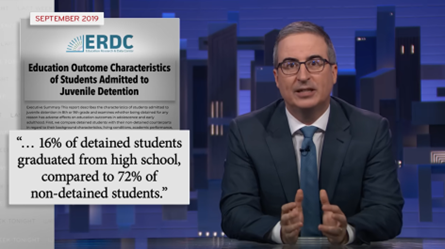
ERDC report featured on the late night television. One of ERDC’s reports on juvenile-justice-involved youth from September 2019, “Education Outcome Characteristics of Students Admitted to Juvenile Detention,” was recently featured on the late-night show Last Week Tonight with John Oliver during an episode about juvenile justice. Viewer discretion is advised for this HBO series.
See more ERDC data in action.

|