|
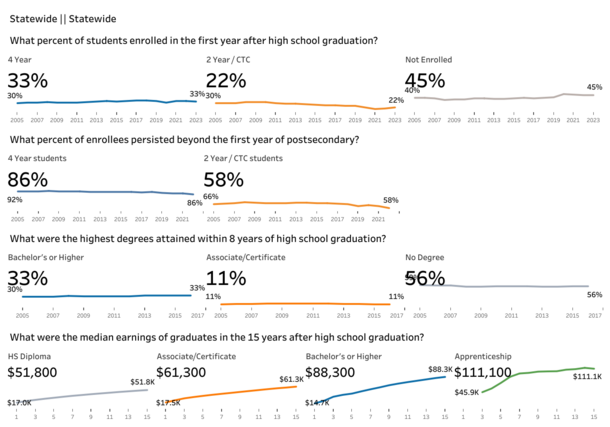
🎓High school graduation outcomes for class of 2023 are available
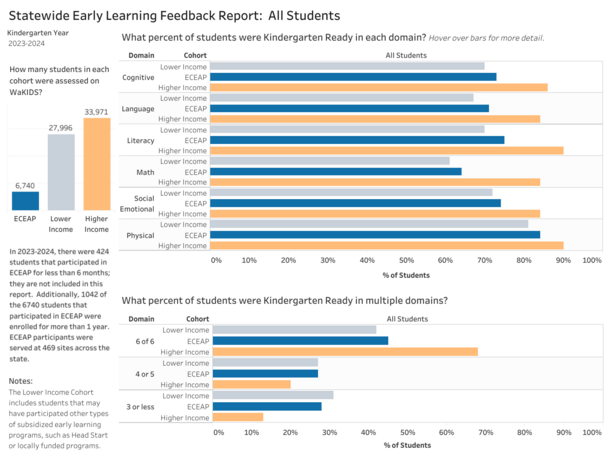
🚸Early learning feedback report for 2023-24 kindergarten year is available
- View our early learning feedback report dashboard (see snapshot below), now updated with readiness data for 2023-24 kindergarteners. This information helps viewers understand how well children did while transitioning into kindergarten.
-
Did you know that, nationally, student parents make up more than 20% of undergraduate college students? Read more about the characteristics, educational pathways, and workforce outcomes of student parents enrolled in Washington community and technical colleges (CTCs) in this new ERDC research report.
-
Gaps in on-time high school graduation for students experiencing foster care or homelessness have decreased over time, though gaps for students experiencing institutional education persist, as detailed in a new ERDC research brief. This research builds on previous ERDC research about inequitable outcomes for students experiencing foster care and homelessness.
-
📊 New reports will give districts insight into students’ postsecondary outcomes. ERDC is collaborating with OSPI to provide Washington school districts with postsecondary enrollment and completion data from National School Clearinghouse. In December 2024, OSPI released school-level aggregate reports on postsecondary enrollment for students who graduated in 2023. OSPI and ERDC are now working to distribute reports for students who graduated in 2024 and enrolled in postsecondary education in Fall 2024.
-
💬 Have something to say about postsecondary data? ERDC will be seeking feedback from partners and postsecondary community members on our in-development postsecondary data strategy, starting in Summer 2025. Look for more information about this soon, and if you want to get involved now, email erdc@ofm.wa.gov.
Harvard Strategic Data Project Fellowship
- ERDC staff Heather McCabe and Melinda Wengrin were accepted as fellows for the Harvard Strategic Data Project (SDP) as part of an Early Learning cohort focused on equitable preschool system transformation. Melinda’s project will concentrate on the achievement gap between kindergarten and third grade, and Heather’s will connect data across public early learning programs to assess equitable access to prekindergarten for Washington children who experience poverty.
Status of ERDC Requests
- This quarter, we received 25 requests. Though January is historically one of the busiest request times at ERDC, we successfully filled 18 requests over the last three months.
Welcome two new team members
-
Anna Batie Kuka joined the OFM Forecasting team as a Senior Data Scientist in December 2024. She is working with private postsecondary institutions on the Postsecondary Data Collection Project, which will add data from these institutions to ERDC’s P20W data system. Anna has a background in data and project management, with master’s degrees in sociology and education. She was most recently the IT Data Management Coordinator for the Washington State Department of Commerce, where she oversaw 30+ data systems.
-
Kaitlin Throgmorton joined ERDC as a Senior Data Governance and Operations Specialist in February 2025. She will lead the creation of a comprehensive postsecondary data strategy, supported by Gates Foundation funding. Kaitlin has over a decade of experience working in various government, nonprofit, and higher education roles, and has a master’s degree in library and information science from University of Washington. Most recently, she was Data Librarian for the Health Sciences at Yale University.
-
In the Seattle Preschool Program (SPP), kindergarten readiness is rising among almost every student demographic. SPP was recently evaluated by Education Northwest using ERDC data, and the report findings were recently reported by the Seattle Times.
-
Academic acceleration policies (AAPs) are increasing advanced course enrollment, equity in that enrollment, and access to dual credit, according to AAP research conducted with ERDC data.
- One article, produced by researchers from the American Institutes of Research (AIR) and Center for Analysis of Longitudinal Data in Education Research (CALDER) and published in the American Educational Research Journal, found that advanced course enrollment increased and became more equitable after AAP implementation.
-
Read summary of findings.
-
Read full article: Austin, M., Backes, B., Goldhaber, D., Li, D., & Streich, F. (2024). Leveling Up: An Academic Acceleration Policy to Increase Equity in Advanced High School Course Taking. American Educational Research Journal, 62(1), 136-179. https://doi.org/10.3102/00028312241282793
- The other, written by a Virginia Tech researcher, found that automatically enrolling students in advanced coursework can increase access to dual credit courses, but may not significantly improve educational outcomes, suggesting that access alone is not sufficient.
- See more ERDC Data in Action.

|