|
In this month’s issue we bring you:
- A reminder of upcoming OCB webinars on the long-term strategy
- An opportunity to contribute your story to OCB about your experience in the Basin
- An update on the first field season of the bass suppression study
- Outcomes from the recent Aquatic Species Restoration Program Symposium
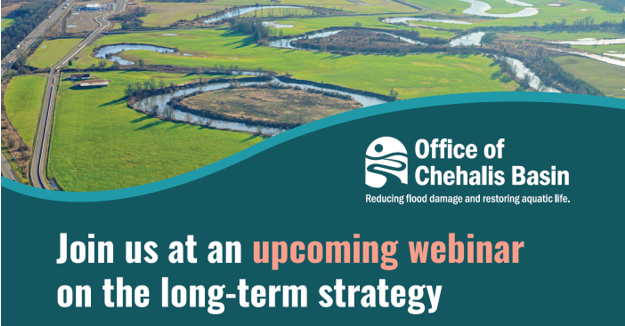 A flyer notifying people of an upcoming OCB webinar on the long-term strategy.
The Office of Chehalis Basin and Chehalis Basin Board are transitioning to a new phase of basin-wide aquatic species restoration and flood damage reduction. Come learn more about the many successful projects completed to-date, why continued action in the Basin is more critical than ever, the next two years of investment priorities, and the Board’s vision and next steps for the Long-Term Strategy. Join us for a “2026 Long-Term Chehalis Basin Strategy Update” one-hour webinar held on Nov. 10 at 12 p.m. and on Nov. 16 at 5:30 p.m. We are offering two sessions to accommodate a range of participants – each will provide the same updates, though those interested are welcome to attend both.
This free webinar, hosted by the Department of Ecology’s Office of Chehalis Basin (OCB), will be an opportunity to:
- Hear about the 240+ projects implemented or in progress across the Basin.
- Understand findings from a study on the “risks of inaction,” or what the potential impacts would be to people, communities, and the environment if investments in flood protection and aquatic restoration stopped.
- Hear more about the Board’s 2027-29 biennium budget recommendations.
- Receive information on what to expect from the Long-Term Strategy, including timing, key aspects, and outstanding questions.
We will have time to answer questions in a live Q&A. A recording will be provided after each webinar in case you are unable to attend. We hope to see you there!
Register for the webinar on Nov. 10 at 12 p.m. or register for the webinar on Nov. 16 at 5:30 p.m.
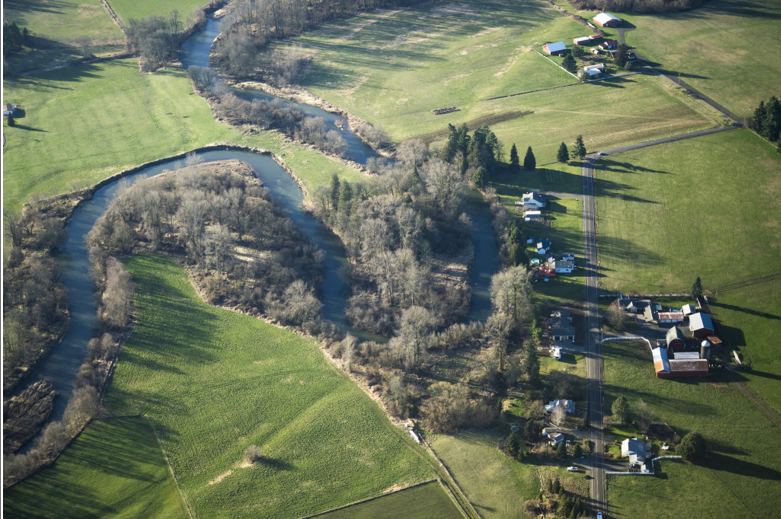 An aerial photo of a river through a farm in the Chehalis Basin.
For nearly a decade, OCB and its partners have invested in 240+ projects to reduce flood damage, restore aquatic habitat, and strengthen communities across the Basin. Science and monitoring help us understand whether these efforts are achieving their intended outcomes, but they don't always capture how this work is experienced by the people who live, work, and spend time here.
As we look ahead to the next chapter of the Chehalis Basin Strategy, we're interested in a different question: How has this work impacted you? In no more than 1,000 words and three photos, tell us about what changes you have seen in rivers, streams, wetlands, and your community in the Chehalis Basin over the past decade. Other questions to consider include:
- How have flooding or efforts to reduce flood damage affected you, your family, property, business, or community?
- Have you seen changes to the habitat or wildlife in rivers, streams, or other places you care about? What has your experience been with efforts to restore and protect habitat?
- Have you experienced a project or program in the Basin that made a difference for you?
- What changes have you noticed in the Basin over the past decade?
- What do you hope to see for the future of the Chehalis Basin?
Share your story with us at info@officeofchehalisbasin.com by Dec. 1, 2026. We look forward to hearing from you!
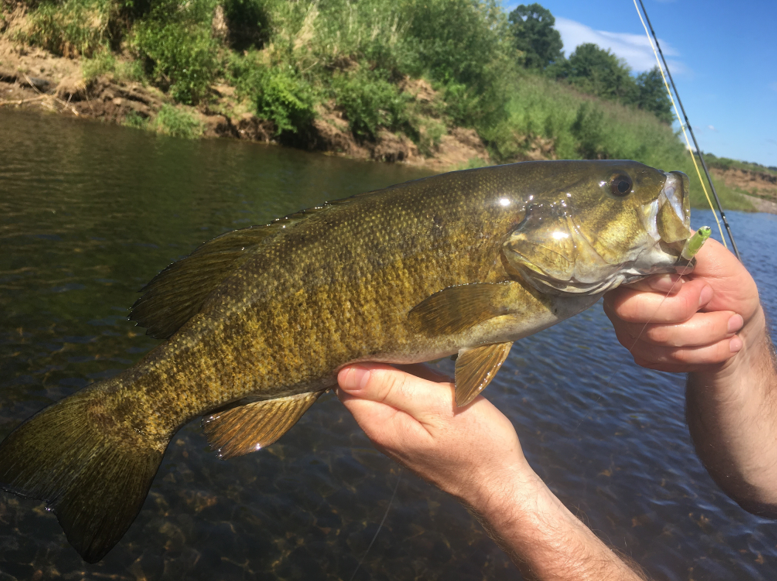 A smallmouth bass held by a fisher on the Chehalis River.
In our June newsletter, we shared about a study examining whether nonnative bass, particularly smallmouth bass and rock bass, may affect juvenile Chinook salmon as they migrate through the Chehalis River. Researchers found that juvenile Chinook salmon made up about 15% of smallmouth bass diets, on average, during the spring and early summer migration season, eating the young salmon as they move downstream. Since then, researchers with the Washington Department of Fish and Wildlife (WDFW) have completed their first field season of a bass suppression research study and provided updates on what they learned so far at the October Chehalis Basin Board Meeting.
The study focuses on the stretch of the mainstem Chehalis River between the Newaukum River and Skookumchuck River, where researchers have documented high concentrations of bass in areas used by migrating juvenile salmon. During the 2026 field season, WDFW crews surveyed fish populations, estimated bass abundance, and conducted targeted removal efforts. They estimate the stretch of river they studied supports more than 1,000 bass per kilometer that are large enough to consume juvenile salmon. Crews removed 626 smallmouth bass and 917 rock bass that are large enough to consume juvenile salmon, and 6,733 juvenile bass this first year of the study.
Over the next several years, WDFW will continue monitoring fish populations, analyzing diet samples, and evaluating whether bass suppression can improve survival for juvenile Chinook salmon. The study will help managers better understand the role predation plays in salmon recovery and determine whether bass suppression can complement the habitat restoration work already underway through the Aquatic Species Restoration Program.
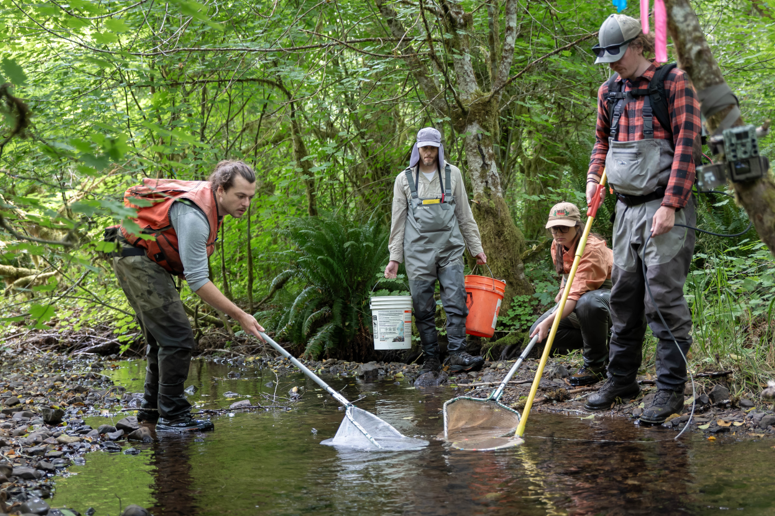 Image Description: WFC and WDFW conducting sampling on West Fork Wildcat Creek. Photo Credit: Aaron Jorgenson.
This past October, approximately 80 researchers, restoration practitioners, project sponsors, biologists, and Aquatic Species Restoration Program (ASRP) Steering Committee members gathered for the 2026 ASRP Progress & Planning Workshop. The annual event provides an opportunity for the ASRP community to reflect on the past year of restoration work, share scientific findings, and collaborate on future priorities.
Participants worked together to identify new ways that ASRP-funded research can inform project prioritization and design, while also discussing which project development efforts may be ready to seek implementation funding by the end of the current biennium. Through a combination of breakout discussions and project updates, attendees exchanged lessons learned, identified research gaps, explored future partnerships, and discussed opportunities to strengthen coordination across the basin.
Discussions were organized around four restoration clusters:
- The Upper Basin and Chinook salmon
- The Olympic Mountains
- The Black River and wetland systems
- The Grays Harbor estuary
These sessions created space for project sponsors and science teams to share updates on ongoing restoration and research efforts while helping shape future work.
A summary report highlighting key outcomes and next steps from the 2026 workshop is currently being developed and is expected later this year. Planning is already underway for the 2027 workshop as the ASRP community continues working together to advance science-based restoration throughout the Chehalis Basin.
For more information, including past workshop reports and resources, visit the ASRP Progress & Planning Workshop webpage.
Chehalis Basin Board Meeting | Nov. 5, 9 a.m. to 4 p.m. Veteran’s Memorial Museum, 100 Veterans Way SW, Chehalis, WA 98532
Once a month, the Chehalis Basin Board meets to discuss funding, evaluate priorities, and put flood and habitat projects in place that support the Chehalis Basin Strategy. Listen in to find out more. Access more information on the agenda and how to attend virtually and in-person on the Board’s website.
Chehalis River Restoration with Grays Harbor Conservation District | Nov. 14, 10 a.m. to 12 p.m. Chehalis River, 15 S Bank Road, Elma, WA 98541
Join the Grays Harbor Conservation District for a morning of hands-on restoration along the Chehalis River! Volunteers will help plant native trees and shrubs and remove invasive plants to improve habitat for fish and wildlife. All ages and abilities are welcome. See the Grays Harbor Conservation District event page for more information and to RSVP.
Teacher Training: Meaningful Watershed Educational Experience (MWEE) | Nov. 18, 4 p.m. to 5 p.m. and Nov. 21, 9 a.m. to 5 p.m.
Twin Harbors Waterkeeper is hosting a 2-part training for teacher to learn how to create MWEEs with their students and technical training on topics related to stream health in western Washington. Teachers can receive 7.5 STEM clock hours and may be eligible for a small stipend. Lunches will be provided. Register online or reach out to maya@twinharborswaterkeeper.org for more information.
Opt Outside: Chehalis River Restoration Day | Nov. 28, 10 a.m. to 12 p.m. Chehalis River, 15 S Bank Road, Elma, WA 98541
Look for a way to spend Saturday after Thanksgiving that doesn’t involve shopping? Opt outside and give back to your community. Join the Grays Harbor Conservation District for a morning of hands-on restoration along the Chehalis River. Volunteers will help plant native trees and shrubs and remove invasive plants to improve habitat for fish and wildlife. All ages and abilities are welcome. See the Grays Harbor Conservation District event page for more information and to RSVP.
Freshwater in Fall at the Dawg House | Nov. 28, 11 a.m. to 1 p.m. 210 Main Street, Montesano, WA 98563
Join the Coastal Interpretive Center at the Dawg House in Montesano for an education event centered around three stations. Bring the family to experience life as a water molecule, search for macroinvertebrates, and build a bug.
|
Follow us on social media and never miss the latest news, project updates, and coming events:
|
|
|