6PPD Update - August 2026
Finding Solutions
Ecology is focused on several key areas to reduce the threat of 6PPDQ on aquatic life. We highlight our efforts to advance research and activities below.
Assessing 6PPDQ risk to aquatic life: Measuring and mapping to support recovery
6PPDQ in marine sediments: In June 2026, Ecology’s Toxics and Marine Monitoring units conducted their second survey of 6PPDQ in marine sediments as part of the annual Puget Sound Ecosystem Monitoring Program (PSEMP). The initial round of surveys in June 2025 demonstrated that marine sediments can serve as a useful medium for evaluating the presence and distribution of 6PPDQ in Puget Sound. While these early efforts provide important baseline information, long-term sampling is needed to assess patterns or trends.
6PPDQ exposure and toxicity in amphibians: Ecology and the Washington Department of Fish and Wildlife (WDFW) continue to study how amphibians are exposed to 6PPDQ in urban stormwater ponds used as breeding and rearing habitat. Ecology deployed passive samplers in ponds to quantify 6PPDQ present during sensitive aquatic life stages, while WDFW surveyed each site to document amphibian species diversity and abundance.
WSU Vancouver (WSUV) successfully completed the in-situ 6PPDQ exposure toxicity testing on Pacific Chorus frogs in May, and data analysis is underway. In June, WDFW biologists collected American bullfrog egg masses from stormwater ponds and delivered them to WSUV to begin the next round of toxicity testing. These studies will help clarify the direct impacts of 6PPDQ on multiple amphibian species. Ecology, WDFW, and WSUV also plan to expand laboratory experiments to include red‑legged frogs.
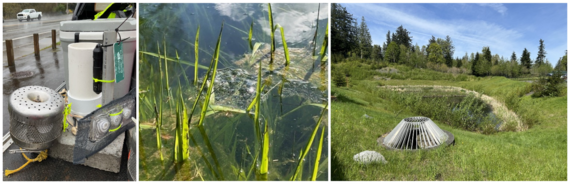 Photos above from left to right: 6PPDQ passive sampler package, bullfrog egg masses, example stormwater pond amphibian habitat.
Targeted stream monitoring for 6PPDQ: Over the past year, Ecology has partnered with Trout Unlimited to monitor 6PPDQ in stream systems around Lake Washington and Lake Sammamish using passive samplers. This fall, we will conduct intensive sampling in a smaller set of tributaries where higher concentrations were observed. Sampling will include passive samplers, autosamplers, and bioassays to further characterize 6PPDQ conditions at these sites.
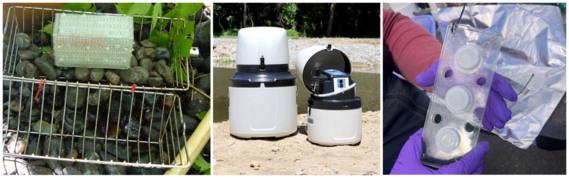 Photos above from left to right: Fish hatchbox used to assess stream conditions for target fish species, autosampling unit, diffusive gradients in thin films (DGT) passive sampler membranes.
Reducing sources of 6PPD: Tire research, alternatives assessment, and action plan
The U.S. Geological Survey Western Fisheries Research Center (WFRC) started two new studies to support Ecology’s work to assess safer alternatives to 6PPD in tires.
Sensitivity of Pacific lamprey (Entosphenus tridentatus): Pacific lampreys, a culturally significant species for Tribal Nations and a key contributor of marine nutrients to Columbia Basin freshwater ecosystems, are listed as a Species of Greatest Conservation Need in Washington. Despite their ecological and cultural importance, little is known about how tire‑related contaminants—particularly 6PPD and its transformation product, 6PPD‑quinone—affect lamprey health.
WFRC will expose lamprey larvae to 6PPD and 6PPDQ to establish LC50 values, expose lamprey larvae to tire wear particles in sediment to evaluate risks, and examine changes in tissues that could be caused by chemical exposures.
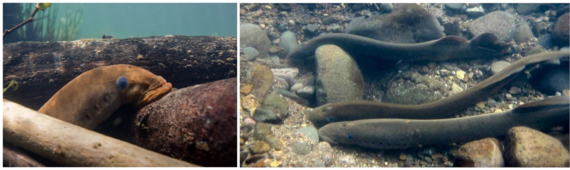 Photos above: adult pacific lampreys, by U.S. Fish and Wildlife Service.
Toxicity of PPD quinone transformation products: Emerging research on alternatives to 6PPD in tires shows that several related PPD chemicals generate quinone transformation products with widely varying toxicity. Notably, quinones from IPPD and 7PPD cause mortality in coho salmon at relatively low concentrations, raising concerns about their suitability as substitutes. A key question remains whether these chemicals act through the same biological pathway as 6PPDQ.
WFRC studies have found that 6PPDQ triggers a distinct pattern of cellular injury in coho salmon, specifically apoptosis in the sensory tissues of the olfactory bulb and taste buds—damage that can impair feeding, predator avoidance, migration, and reproduction. The new project will examine whether quinones from 7PPD, 77PD, and IPPD produce similar histopathological effects in coho salmon and coastal cutthroat trout, alongside acute toxicity testing. Results will help determine whether these alternative PPDs share a common mechanism of toxicity and whether they truly offer environmental advantages over 6PPD.
Rubber testing: Ecology is testing the performance of potential chemical alternatives in rubber. ACE Laboratories completed part five of the Antioxidant/Antiozonate Sidewall Study, testing the anti-ozonant performance of potential alternatives to 6PPD. Using the dynamic ozone testing method, slabs of rubber are stretched while being exposed to ozone until they crack and break. Previous study results are available on our research and proposed alternatives webpage.
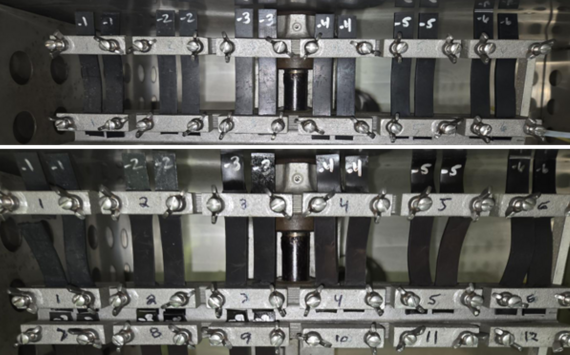 Photos above: samples from the Ace Laboratories Antioxidant/Antiozonate Sidewall Study at Initial Setup (top) and final 240-hour check (bottom). Round five tested two proprietary chemicals, Kuminox 19 from Kumho Petrochemical (Korea), and SA6000 from Sennics (China). Both chemicals performed similarly to 6PPD, confirming that they have the potential antiozonant performance to replace 6PPD in tires.
Safer Products for Washington: The Safer Products for Washington draft regulatory determinations report is planned for publication in November. Between now and then, input, data, and other information on each of the priority products under review can be shared at SaferProductsWA@ecy.wa.gov. For updates about recent safer alternatives research for each product under review in our current cycle, including 6PPD in motor vehicle tires and artificial turf, check out our video playlist.
Reducing 6PPDQ in stormwater: Mitigation and best management practices (BMP)
Ongoing Stormwater Guidance and Manuals Updates:
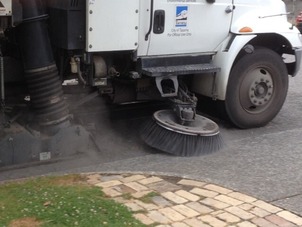
Street Sweeping Manual – Washington Stormwater Center: The Synthesis of Street Sweeping Research and Practices: Guiding Program Development and Implementation guidance manual is being finalized. The manual will provide information and tools for permittees to develop and/or improve street sweeping programs. Street sweeping is a source control measure that removes tire wear particles containing 6PPD and 6PPDQ from roadways prior to them being washed into stormwater drains and receiving waters. The final manual will be posted to the Washington Stormwater Center website late fall and an online training program will be available early 2027.
Photo above: City of Tacoma street sweeper cleaning residential neighborhood.
|
6PPD BMP Effectiveness Research Synthesis and Guidance – Washington Stormwater Center: The Washington Stormwater Center has contracted with Evergreen StormH2O to conduct an extensive literature review on 6PPD stormwater BMP effectiveness studies. The goal is to help develop guidance on potential treatment methodologies and identify data gaps that should be addressed in future research. A Technical Advisory Committee (TAC) has been assembled – consisting of permittees, subject matter experts, and Ecology staff members – to provide input and support the development of the guidance to ensure it is informative and a useful resource. The guidance document is scheduled to be finalized and released to the public in late June 2027.
BMP Effectiveness Study updates: Stormwater sampling to test installed BMPs will continue this fall. A few project highlights include:
The City of Spokane’s 6PPDQ Monitoring in Arterial Catchments Study: The City of Spokane will be collecting stormwater samples from catch basins located at two collection sites to be analyzed for 6PPDQ and other stormwater pollutants.
Snoqualmie Indian Tribe’s Phase II Sampling: This project will entail monitoring 6PPDQ concentrations throughout the Snoqualmie Reservation, testing the effectiveness of installed BMPs, and retrofit of stormwater collection pond high performance biofiltration media.
NV5 Verification of BMP Effectiveness – Phase 2 Sampling and Monitoring: The study will monitor four different BMP systems at three locations, collecting influent and effluent samples during 5 storms events. Samples will be analyzed for 6PPDQ, total suspended solids, and total and dissolved metals.
Determining tire recycling impacts: Assessing environmental pathways of 6PPDQ
The Washington Waste Tire Assessment Report is now available online. This study examines Washington’s waste tire market and management practices, detailing where waste tires come from and where they go. It also evaluates alternative uses for tire derived rubber within waste tire markets.
The report found most used tires in Washington are landfilled (40 percent), burned for energy (26 percent), or recycled (26 percent). The life-cycle analysis concluded that landfilling resulted in minimal environmental impacts compared to burning or recycling.
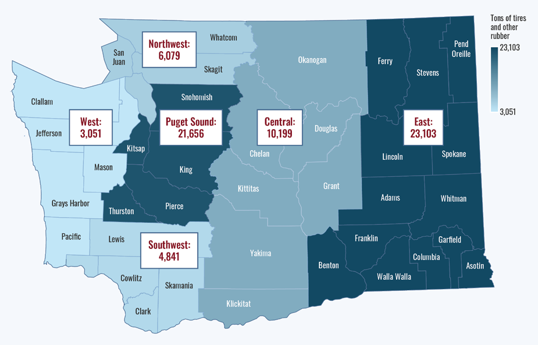 Photo above: Figure 4 from the Washington waste tire assessment report – total tons of tires and other rubber disposed by waste generation area, 2009-2021.
Working Groups
The Stormwater Work Group voted in July to fund a new suite of Stormwater Action Monitoring (SAM) studies. Included in the approved list are two projects dedicated to 6PPD research.
The timeline for these projects and creation of Technical Advisory Committees will be announced through the Stormwater Work Group's meetings and communication channels.
Stormwater Work Group 6PPD Subgroup: The SWG 6PPD Subgroup met on May 21, 2026. The Department of Ecology gave an extensive presentation on study results from Stormwater BMP Effectiveness studies and overview of new studies for the 2025-2027 Biennium. A meeting summary and link to the presentations is available online. The next SWG 6PPD Subgroup meeting will be held virtually on September 17, 2026, 10 a.m. - 12 p.m. For more information, visit the SWG Work Group Website.
Upcoming 6PPD Meetings and Events
Stormwater Work Group
Stormwater Work Group 6PPD Subgroup
Puget Sound Ecosystem Monitoring Program Toxics Workgroup
Resources & Research
6PPD and 6PPDQ research is underway around the world. Below are links to recently published papers and other resources that inform Ecology’s work.
Additional Resources
Ecology is working to address 6PPD through source reduction, stormwater management, and environmental monitoring. You can sign up to receive future updates and read more about our 6PPD work below.
|