|
As summer arrives in the Chehalis Basin, we’re looking forward to longer days and community gatherings. This month’s newsletter features information on:
- A funding opportunity for Basin residents impacted by the December 2025 flooding.
- A bass suppression study being conducted by Washington Department of Fish and Wildlife.
- Community events Office of Chehalis Basin staff and partners will be tabling at this summer.
Basin residents impacted by the historic flooding in December 2025 may be eligible for federal disaster assistance, and the deadline to apply is June 10. Following a federal disaster declaration requested by Governor Bob Ferguson and approval by the president, assistance is available through Federal Emergency Management Agency (FEMA) Individual Assistance, Disaster Unemployment Assistance, and low-interest Small Business Administration loans. FEMA assistance can help cover costs not paid for by insurance, such as temporary housing, home repairs, or replacing personal property, while unemployment assistance is available for people whose jobs or income were disrupted by the disaster.
If your home, business, or employment was impacted by flooding, you can explore available resources and apply before the deadline. Residents can apply:
If you’ve spent time on the Chehalis River, you may have noticed more bass in recent years. Recent evidence suggests that non-native species, especially smallmouth bass and rock bass, have become increasingly common in parts of the Basin. These fish are opportunistic predators, meaning they eat whatever swims by them and is the right size, including juvenile salmon.
In the Chehalis River, smallmouth and rock bass are found in the same areas where young Chinook salmon migrate, especially between the Skookumchuck and Newaukum Rivers. Researchers at the Washington Department of Fish and Wildlife (WDFW) have found some of the highest concentrations of bass in this area. Scientists have also found that warming river temperatures are making more of the Basin suitable for bass than in past decades, and they have been replacing native predator species, such as the northern pikeminnow, in parts of the Basin.
WDFW’s recent work is helping to sharpen the picture of what’s happening. Studies conducted since 2019 found that Chinook salmon made up about 15% of smallmouth bass diets during spring and early summer, when juvenile Chinook are migrating downstream. While Chinook are only part of what bass eat, the cumulative effect of many predators may be meaningful for salmon populations.
In response, WDFW is beginning a bass suppression study this spring focused on the 10-mile stretch of the mainstem Chehalis River between the Newaukum and Skookumchuck Rivers. Crews will use methods like electrofishing to estimate bass abundance, test how effectively bass populations can be reduced, and study whether suppression could improve survival for juvenile Chinook salmon. Fieldwork is expected to continue over multiple months during spring and summer 2026, with repeated visits to study sites throughout the season.
This work connects closely to the Aquatic Species Restoration Program (ASRP) and the broader Chehalis Basin Strategy. Habitat restoration remains at the heart of ASRP, but understanding other pressures on salmon, such as predation from non-native species, helps partners better understand what may be limiting their return. Studies like this can help inform future decisions and ensure restoration investments are paired with the best available science.
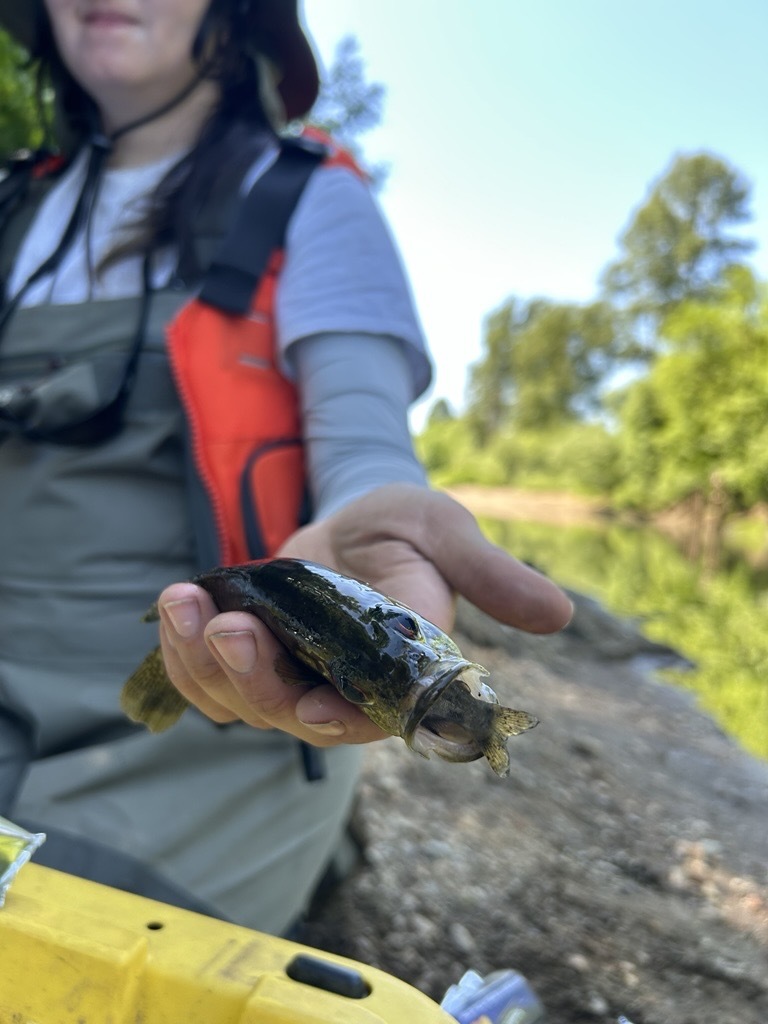 A chinook smolt in the gullet of an invasive rock bass in the Chehalis River. (Photo credit: WDFW)
The Office of Chehalis Basin is hitting the road this summer and will be at fairs, festivals, and community events across the Basin! Whether you’re curious about local restoration projects, flood damage protection efforts, salmon recovery, or the future of the Chehalis Basin Strategy, we invite you to stop by, say hello, and learn more. We’ll have a booth at:
We look forward to sharing updates, answering questions, and connecting with community members throughout the summer!
Chehalis Basin Board Meeting | June 4, 9 a.m. – 12 p.m.
Fairfield Inn & Suits by Mariott, 6223 197th SE, Rochester, WA 98593
Once a month, the Chehalis Basin Board meets to discuss funding, evaluate priorities, and put flood and habitat projects in place that support the Chehalis Basin Strategy. Listen in to find out more. Access more information on the agenda and how to join the meeting virtually or in-person on the Board’s website.
Rochester’s Swede Day Mid-Sommer Festival | June 19 – 20
Swede Hall, 18543 Albany Street, Rochester, WA
The Swede Day Mid-Sommer Festival in Rochester will hold a parade (June 20), court social (June 19) and many other things to do! Have a Swedish pancake breakfast, learn some history and join the maypole dance. The Office of Chehalis Basin will be present and ready to talk about our work in the Basin. See the Swede Hall website for more details.
Grays Harbor Stream Team Field Event | June 27, 12 p.m. – 4 p.m.
Lake Sylvia State Park – Email streamteam@grasyharborcd.org for driving directions
Join the Grays Harbor Stream Team in the field at Lake Sylvia State Park! Anybody is welcome to come and learn more about macroinvertebrate sampling, water quality testing, and site evaluation.
|
Follow us on social media and never miss the latest news, project updates, and coming events:
|
|
|