Improving Our Solid Waste System With Consistent Colors and Labels
Washington is now the second state to unify container colors between solid waste service providers and their customers by adopting a statewide color-code and new labeling requirements. Containers in public places are also required to follow the color code if they are maintained by the city or county. Over time, this will cut contamination and improve recycling outcomes across the state.
Container and Lid Colors
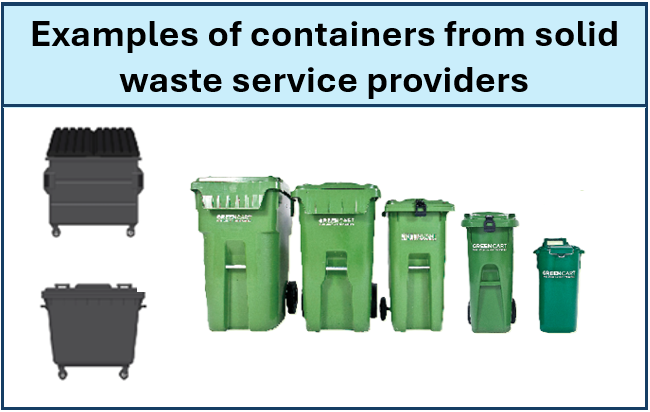
Starting in 2028, containers given to a customer to collect their garbage, recycling, and organic waste must be color-coded and have clear labels. The same is true for containers put in a public space by a city or county. Black or grey containers are for garbage, blue containers are for recycling, and green or brown containers are for organics. Containers larger than 101 gallons are exempt.
Lids must be black or follow the same color requirements.
Leading up to 2028 and effective immediately, service providers that purchase new containers must buy ones that follow the color requirement. Functional containers purchased before Aug. 1, 2025, are exempt until replacements are necessary.
Exemptions available later
Cities and counties can request an exemption from Ecology for the color-code requirements for various reasons. Cities and counties can apply for exemptions including special container colors for fundraising, a need to extend their transition timeline, or having an alternate plan to reduce contamination, if standard container colors are not feasible. Exemptions are not available to private haulers.
We will have more information about exemptions later. In the meantime, we encourage cities, counties, and haulers to reach out with their questions and concerns. Our staff are available to present at county SWAC and other meetings.
Container and Lid Labels
The law requires clear and obvious labels on both containers and lids. This applies to containers a solid waste service provider gives to a customer by a hauler, and containers managed by the local government in a public space. A container and its lid must be labeled by Jan. 1, 2028, if either of the following is true:
- Given to a customer by their solid waste service provider
- Provided by the city or county in a public space
Labels can be stickers, imprints, or embossments. The background of the label or the label text must use the same colors required for containers. For example, labels on recycling carts must use blue in the background or text.
Labels can use text, graphics, or both to convey the material category (i.e., garbage, recycling, or organic waste). We encourage labels in multiple languages and more specific examples of materials that are allowed in the container. For example, calling out yard waste and food waste on the organics label.
Unlike the color requirements, containers and lids must have a label regardless of size. For large containers that hold 1 cubic yard or more of material, the label area needs to be at least 1 square foot (144 square inches).
There are no exemptions available for labeling requirements.
Join DES Sourcing Team
Did you know city and county governments can use statewide contracts managed by the Department of Enterprise Services? DES needs your input on contract #07325 Bulk Solid Waste & Recycling equipment (Sourcewell). They are asking "what vendors/contractors should be on the DES Statewide Agreement?"
If your city or county is interested in being part of the DES Sourcing Team, fill out this survey or reach out to Julie Hannah.
Reach out
If you have additional questions, please reach out to Organics@ecy.wa.gov.
To request ADA accommodation, contact Ecology's ADA Coordinator by email at ecyadacoordinator@ecy.wa.gov, or call 360-407-6831, 711 (relay service), or 877-833-6341 (TTY). More about our accessibility services.
|