6PPD Update - 2025 Q1
Communications and Outreach
Ecology's 6PPD team presented at several public forums in early 2025, including:
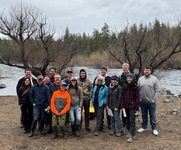
- The Upper Columbia United Tribes Toxics Monitoring Workshop. Ecology’s toxics studies staff provided technical training for monitoring water quality issues posed by 6PPD-quionone (6PPDQ) and other toxics of concern. The Upper Columbia United Tribes and the Columbia River Basin Toxics Reduction Lead Entity organized the workshop. Right: Photo courtesy of Caroline Keever.
|
|
 |
- The Pacific Northwest Clean Water Association Spring Summit. Herrera Environmental Consultants, the TAPE Testing Facility manager, and Stewardship Partners provided a site tour of the I-5 Ship Canal testing facility during the summit. Right: The TAPE testing facility, which is used to collect highway stormwater samples and test proprietary treatment devices for several of Ecology’s 6PPD projects.
|
|
 |
Finding a Solution
|
Ecology is focused on several key areas to reduce the threat of 6PPD-quinone (6PPDQ) on aquatic life. We highlight our efforts to advance research and activities below.
|
Assessing 6PPDQ risk to aquatic life: measuring and mapping to support recovery
Lab accreditation: Ecology has accredited three labs for 6PPDQ in Washington. Access a list of available labs here. Two commercial labs have recently applied for accreditation.
Method development and lab testing: The Manchester Environmental Lab’s (MEL) organics lab has developed a method for measuring 6PPDQ in solids. The Lab Accreditation Unit is currently reviewing it. MEL can also accept water samples for 6PPDQ analysis.
Environmental research and monitoring: Ecology continues to partner with state, county, and federal agencies to develop sampling methods, conduct 6PPDQ toxicity studies, and provide technical training. Some research updates are listed below and you can access more updates here.
- We are assessing the presence of 6PPDQ in marine sediments collected from Puget Sound to understand the fate, transport, and occurrence of 6PPDQ in estuarine and marine systems.
- We are conducting a crumb rubber runoff study to evaluate sport fields as an additional source of 6PPDQ.
- We are planning joint lab and field studies with research partners to integrate habitat, population, and toxics assessments for additional species of concern.
-
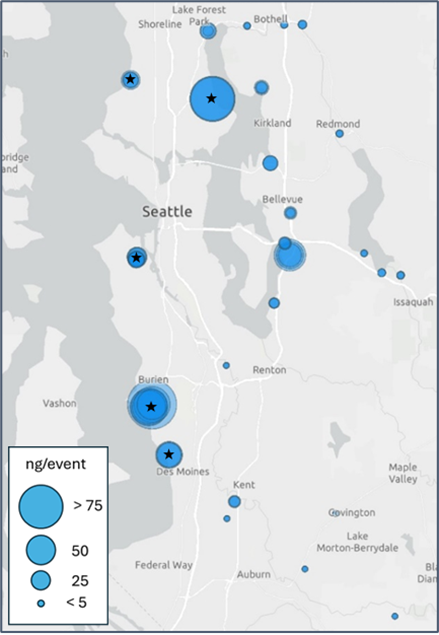
Below: We are using passive samplers to screen for 6PPDQ in water after a fall 2024 study with King County and the United States Geological Survey (USGS) demonstrated their effectiveness. Results from the urban stream passive sampler survey show the accumulated amount of 6PPDQ in nanograms (ng) collected over several storm events. The larger the points the greater the amount of 6PPDQ. The stars indicate where re-occurring pre-spawn mortality occurs.
Reducing sources of 6PPD: tire research, alternatives assessment, and action plan
Reducing 6PPD-quinone in stormwater: mitigation and best management practices
|
6PPD Stormwater Best Management Practices (BMP) Effectiveness Research: Ecology is funding over 20 research projects to assess the effectiveness of stormwater BMPs. We recently published the final report for Pierce County’s decant facility study. This study tested full-scale decant facility removal of 6PPDQ, including assessing the effectiveness of granular activated carbon.
King County released a video on bioretention soil mix research. Ecology has contributed $2.5 million to this important research, including funding from the 6PPD Legislative proviso.
Ecology also contracted four new studies (partner organizations listed in parentheses):
- Ohop Creek stormwater filtration effectiveness study (Long Live the Kings, in partnership with the Nisqually Indian Tribe).
- Measuring street sweeping 6PPDQ whole environment load reductions (Seattle Public Utilities).
- Scaling Adopt-a-Downspout for the treatment of toxic roadway pollutants (Stewardship Partners).
- Pilot study evaluating stormwater facilities and BMPs for 6PPDQ mitigation (Washington State University).
For more information about these projects and deliverables, see our BMP research website.
Determining tire recycling impacts: Assessing environmental pathways of 6PPDQ
Washington Used Tire Assessment: In January 2025, Ecology and Eastern Research Group held a public listening session for the Washington Used Tire Assessment. We opened the listening session with background and an overview of the six research questions for the report. We will share the initial results from our research on April 28, 2025, from 1:30 to 2:30 p.m. After presenting our findings, participants will have the opportunity to ask questions. Register for this event here.
Working Groups
Stormwater Work Group (SWG): The SWG held a meeting on February 12, 2025. At this meeting, the SWG welcomed Eastern Washington permittees into the SWG, discussed 6PPD lab accreditation, and recruited new voting members for the SWG. The next SWG meeting is on May 14, 2025, from 9 a.m. to 12:30 p.m. For more information, visit the SWG Website.
SWG 6PPD Subgroup: The SWG 6PPD Subgroup held a meeting on February 5, 2025. Ecology provided updates on current 6PPD research projects, the 6PPD Action Plan, the 6PPD Legislative Report, and 6PPD Budget Requests. In addition, Ecology’s Lab Accreditation Unit presented on the requirements and process for 6PPQ accreditation. Access a copy of the meeting notes and presentation slides here. The next SWG 6PPD Subgroup meeting will be held virtually on June 4, 2025, 1 to 3 p.m. For more information, visit the SWG 6PPD Subgroup Website.
Toxics Work Group: The Puget Sound Ecosystem Monitoring Program’s Toxics workgroup held a special session in January to discuss 6PPDQ, tire wear particles, and human health. The topics included:
- Environmental occurrence and transformation (Ed Kolodziej - University of Washington).
- Occurrence and transformation in Puget Sound biota (Irv Schultz - NOAA and Sandie O’Neill - Washington Department of Fish and Wildlife).
- A review of exposure effects on humans (Elinor Fanning, Emerson Christie, and Mallory Little – Washington Department of Health).
For more information, visit the Toxics Work Group website.
|
Upcoming 6PPD Meetings
6PPD and the Used Tire Life Cycle, Presentation on Initial Results (Ecology and Eastern Research Group):
- April 28, 2025, 1:30 to 2:30 p.m.
Clu-In: Interstate Technology and Regulatory Council (ITRC) - Overview of the Tire-Derived Chemicals 6PPD & 6PPD-quinone Training
- May 1, 2025, 1 to 2:30 p.m. EDT
Stormwater Work Group (SWG):
- May 14, 2025, 9 a.m. to 12:30 p.m.
- September 10, 2025, 9 a.m. to 12 p.m.
- November 12, 2025, 9 a.m. to 12 p.m.
SWG 6PPD Subgroup:
- June 4, 2024, 1 to 3 p.m.
Toxics Work Group:
Research and Articles
6PPD and 6PPD-quinone research is underway around the world. Below are links to recently published papers that inform Ecology's work.
Additional Resources
Ecology is working to address 6PPD through source reduction, stormwater management, and environmental monitoring. You can sign up to receive future updates and read more about our 6PPD work below.
|