|
Having trouble viewing this email? View it as a Web page.
 Conferences

National Brownfields Conference in August
Join the world's largest gathering of brownfield professionals at this 4-day conference and learn from people who have walked in your shoes. You'll hear about brownfield successes and why they're working; explore innovative ways to engage your community; and learn best practices in remediation, redevelopment, environmental justice, and sustainability. Tuesday-Friday, August 8-11, Detroit, Michigan.
IACC Conference in Wenatchee Oct 24–26, registration opens in August
Join us this fall for the 2023 Infrastructure Assistance Coordinating Council Conference in Wenatchee, Washington. The annual 3-day event will be in-person only this year (no hybrid option) with sessions, tech teams, exhibits, and networking events that connect you with funding resources and technical assistance, as well as with local, state, federal, and Tribal governments.
To reserve an exhibitor table, contact Cynthia.Fuller@Commerce.wa.gov.
Tuesday–Thursday, October 24–26. Registration opens in August. Learn more.
Funding Opportunities

Integrated Planning Grant applications accepted July 5–Aug 8
Local governments that own (or are considering acquiring) a brownfield property can apply for Ecology's Integrated Planning Grants to help plan for cleanup and redevelopment.
Policy update: The 2023-25 IPG guidance includes updates to policies for readiness to proceed and limits for non-cleanup tasks. To take advantage of this funding cycle, you must submit a completed application through Ecology's Administration of Grants & Loans (EAGL) by 5 p.m. Tuesday, August 8, 2023. EAGL Instructions for 2023-25 IPGs.
Check out Ecology's Integrated Planning Grant webpage for instructions on how to apply. If you have questions about a potential brownfield redevelopment project and whether it qualifies for an IPG, please contact one of our staff members listed at the bottom of the IPG webpage.
|

Affordable Housing Planning Grant applications accepted July 5–Aug 31
Have an affordable housing project in the works? Ecology's new affordable housing planning grants (AHPG) can help. Funding is available to public, private, and nonprofit entities that are considering cleaning up a contaminated site with affordable housing as the end use.
Review the criteria in our 2023–25 affordable housing planning grant guidelines to learn if your project is eligible. If you have questions about a potential affordable housing development project and whether it qualifies for an AHPG, please contact the Project Manager and Grant Manager listed at the bottom of the AHPG webpage.
To take advantage of this funding cycle, you must submit a completed application through Ecology's Administration of Grants & Loans (EAGL) by 4 p.m. Thursday, August 31, 2023. Check out Ecology's Affordable Housing Planning Grant webpage for instructions on how to apply. EAGL Instructions for 2023-25 AHPGs.
|
If you have questions or would like more information about Ecology’s Remedial Action Grants & Loans, please contact one of our Remedial Action Grant Managers:
Aalia Dixon, aalia.dixon@ecy.wa.gov or (564) 669-1763
Dan Koroma, daniel.koroma@ecy.wa.gov or (360) 764-6459
Lydia Lindwall, lydia.lindwall@ecy.wa.gov or (360) 790-1124
EPA job training grant applications due Wednesday August 2
EPA is accepting applications from eligible entities, including nonprofit organizations, to deliver Brownfields Job Training programs that recruit, train, and place local, unemployed and under-employed residents with the skills needed to secure full-time employment in the environmental field. More information is available at FY 2024 Brownfields Job Training (JT) Grants.
Review the grant guidelines and an informational webinar recording. Apply through Grants.gov by 8:59 p.m. Pacific, Wednesday, August 2.
Apply for a Targeted Brownfields Assessment
EPA's Targeted Brownfields Assessment (TBA) program promotes the cleanup and redevelopment of brownfields by helping states, Tribes, municipalities, other government entities, and nonprofit organizations minimize the uncertainties of contamination often associated with brownfields. Unlike funded grants, TBAs are an EPA service, and the assessments are conducted by an EPA contractor. A TBA may encompass one or more of three activities:
- “All appropriate inquiries” assessment (Phase I), which includes a background and historical investigation, and a site inspection.
- Full site assessment (Phase II), including sampling activities to identify areas of contamination and types and concentrations of contaminants.
- Determining how much more investigation is needed and/or establishing cleanup options and cost estimates based on planned uses after redevelopment.
No application deadlines for this service. Learn more.
July webinars for $20 billion clean technology grants
EPA launched two grant competitions to support tens of thousands of clean technology projects nationwide. National Clean Investment Fund has $14 billion available to 2 or 3 national clean financing institutions that partner with the private sector to provide affordable financing for projects. $6 billion from Clean Communities Investment Accelerator will support up to 7 nonprofit organizations that provide funds and technical assistance to lenders working in communities with environmental justice concerns.
Register for July webinars:

Solar for All Grants: Notices of intent due August, applications due September
Sixty competitive grants will be awarded nationwide to states, territories, Tribal governments, municipalities, and nonprofits to expand the number of low-income and disadvantaged communities primed for residential solar investment. Learn more.
Notices of intent due Monday August 14 (for territories, municipalities, and nonprofit organizations) and Monday, August 28 (for tribes and tribal consortia). Full applications due Tuesday, September 26 by 8:59 p.m. Pacific.
|
Expanding high-speed Internet access grants: Applications due Tuesday, August 15
The Broadband Equity, Access, and Deployment (BEAD) Program is providing $42.45 billion to government entities for funding planning, infrastructure deployment, and adoption programs. Projects should aim to expand Internet access in locations that have limited to no service. Learn more. Letters of Intent due Tuesday, July 18, and initial planning funds applications due Tuesday, August 15. Apply on the NTIA Grants Portal.
Dirty school bus & infrastructure grants: Applications due Tuesday, August 22
EPA's 2023 Clean School Bus Grant Program is awarding $400 million in competitive grants to replace existing school buses with zero-emission buses and build charging infrastructure. Priority will be given to applicants needing to replace buses that serve:
- High-need local education agencies
- Rural areas
- Tribal school districts funded by the Bureau of Indian Affairs, or
- Public school districts that receive basic support payments for students living on Tribal land.
Subscribe to the newsletter or attend a webinar for details. Applications due 8:59 p.m. Pacific, Tuesday, August 22. Learn more.
Trainings & Webinars
August webinars spotlight new EJ funding opportunities
Register for three webinars to learn how EPA's Environmental and Climate Grant Program works and if your organization is eligible. Some registration links are pending and will be posted here.
-
Intended for federally recognized tribal governments, Alaskan native villages, tribal community representatives, and tribal and/or indigenous community-based nonprofit organizations. Thursday, August 3, 10:30-12:30 p.m. Pacific.
-
Intended for potential applicants and other interested parties within specified U.S. territories. Tuesday, August 8, 9 p.m. Pacific.
- Intended for potential applicants and other interested parties within specified U.S. territories. Wednesday, August 9, 12:00 a.m. Pacific.
Community Resources & Opportunities
 |
|
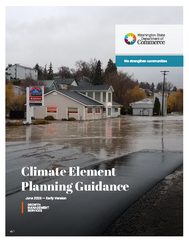
Climate element planning guidance now available
The Washington State Department of Commerce, in partnership with other state agencies, tribes, and local planners, has developed an early climate element planning guidance to help cities and counties address climate change in their comprehensive plans. It's a good time to learn about it: Commerce will be providing $30 million in grants over the next 6 years to support communities developing climate elements. Learn more. Download the guidance. View the interactive dashboard.
|
Interactive tool makes brownfield assessment & cleanup costs public
An interactive Analysis of Brownfields Costs (ABC) Tool from Kansas State University TAB provides available data from multiple sources and helps you make initial brownfields redevelopment and planning decisions. You can slice and dice the data to understand how different factors affect brownfields cleanup costs. Learn more.
National Environmental Youth Advisory Council
The National Environmental Youth Advisory Council (NEYAC) is an exciting opportunity for young people between the ages of 16-29. This group of passionate young leaders from across the country will provide advice and recommendations on environmental issues directly to the head of the EPA. The NEYAC will include sixteen members, and anyone can apply themselves or nominate someone else. Selected applicants who become members are appointed to NEYAC for a two-year term.
For more information, visit National Environmental Youth Advisory Council.
 Do you have a brownfield project?
|