View this e-bulletin in your browser.
What you'll find in this issue:
- How recent Safe Routes to School projects are enhancing communities
- Calls for projects: Pedestrian/Bicyclist and Safe Routes to School Programs
- A new resource for evaluating grant program application elements
- Legislative bill tracking
- Recommendations for things to read/watch/listen to
- Events and trainings to keep on your radar
- Grants and funding opportunities
- Opportunities to present and publish
- Surveys to take
- Plenty of useful resources!
Year in Review (and Opportunity Open Now) – The WSDOT Safe Routes to School Program
We’re reflecting on recent outcomes of our active transportation funding programs. Review the highs of our Pedestrian/Bicyclist Program in last month’s edition of this newsletter .
Every stretch of sidewalk and block of bike lane we’re able to fund improves all of our lives. But some projects matter most to the smallest and most vulnerable among us. This is the focus of our Safe Routes to School Program (SRTS, RCW 47.04.300 ), which directs dollars to projects that help children walk, bike and roll more safely to and from school and just launched a new call for projects (applications due April 15).
SRTS has supported hundreds of local and tribal partners’ improvement projects around the state since launching in 2005. As with the Pedestrian/Bicyclist Program, SRTS’s total investment in local agency and tribal partner projects has nearly doubled since 2020. This is due largely to Climate Commitment Act revenues and action by the Washington State Legislature to support clean transportation, climate resiliency programs and address health disparities in cities and counties and with tribes across the state.
In 2025, the Washington State Legislature awarded nearly $55 million to 32 projects. Half (16) of these projects serve overburdened communities, which were also the areas of the state served by the AT Assistance Program. The projects span every region in the state, serving rural population centers in counties and towns as well as cities.
As we gear up for another funding round, we’re highlighting what programs like SRTS can accomplish.
Example Projects Completed in 2024-2025
Note: You may already be familiar with great SRTS projects in your community or region that are already serving the public with new infrastructure. The following examples are fully closed out through WSDOT Local Programs and therefore marked as complete in our system. Photos below are from Google StreetView unless otherwise noted.
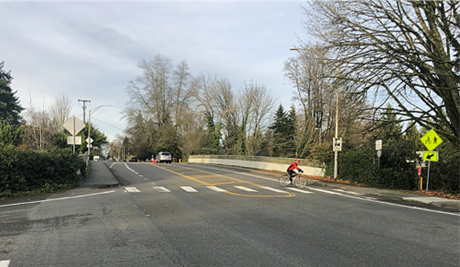 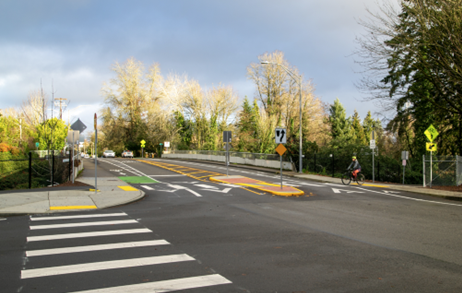 Courtesy of the City of Olympia
Olympia’s Boulevard Road Trail Crossing and Bike Corridor Safety Improvements
Award year: 2021
Project completed: 2025
Olympia made the following improvements, connecting a city bicycle boulevard from downtown through the east-side neighborhood to the regional shared-use path/trail system: ‘Stop here for pedestrians’ sign (in-street), marked crosswalk (includes illumination), median refuge island, pedestrian crossing advance stop bars, reduced curb radii, raised crosswalk, median channelization/turn restrictions, ADA curb ramp retrofits, bicycle boulevard conversion, bicycle wayfinding signs and markings, standard and protected bike lanes, sidewalk with curb, bollards or path barriers and shared-use path.
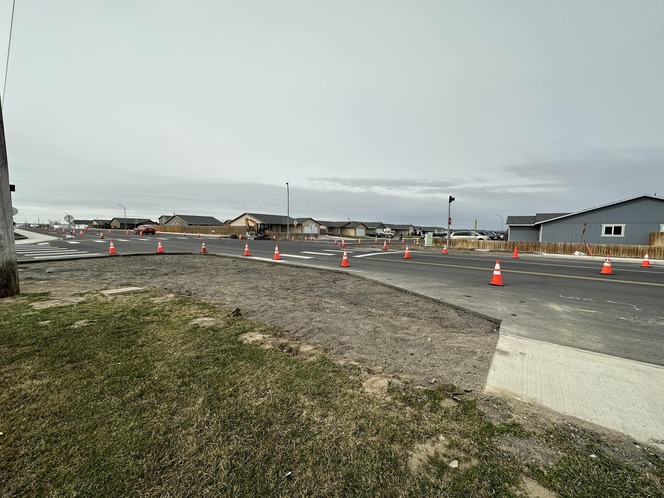 Courtesy of Othello School District
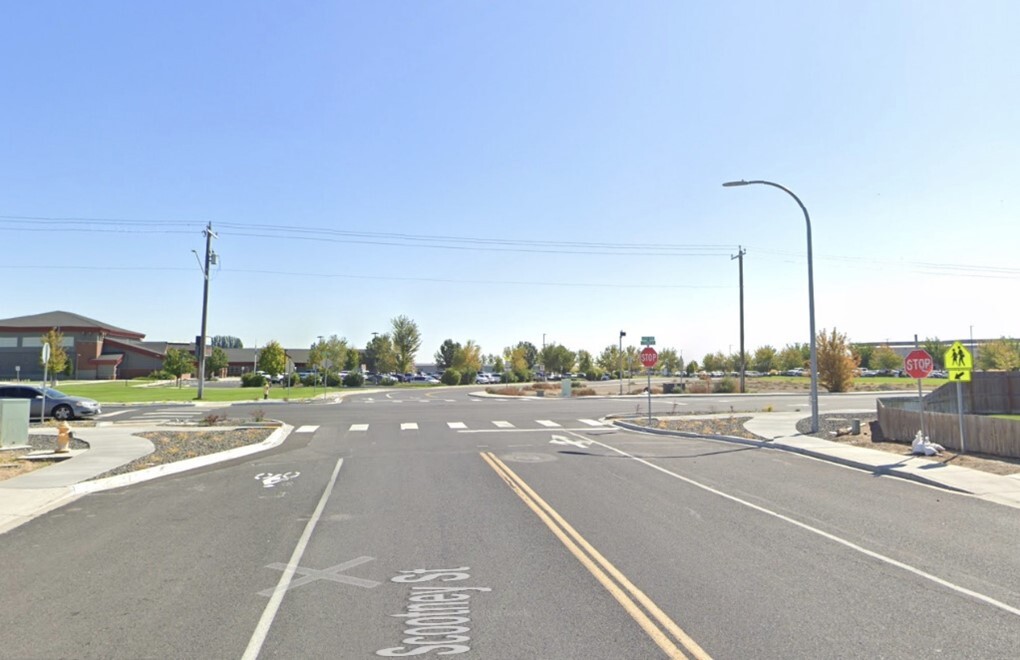 Othello’s Scootney & 14th Wahitis Elementary Pedestrian Safety Improvements
Awarded: 2021
Project completed: 2024
This project installed curb extensions, lane width reduction, road reconfiguration pavement markings, ADA curb ramp retrofits, and pedestrian-scale lighting to connect residential areas better to the elementary school. This builds on several curb extensions installed through a previous award (Ash Street Safety Improvements - SRTS 2019) to support walking and rolling for three other nearby schools.
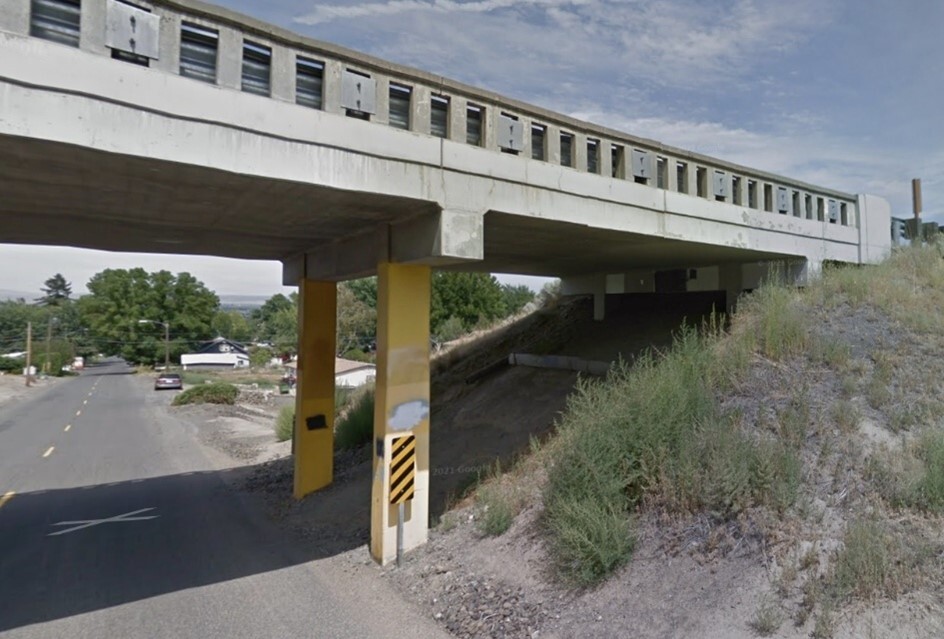 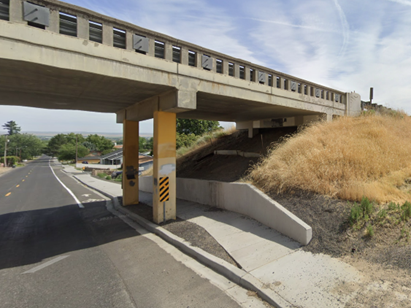 Prosser’s Kinney Way Improvements
Award year: 2021
Project completed: 2024
Prosser installed marked crosswalk, a pedestrian over/under pass, school speed zone flashing beacons and signage, ADA curb ramp retrofits, sidewalk with curb, and bike lane, connecting a 100+ residence neighborhood south of State Route 22 to an elementary school and parks and offering an active transportation route for a larger part of the west side of the city.
Tips for applying to our Safe Routes to School and Pedestrian/Bicyclist Programs:
-
Get to know our programs: Local agency and tribal government partners use these grants to fund construction of a range of active transportation treatments. The Safe Routes to School Program also funds education and encouragement activities that provide students with meaningful information and skills for walking, biking and rolling to school.
-
Double-check the deadlines: These calls are opportunities for local and tribal partners to submit applications for projects that would begin in the first year of the 2027-2029 biennium, with funding available starting as soon as July 2027. The calls for projects are open and run through midnight on April 15, 2026, for both the Pedestrian/Bicyclist and Safe Routes to School Programs. Applicants will find links to all necessary application information on each program’s respective web page (including getting signed up for webinars and application trainings in February).
-
Consult affected tribes: In this upcoming call for projects, we expect applicants to have completed tribal consultation with any federally recognized tribes affected by a project before submission, per the Climate Commitment Act (RCW 70A.65.305).
-
Work on your schedule: Applicants can complete PBP and SRTS applications in stages rather than all at once. The application website allows you to start, save and return to application(s) during the open call for projects time period.
-
Ask questions early: Please direct any questions to the WSDOT ATD Grants Mailbox (ATDGrants@WSDOT.WA.GOV). We look forward to reviewing your applications and continuing to support investments of funding and technical assistance for jurisdictions building safer, more equitable communities.
For more information on the status of all PBP and SRTS projects, plus the full range of funding programs and projects, please review the 2025 WSDOT Active Transportation Funding Programs Legislative Report.
New Resource: Rubric for Evaluating Active Transportation Design at Crossings
You've read the Active Transportation Programs Design Guide. You're ready to submit an application to one of our grant programs that accounts for our design recommendations. And as of December, you have more information to help you understand how your application might rank.
Say hello to our new Rubric for Evaluating Active Transportation Design at Crossings. This new tool supplements the Programs Design Guide by showing how the grant programs evaluate proposed intersection designs within an application. Our evaluation approach is meant to help communities achieve low traffic stress for people when they walk, bike and roll across intersections and midblock crossings.
Tracking Bills in the 2026 Legislative Session
The Washington State Legislature began the 60-day 2026 legislative session January 12. You can search for bill copies, detailed legislative reports, and other information at the legislature's bill information page.
Policy bills introduced so far that have some bearing on active transportation include:
We add new trainings as we find them, so the list changes with every issue. Some of these offer continuing education credits. All times are shown in Pacific Standard Time.
All items are webinars unless a location is noted.
January
February
- Feb. 10, 10 a.m. Working Together for Safer Responses: Collaboration Strategies for EMS and Highway Safety Partners (FHWA)
- Feb. 17, 10 a.m.: WSDOT Pedestrian/Bicyclist and Safe Routes to School Orientation and How to Apply Webinars (WSDOT)
- Feb. 18, 12 noon: Daylighting in Austin: A Proactive, Data-Driven Approach to Safer Intersections (APBP – Fee)
- Feb. 19, 10 a.m.: Beyond the Banks: Leveraging Levees for Trails, Recreation, and Resilience (American Trails – donations appreciated)
- Feb. 19, 11 a.m.: WSDOT PBP/SRTS Programs Design and Evaluation (WSDOT)
- Feb. 25, 10 a.m.: Looking Ahead to 2026: Trails, Transportation and the Midterm Elections (Rails to Trails Conservancy)
March
- March 12, 10 a.m.: Bridges and Boardwalks: Planning, Design, and Construction (American Trails – donations appreciated)
- March 17 - 20: 2026 Bicycle Leadership Conference (Dana Point, CA, People for Bikes)
- March 18, 10 a.m.: Leveraging Unobligated Funding: How to Fund Your Trail with Unspent Federal Funding (RTC)
- March 18, 12 noon: War for the Curb in the Age of Accessibility and Mobility (APBP)
- March 24 - 26: National Bike Summit (Washington, DC, League of American Bicyclists)
- March 26, 10 a.m.: Harnessing Communications to Educate and Engage Community of Trail Volunteers (American Trails – donations appreciated)
Save the Date (The following events typically require registration, fees, etc.)
- Apr. 1 - 3: Bike, Walk, Roll Summit (Wenatchee, WA, Cascade Bicycle Club and partners). Early bird deadline: January 31.
- Apr.14 - 16: 2026 Sustainable Trails Conference (Boise, ID, Professional TrailBuilders Association)
- Apr.19 - 21: 2026 Lifesavers Conference on Roadway Safety (Baltimore, MD, Lifesavers Conference, Inc.)
- May 11 - 14: 2026 National Outdoor Recreation Conference (Duluth, MN, Society of Outdoor Recreation Professionals)
Keep track of all of the USDOT’s discretionary funding opportunities at the DOT Discretionary Grants Dashboard. Also, a full listing of pedestrian- and bicycle-related federal funding programs is available through FHWA.
Have any funding opportunities people should know about? Send them to WSDOTActive@wsdot.wa.gov.
Have an upcoming project, open house, public comment opportunity? Construction projects people should know about as they relate to biking/walking? Compliments on a project? Send to WSDOTActive@wsdot.wa.gov.
Calls for papers/presentations/abstracts:
Calls for applications/expressions of interest/nominations:
We share new papers, established databases, thoughtful essays, and even older research that was ahead of its time. If these are helpful to your existing work or spark a new project: Email WSDOTActive@wsdot.wa.gov to let us know!
If you read this far, thank you! You're finding something of value here and you know someone else who should receive this kind of news. Forward WSDOT Walk and Roll to others and share the subscription link on social media (tag it #WSDOTactive).
Hannah Weinberger
Communication Lead, WSDOT Active Transportation Division
hannah.weinberger@wsdot.wa.gov
|



