View this e-bulletin in your browser.
What you'll find in this issue:
- WSDOT Complete Streets progress report
- Status update about WSDOT's Pedestrian/Bicyclist Program
- Recap of Rails to Trails Conservancy webinar on partnering with state governments
- Recommendations for things to read/watch/listen to
- Events and trainings to keep on your radar
- Grants and funding opportunities
- Opportunities to present and publish
- Surveys to take
- Plenty of useful resources!
Streets that have it all: Our progress with Complete Streets
If you're reading this newsletter, you likely value having travel options. Depending on your destination, biking might be an efficient and healthy option. Transit might get you there without the hassles of parking. If you have access to a car, you may sometimes prefer to drive. And sometimes you may weave all of these methods into one multimodal trip.
Normalizing multimodal roads means helping everyone get from A to B while keeping the whole system more resilient. Systems that account for every traveler help us achieve goals like fewer vehicle miles traveled, cleaner air and water, increased foot traffic to local businesses, transportation cost savings, more transportation independence for people of all ages and abilities, and much more. A transportation system that anticipates travelers' different and changing needs can make all the difference.
One thing helping us expand Washingtonians' transportation choices is implementing the Complete Streets requirement state legislators passed three years ago. We recently published our first-ever report on how that implementation is going. It offers windows into not just how our streets are becoming more multimodal, but how agencies like ours can organize to make it happen.
What is the Complete Streets requirement? The requirement considers the needs of people walking, biking, rolling and using transit in state transportation projects. Legislators ask us via the requirement to review and address whether state transportation projects create more comfortable, safer access for everyone no matter how they get around. The Complete Streets requirement supports the state transportation policy goals and those expressed in the Washington State Active Transportation Plan. These include a need for streets that support safe, connected and accessible transportation for people who walk, bike and roll.
In only a few years, hundreds of staff have collaborated to develop and adopt new policies and workflows. Today, we're considering these needs all across the state.
What does it mean to implement this requirement? Staff first screen whether the project is located where people are likely to and would benefit from walking, biking and rolling.
Next we get together with community members to discuss what facilities would meet their needs in a stage known as pre-design. It's important for us to develop these projects with community members rather than make choices for them.
When we come out with an agreeable design, it's off to final design and construction. This can take time.
 Complete Streets project locations from July 1, 2022, to July 1, 2025
So how many projects are being considered? A lot. We've already evaluated nearly 1,000 projects and determined 35 percent of them meet criteria for Complete Streets development.
As of July 2025, 31 projects had completed pre-design, 17 completed design, and the first four projects to go all the way through the process went to construction this summer.
What have you learned from implementing the requirement? A lot, again! Some things that are top of mind:
-
It's an opportunity to reassert commitment to active transportation. With hundreds of staff learning about and participating in the Complete Streets process, we're not only spreading awareness about Complete Streets to partners across the state but also affirming that developing active transportation is everyone's job.
-
We're strengthening relationships. The systems we set up to collaborate on Complete Streets are strengthening relationships all around the agency and beyond. We’re building stronger relationships with communities and partner organizations through earlier, more frequent engagement. We plan with residents to build facilities they want.
-
We're finding ways forward. It takes work and resources to find designs that everyone likes, and it takes funding to get those designs in the ground. We're working to increase capacity inside and outside of the agency so that communities are ready for us when projects do get funded. That takes the form of everything from technical assistance to communities developing active transportation plans or projects that might connect with future Complete Streets projects, to workshops that help our staff become even better at engagement.
Every project that improves, adds or connects walking and bicycling facilities will change what is possible for Washingtonians, and we're excited to see relationships and skills building before we're even able to get on site our shovels. We can't wait for what 2026 has in store!
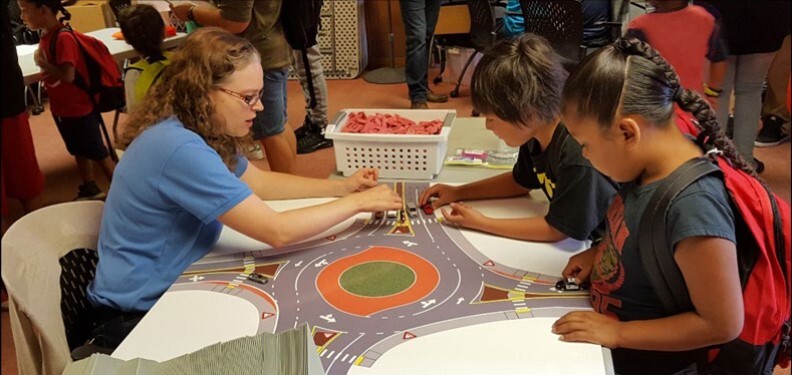 Children learning how to navigate a roundabout at a South Central Region event.
The Pedestrian/Bicyclist Program: Past and present
The end of the year is a great time to reflect on our active transportation programming past and future. We’ve been thinking a lot about our Pedestrian/Bicyclist Program (RCW 47.04.430), which will be putting out a call for projects soon!
This grantmaking opportunity has supported hundreds of projects improving safety and mobility for people walking and bicycling in the two decades since it launched. However, the PBP’s total investment in local agency and tribal partner projects nearly doubled just within the past two funding cycles. This is due to Climate Commitment Act revenues and the Washington State Legislature’s approval of transportation budgets providing resources to this and other active transportation programs.
We’ve been hard at work putting this funding to use in collaboration with our partners, and there’s a lot to celebrate. In 2025, the Washington State Legislature awarded over $50 million to 24 projects. Most (20) served overburdened communities, and a substantial portion (25 percent) were awarded to tribal governments, plus others benefiting from the new AT Assistance Program. The projects span every region in the state, serving rural population centers in counties and towns as well as cities.
Recently completed projects
You may already be familiar with great PBP projects in your community or region that are already serving the public with new infrastructure. The following examples are fully closed out through WSDOT Local Programs and therefore marked as complete in our system. Photos below are from Google StreetView.
Kenmore’s wayfinding and connectivity improvements
Award year: 2021
Project completed: 2024-2025
Kenmore installed pedestrian lighting, green pavement markings, rectangular rapid flashing beacons, lane width reduction, wayfinding signs, buffered bike lanes and vehicle access control at a crossing to the popular Burke-Gillman Trail shared-use path.
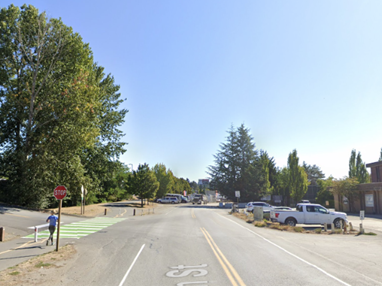 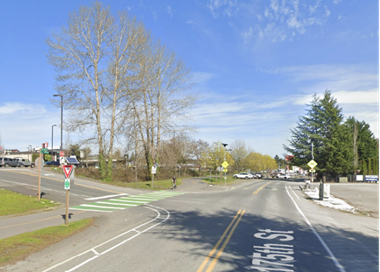 Spokane Valley’s Sprague Avenue pedestrian hybrid beacon
Award year: 2022
Project completed: 2025
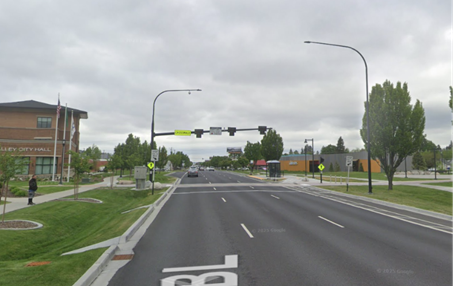
This project completed a mid-block crossing of the major arterial Sprague Avenue supported with a pedestrian-hybrid beacon. It provides an important north-south connection between the Appleway Trail, Spokane Valley City Hall, a park and restaurant destinations on the other side of the multi-lane crossing. The project includes pedestrian countdown and accessible pedestrian signals. The city reduced the number of motor vehicle lanes on this portion of Sprague Avenue and added a buffered bike lane, further supporting active transportation in this central city area.
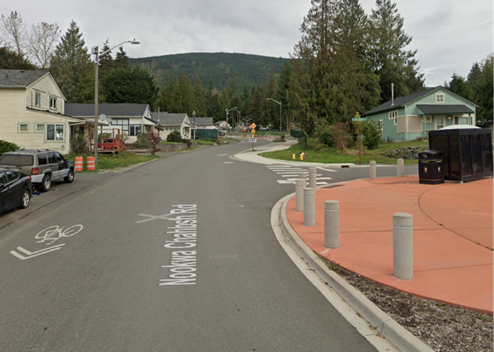
  Upper Skagit Indian Tribe (USIT)’s Nookwa-Chahbsh Lane safety improvements
Award year: 2019
Project completed: 2024
This project installed a pedestrian path, curb ramps, marked crosswalks, a raised crosswalk and shared lane markings for the main residential community of the Upper Skagit Indian Tribe.
The USIT has since successfully secured PBP funds for another project (2025 award). These funds will support improvements connecting the earlier project along the main road entering the reservation and connecting to services and other destinations there. Known as the Coyote Drive Pedestrian Safety Project Improvement Project, it includes a 20 MPH speed zone, lane width reduction, raised crosswalks, curb extensions, pedestrian and bicyclist lighting, ADA curb ramps, a shared-use path and more.
Before picture unavailable.
 Vancouver’s Devine Road Bicycle and Pedestrian Safety Project
Award year: 2019
Project completed: 2024
This project installed sidewalk with a curb and gutter, pedestrian-activated flashing beacons, a shared-use path, a bike lane and a traffic barrier. The project connects neighborhoods along North Devine Road to the Burnt Bridge Creek Trail system. This provides all-ages access from neighborhoods along Mill Plain Boulevard to many destinations including parks, retail areas and schools in various parts of Vancouver.
  Tips for applying for our grant programs:
-
Dialogue with us: If you’re working on a state-route-involved project application, start a conversation with us if you haven’t already. . Visit the WSDOT PBP webpage to review 2027-29 applicant guidance.
-
Consult affected tribes: In this upcoming call for projects, we expect applicants to have completed tribal consultation with any federally recognized tribes affected by a project before submission, per the Climate Commitment Act (RCW 70A.65.305). Work on your schedule: Applicants can complete PBP and SRTS applications in stages rather than all at once. The application website allows you to start, save and return to application(s) during the open call for projects time period.
For more information on the status of all PBP projects, plus the full range of funding programs and projects, please review the 2025 WSDOT Active Transportation Funding Programs Legislative Report.
Building relationships with your state DOT - Webinar recap
If you’re passionate about active transportation advocacy, it’s worth building relationships within your state department of transportation.
That’s a key message of a recent Rails to Trails Conservancy (RTC) webinar panel, which explored how establishing these relationships can get more active transportation projects done. ATD Division Director Barb Chamberlain joined RTC external relations strategist Ken Bryan on the panel moderated by state agency advocacy specialist Kim Chesser, also of RTC. With a primary audience of advocates on the call, the panelist discussed both steps to build these relationships and the relationship between state DOT work and federal funding decisions.
Highlights:
-
Keep the funding asks coming: Chesser shared concerns about national-level organizations’ perceived caution when it comes to requesting transportation funding reauthorization. This may run counter to maintaining the flow of federal Transportation Alternatives resources that have been key to supporting active transportation infrastructure development (trails in particular) across the country. The panelists responded that sometimes those associations do have to take a middle-of-the-road stance, and so the opportunity lies in building up support in the various members (state legislators and DOTs) to give more weight or voice to the needs of people using active transportation. Both Chamberlain and Bryan indicated a groundswell of support from communities and local governments is crucial in this process. A state DOT can reflect that support, especially if policymakers (state legislators) are also supportive. Both Washington and Florida were cited as examples of states where there is such a local groundswell and the support for AT runs across party lines.
-
There’s more than one way to provide support: With experience both inside and outside of state governments, the panelists shared stories noting the many avenues to get involved with improving active transportation. They offered tips on identifying and getting involved in processes that steer a high proportion of funding for active transportation around the country. It’s useful to know who your state’s bike-ped coordinator is connect with them.
-
Tipping scales: Chamberlain emphasized taking time to understand the trade-offs that state officials may be facing. For instance, maintenance and preservation of roadways and other transportation infrastructure is chronically underfunded.
-
Show, don’t tell: Chamberlain also noted how important it is to get out and visit places with elected and other state officials (a bike ride, a trail event), so that they can experience the active transportation needs first-hand.
-
Shape the plans: The panelists noted the importance of being part of and shaping physical plans, the written roadmaps of what investments will be and where they’ll be built. Activities to consider include making comments on plans and offering to be on committees advising an agency or legislature on defining plans or policies. Chamberlain recommended putting walking and bicycling considerations into as many plans (as well as assessments and standards) as possible. She also recommended finding opportunities created by requirements, such as the Federal Highway Administration’s requirement of states to do vulnerable road user safety assessments.
-
Getting on well: The panelists differed in their views on how well state governments have supported active transportation, both value maintaining good relationships with state DOTs. This includes remaining respectful even when strongly disagreeing with a state decision or policy. This builds trust for your group and therefore its cause, and keeps the communications lines open. (Tip: Try to give a heads up to your key contacts at the state when you are going to take a stand, issue a press release, etc. against something the state is doing.) Lead with your questions rather than criticism and applaud jobs done well. Cast a wide net: You may have more options for allies than you realize. Panelists recommended thinking about how your project or policy concern could connect with or address other groups’ needs. When your win is a win for everyone, your project could support not just active transportation but also healthy communities, aging in place, traffic safety, disability mobility and beyond.
Catch the whole presentation at RTC’s Resource Library webpage for this event.
Annual Report on Active Transportation Safety available
The Cooper Jones Active Transportation Safety Council, supported by WSDOT and the Washington Traffic Safety Commission, has sent its 2025 ATSC Annual Report to the Washington State Legislature. Read the report to know more about the Council’s work, a summary of fatal case reviews and a variety of recommendations related to the Safe System Approach.
We add new trainings as we find them, so the list changes with every issue. Some of these offer continuing education credits. All times are shown in Pacific Standard Time.
All items are webinars unless a location is noted.
January
Save the Date (The following events typically require registration, fees, etc.)
- Mar. 24 - 26: National Bike Summit (Washington, DC, League of American Bicyclists)
- Apr. 1 - 3: Bike, Walk, Roll Summit (Wenatchee, WA, Cascade Bicycle Club and partners). Early bird deadline: January 31.
- Apr.14 - 16: 2026 Sustainable Trails Conference (Boise, ID, Professional TrailBuilders Association)
- Apr.19 - 21: 2026 Lifesavers Conference on Roadway Safety (Baltimore, MD, Lifesavers Conference, Inc.)
- May 11 - 14: 2026 National Outdoor Recreation Conference (Duluth, MN, Society of Outdoor Recreation Professionals)
- Washington State’s Freight System Plan (FSP) is open for public comment. WSDOT seeks your input on freight needs, challenges, and opportunities throughout the state. Visit the online open house. Your response to the survey you can find there is due January 30.
- Puget Sound Regional Council is seeking public comment for the update to the Regional Transportation Plan for the central Puget Sound area. Find the Plan and collecting feedback link by visiting the Plan’s Engagement Hub webpage. Comments due by February 2.
Have an upcoming project, open house, public comment opportunity? Construction projects people should know about as they relate to biking/walking? Compliments on a project? Send to WSDOTActive@wsdot.wa.gov.
Calls for papers/presentations/abstracts:
Calls for applications/expressions of interest/nominations:
We share new papers, established databases, thoughtful essays, and even older research that was ahead of its time. If these are helpful to your existing work or spark a new project: Email WSDOTActive@wsdot.wa.gov to let us know!
If you read this far, thank you! You're finding something of value here and you know someone else who should receive this kind of news. Forward WSDOT Walk and Roll to others and share the subscription link on social media (tag it #WSDOTactive).
Hannah Weinberger
Communication Lead, WSDOT Active Transportation Division
hannah.weinberger@wsdot.wa.gov
|



