Vocational Recovery Advisory Committee 2025 Year in Review
As 2025 draws to a close, members of the Vocational Recovery Advisory Committee (VRAC) wish to share an update with the vocational community about our activities, priorities and expectations for the coming year.
The Washington State Department of Labor & Industries (L&I) established the VRAC to maintain a consistent culture of continuous improvement by partnering with representatives of the private sector vocational rehabilitation community. The committee works to identify, prioritize, and take actions on recommendations that elevate vocational services within the Washington workers’ compensation system.
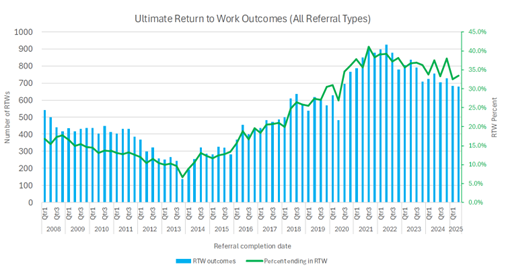
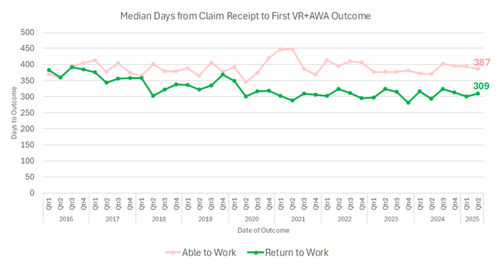
It has been five years since the rollout of a significant transformation in the delivery of vocational services. Since that time, we have seen:
- An increase in the total number of return-to-work outcomes.
- A decrease in the time it takes to achieve return-to-work outcomes.
 This accomplishment reflects our shared commitment. Thanks to all of you for the care you put into this work.
We know that workers who do not return to work quickly struggle to exit our system. In the last year:
- There has been an increase in the number of workers who reach long-term disability (time-loss paid in the 12th month following an injury).
- Fewer workers progress to vocational retraining, but a greater proportion of those who do have additional barriers, like limited English proficiency, at the start of plan development.
The longer workers are in our system, the less likely they are to return to full employment and economic self-sufficiency.
These principles drove our work this year and contribute to our thoughts for the future.
Focus areas of 2025 included:
- Developed and implemented strategies to support skill development earlier in vocational recovery, as outlined in, through Skill Enhancement Training (SET).
- Improved the exchange of feedback between L&I Vocational Services Specialists and Vocational Rehabilitation Counselors (VRCs) by revising the structure of the VRC feedback list.
- Coordinated with L&I’s Interpreter Services to understand the experience of vocational providers and addressed service gaps for in-person and telephonic interpretation services.
- Planned, hosted, and facilitated L&I’s second Quality Assurance Leadership Conference with statewide vocational firm managers.
- Evaluated and made recommendations to the non-cooperation process to improve collaboration between VRCs and Claim Managers on claims that face participation concerns.
As we look to 2026, VRAC has identified areas of interest to focus on.
2026 VRAC priorities include:
- Review and evaluate our quality assurance elements, including a specific focus on AWA, Plan Development, and Plan implementation. Also, identify actionable recommendations as appropriate.
- Utilize and promote best practices for identifying and engaging training providers and training modalities, particularly as we seek to expand Skill Enhancement Training as a tool for return to work.
- Explore factors that contribute to claim duration, and make recommendations, as appropriate.
- Facilitate educational opportunities, including webinars, bulletins, quality assurance leadership, and vocational provider professional development opportunities.
- Continue to develop improvement strategies for effective claims management, such as the non-cooperation process, out-of-state and out-of-country guidance, vocational service specialist feedback loop, and more.
Engaging with VRAC:
We appreciate your engagement and feedback. There are a few ways you can stay informed about the actions of the Vocational Recovery Advisory Committee:
Special thanks to the private sector vocational rehabilitation counselors who volunteered their time and expertise in support of the 2025 work priorities. Your commitment and contributions strengthen the vocational community, support workers, and enhance the overall system.
|




