 |
|
TIRES
(Trucking Injury Reduction Emphasis)
The TIRES research team is working with industry leaders, safety and health professionals, employers, drivers, warehouse and dock workers, and many others to develop educational materials that identify hazards and provide low-cost, simple solutions to prevent injuries in the trucking industry. Learn more about TIRES.
|
|
|
|

 Did you know? All employers are required to have a formal, written accident prevention program (APP). The APP is sometimes referred to as a safety and health plan.
Why is it important? Besides keeping your workers safe, not having an APP is one of the most cited safety violations during inspections.
It must be tailor-made. Your APP must effectively address the hazards relevant to your particular company or that may be encountered by your employees.
Don’t assume anything. Many times employers or safety directors assume they have an APP on a shelf somewhere. It’s safer to assume that if you are not consulting your APP on a regular basis that you don’t have an effective one.
|
 What’s the issue? You want your employees to work safely. In fact you’ve developed an injury prevention plan, you train new hires, hold weekly safety refresher trainings, but your employees are still getting injured. What’s the deal?
Have you considered incentives that you may have unwittingly provided to employees that encourages cheating when it comes to safety? Here are some examples:
Not enough time to complete the task. Anytime rushing is involved, shortcuts will be taken.
Not the right equipment or it’s in poor repair. Do workers have to ‘make do’ with worn or wrong equipment? Make sure they have the right equipment to get the work done. Red tag broken equipment so it can’t be used until fixed.
|
 |
 The direct costs of injuries can be measured easily, but the indirect cost savings of preventing these injuries may be much greater than simply the workers’ compensation dollars. A positive safety climate can increase productivity and improve your bottom line.
Companies report an average 25% increase in productivity after implementing either a program or a control to address injuries to muscles, tendons and joints.
All interventions studied showed a positive impact on productivity.
|
 
 |
|
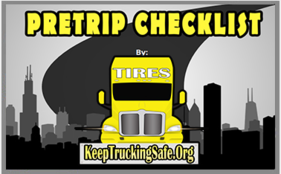
Pre-Trip checklist
This pre-trip simulation tool is intended to help those that are trying to become a truck driver or for experienced drivers that need to refreshen on their skills.
|
 
|
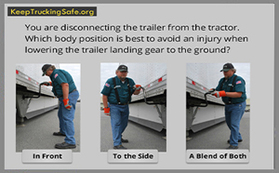
Landing Gear
This course teaches prevention of common upper extremities due to improperly lowering of a landing gear. See which body position is best to avoid an injury.
|
|
 |
 Click here to view more training simulations.

Slips, trips, falls
Strains & sprains (Musculoskeletal disorders)
Getting struck by or against an object
|
Does your input on safety matter?
Companies with positive safety cultures value the input of every employee, recognizing that those on the front line have a very different perspective than those in management. In these companies, workers and management work together to ensure the safest possible conditions. Remind workers that they too are responsible for keeping themselves safe at work.
Click here for safety poster
|
|
Tell me, do you feel lucky?
Luck should not replace playing it safe in the workplace. Often we feel the need to rush or we've done something risky so many times that we cease to recognize the danger. Take the time to re-evaluate your tasks, tools and methods.
Click here for the tip sheet
|
|
|
|
The Trucking Injury Reduction Emphasis (TIRES) project was developed by the Safety and Health Assessment and Research for Prevention (SHARP) program of Washington's Department of Labor & Industries. Contact us at TIRES@Lni.wa.gov
The Trucking Injury Reduction Emphasis (TIRES) project team and the TIRES steering committee are working with the Washington State trucking industry to identify causes for the most frequent injuries to develop effective strategies for preventing them.
The TIRES steering committee is made up of a diverse group of professionals that includes: drivers, safety people from large and small trucking companies, labor and business associations, insurers and a representative from a publicly funded truck driving school.
Funded in part by a grant from CDC NIOSH 5 U60 OH 008487. The contents are solely the responsibility of the authors and do not necessarily represent the official views of CDC/NIOSH.
© Washington State Department of Labor & Industries.
Access Agreement | Privacy & Security Statement | Intended Use/External Content Policy
|