|
ESTUARY AND SALMON RESTORATION PROGRAM NEWSLETTER |
|
ESRP grant round opens Oct. 2, 2026 |
|
|
The Estuary and Salmon Restoration Program (ESRP) administers four distinct grant programs:
- Beach Restoration Small Grants – RFP to be released Oct. 2, 2025
- Restoration and Protection – RFP to be released Nov. 19, 2025
- Regional Pre-Design (e.g. Learning) – RFP to be released Nov. 19, 2025
- Shore Friendly – No RFP this grant round
Every two years, the ESRP team issues RFPs for each program with a unique application and review process. The ESRP team combines the results of each program’s evaluation process to create a singular prioritized project list, referred to as the ESRP Investment Plan. This list is presented to the Legislature by RCO for funding consideration during the biennial budget process.
The ESRP staff team is pleased to announce several significant changes in advance of the upcoming 2025-2026 grant cycle. Most notably, match is eliminated for all ESRP grant programs in the 2026 grant round. In communicating with current ESRP sponsors, we acknowledge the rapidly changing funding landscape and the great deal of uncertainty this presents in planning for and implementing projects. For now, the elimination of match is temporary. We will evaluate the change and speak with sponsors to understand if this is something we wish to make permanent for the program in future grant cycles. Please read on below for a summary of changes by ESRP grant program.
We will review all changes to the ESRP grant programs as well as the process and timeline for applications during our annual grant round informational webinar on Wednesday, Nov. 19 from 9-11 a.m.
Beach Restoration Small Grant Program
- The name of the Small Grants Program is changed to Beach Restoration Small Grants Program to more accurately reflect the shoreform we are targeting with these grants.
- To keep up with real costs, we are increasing the grant cap per landowner from $150,000 to $350,000 per property. There is no maximum funding request per application, nor is there a limit on the number of individual project properties within a proposal.
- We are eliminating the total award cap to incentivize multi-parcel projects, which reduces the administrative, engineering, and permitting costs per project.
- We are removing acquisition as an eligible grant activity. These projects are intended to serve as demonstration sites for neighboring property owners and other marine waterfront landowners. Acquisition does not support the goal of demonstration on existing property and is better suited for ESRP’s Restoration and Protection Program.
- The Beach Restoration Small Grants RFP will be released earlier and final applications due later to allow ample time for sponsors to coordinate with landowners.
Restoration and Protection Grant Program
- With the elimination of match, there will be an ESRP award cap of $3 million. This level is based on previous grant award amounts, as well as an assessment of ESRP’s historic appropriation levels.
Regional Pre-Design (Learning) Grant Program
- There is no award cap – but we strongly encourage projects to be under $350k and suggest phasing projects that require additional funding. This funding level is based on previous grant award amounts, as well as an assessment of ESRP’s historic appropriation levels.
Please consider reaching out to our ESRP team if you have questions or are thinking about applying in the upcoming grant round:
For questions on how to apply or getting set up in PRISM, please contact ESRP’s RCO grant managers:
|
|
2025-2027 ESRP FINAL INVESTMENT PLAN |
|
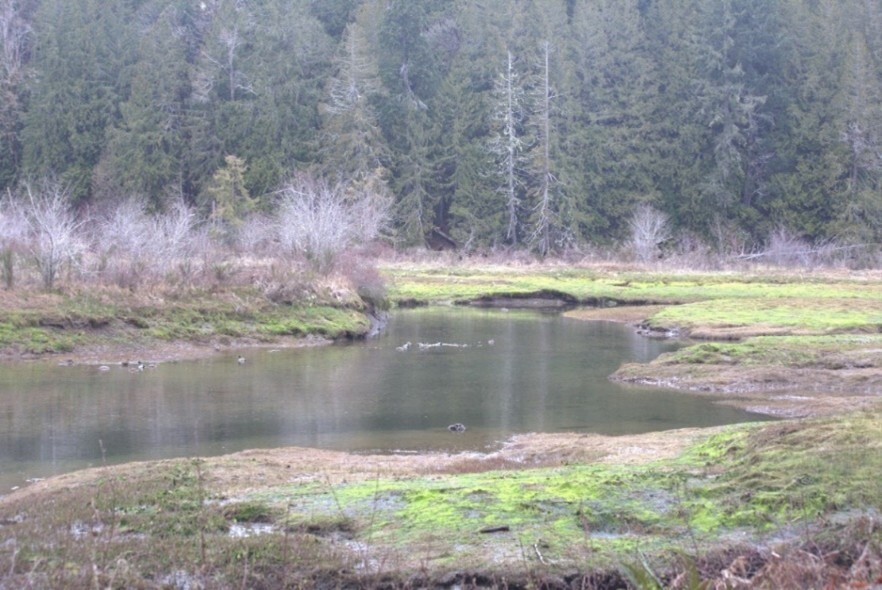 A view of the Dewatto Estuary in Mason County, which will be protected by Great Peninsula Conservancy with ESRP grant dollars (PRISM #24-1280). Image courtesy Erik Steffens.
On May 20, Gov. Ferguson signed the 2025–27 state budget into law. The Estuary and Salmon Restoration Program (ESRP) announced $14.6 million in state capital funding for 25 projects identified on our 2025-27 Final Investment Plan. We’re also excited to say that our team has been busy negotiating contracts for projects funded through the 2024 Supplemental Budget in which ESRP received an additional $10.2 million for projects identified on our 2023-25 Investment Plan. As always, we appreciate the effort of the more than 50 regional technical reviewers who donate their time and expertise in science, policy, and restoration implementation to help prioritize project proposals. Congratulations to all the successful 2025-27 ESRP project sponsors! We look forward to supporting and promoting the important work you are doing for Puget Sound nearshore recovery.
|
|
PROJECT HIGHLIGHT: ROSE POINT EMBAYMENT RESTORATION |
|
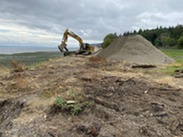
The Rose Point Embayment Restoration project, is a recently completed restoration of a historic barrier embayment in in North Kitsap County. Sponsored by Mid-Sound Fisheries Enhancement Group, what started as a Shore Friendly bulkhead removal assessment, grew rapidly into a large estuary restoration.
The Rose Point Embayment Restoration project, is a recently completed restoration of a historic barrier embayment in in North Kitsap County. Sponsored by Mid-Sound Fisheries Enhancement Group, what started as a Shore Friendly bulkhead removal assessment, grew rapidly into a large estuary restoration.
The historical T-sheets from the late 1800s Government Land Office show that the site was once a barrier embayment protected by two parallel spits with extensive salt marsh fed by a freshwater stream coming down the hillside. The land was cleared for agriculture and, by the 1940s, there was an orchard and pastures. Four rental cabins were located on the northern spit with bermed pathways leading across the marsh to the beach. Coastal embayments are important to migrating fish and birds as they provide stepping stones of protected habitat along their journey. Restoring this site was identified as one of the top 10 priority nearshore restoration projects in the Kitsap Peninsula in 2016.
A few years back, the property owner with the bulkhead, approached the local Washington Department of Fish and Wildlife habitat biologist and was interested in removing the bulkhead. The biologist put him in contact with the local Shore Friendly program, which is funded through the Estuary and Salmon Restoration Program. With a Shore Friendly Kitsap mini-grant, the landowner received a coastal/geotechnical feasibility report and a conceptual design for removal. The Shore Friendly Program contacted neighboring landowner to evaluate their interest in removing the portion of the bulkhead that crossed their property, to which they agreed. Shore Friendly – through their partnership with Mid Sound Fisheries Enhancement Group, took over sponsorship of the project, seeking funding for design and construction.
Mid Sound saw that the project could be a larger, more comprehensive estuary restoration, and the project evolved into something much bigger, including stream, riparian, and fish passage restoration. Like many Puget Sound restoration projects, it received funding from multiple grants, including Salmon Recovery Funding Board, Puget Sound Acquisition and Restoration Fund, and the Family Forest Fish Passage Program. This project is a great example of how various targeted grant programs can be integrated to form a single holistic and complementary restoration project.
|
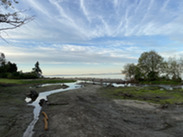
The Suquamish Tribe is a significant partner in this project, providing funding to design and implement septic relocation, supporting the fish out, and conducting pre- and post-construction monitoring to evaluate fish and wildlife response over time. And of course, none of this would have been possible without the two neighboring landowners who are stewarding the land and nearshore habitats they live on for generations to come.
With construction of the restoration completed in September 2024, this restored embayment can now support juvenile Chinook salmon as they outmigrate from Puget Sound in the spring and summer. It also provides potential to restart a small coho and chum run in the freshwater stream – something the North Kitsap Puget Sound Anglers are excited about as they are working upstream of the area on their own salmon restoration goals. For more details about the other funding sources, partners, and scope of this project, please visit the project webpage on the Mid-Sound Fisheries Enhancement Group website.
|
|
|
The mission of the Shore Friendly program is to reduce shoreline armoring in Puget Sound by providing residential landowners incentives to voluntarily remove shoreline armor, forgo armor replacement or installation, build new homes further back from the shoreline than required, and/or use armor replacement alternatives when partial site stabilization is required to protect landward structures. This program was adopted into the Estuary and Salmon Restoration Program (ESRP) in 2019 to increase the number of beach restoration projects in the ESRP capital investment plan.
Across the Puget Sound, Shore Friendly is implemented by six local programs who develop on-the-ground projects directly with willing landowners exploring options for healthy stewardship of their shoreline properties. The program achieves the mission through a variety of services, known as the “Shore Friendly Project Pipeline.” ESRP funds capital-eligible Shore Friendly services from Landowner Recruitment through Project Implementation Assistance.
|
 In addition to the capital funded Shore Friendly activities, the local programs have been very busy this year – conducting workshops for contractors, developing new educational outreach content for shoreline landowners, and developing curriculum for new workshops. The Northwest Straits Shore Friendly Program produced two new videos in their landowner series: Shore Friendly Living - Developing for Resiliency and Home Relocation for Coastal Resilience.
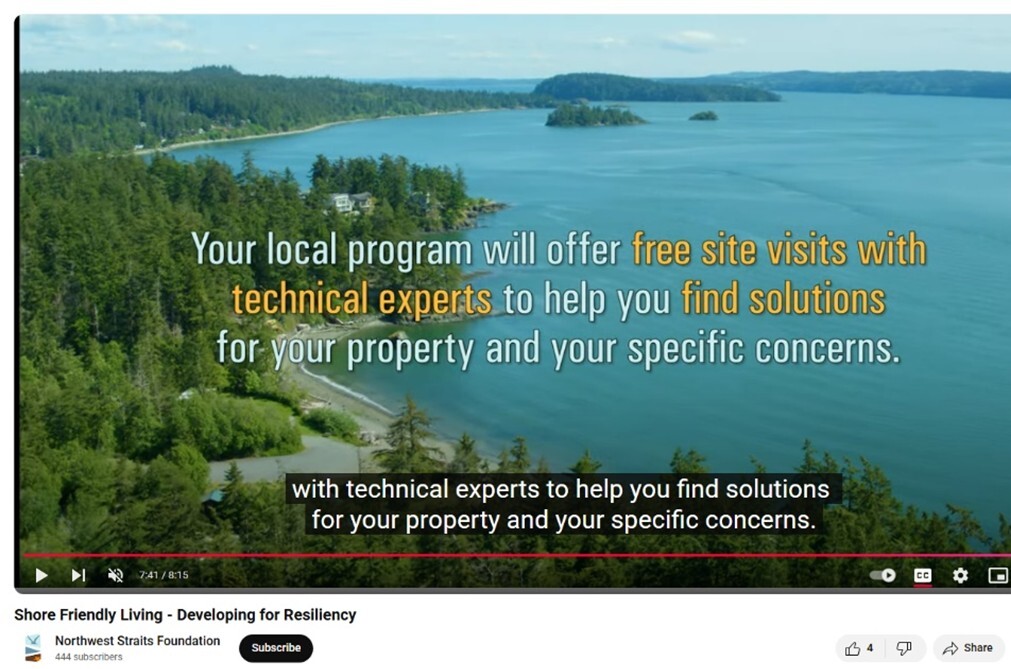 These videos demonstrate how Shore Friendly supports waterfront landowners in their decision-making process. Whether landowners are considering developing their property or they have existing homes, Shore Friendly offers cost effective alternatives to armor, such as setbacks, relocation, and elevation. The new videos and the contractor workshops were developed as part of a broader Shore Friendly communications effort funded by the Habitat Strategic Initiative Lead (HSIL) with EPA Puget Sound Geographic Program funds. The HSIL funding allows the six local Shore Friendly leads to expand their technical assistance services for shoreline landowners beyond what the ESRP capital budget can support.
|
|
ESRP LEARNING PROGRAM UPDATES |
|
|
We are thrilled to share that our ESRP Science Team has expanded to include Dr. Wendel Raymond and Dr. Brian Ulaski as part of a newly formed Nearshore Team in Habitat Science at WDFW. This expanded capacity in our shop will mean that for some learning projects, Brian or Wendel may be reviewing some deliverables, scopes of work, and/or participating in TAGs in collaboration with Dr. Tish Conway-Cranos, nearshore science manager and ESRP Learning Program lead.
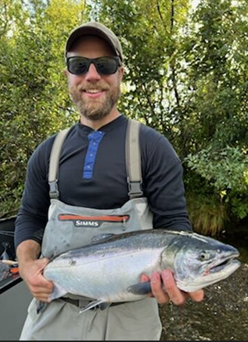
Wendel has been with WDFW in Habitat Science since 2023. He earned his Ph.D in 2020 from University of Alaska Fairbanks where he studied subsistence harvest of sea otters and sea otter effects on seagrass communities in southeast Alaska. Since moving to Washington in late 2020, Wendel has been a research scientist at University of Washington where he has worked on a variety of projects including assessing the impact of the 2021 heatwave on co-managed shellfish, helping develop the new floating kelp bed area vital sign indicator for Puget Sound Partnership, and leading a watershed and algae monitoring program on San Juan Island. Wendel has a gained a breadth of nearshore experience over the years working on a variety of projects including the role of kelp subsidies in the San Juan Islands and the effects of shoreline armoring on beach biota. He is currently working on a variety of projects related to eelgrass, kelp, forage fish and intertidal biota.
|
Brian is a nearshore biologist in Habitat Science. He holds a Ph.D in Marine Biology from the University of Alaska Fairbanks (2022), with a background in marine ecology focused on intertidal and subtidal biological communities. Brian has a strong background in field-based research, including experience as a scientific diver, having worked in environments ranging from South Pacific coral reefs to kelp forests in Alaska. He has also collaborated with mariculture farmers to study biodiversity of organisms that use farm structures as habitat. Since joining WDFW in 2024, his work has centered on forage fish ecology, nearshore fish assemblages, and intertidal fauna and flora, with a focus on understanding ecosystem responses to restoration and climate impacts.
|
Curious about past ESRP Learning Projects?
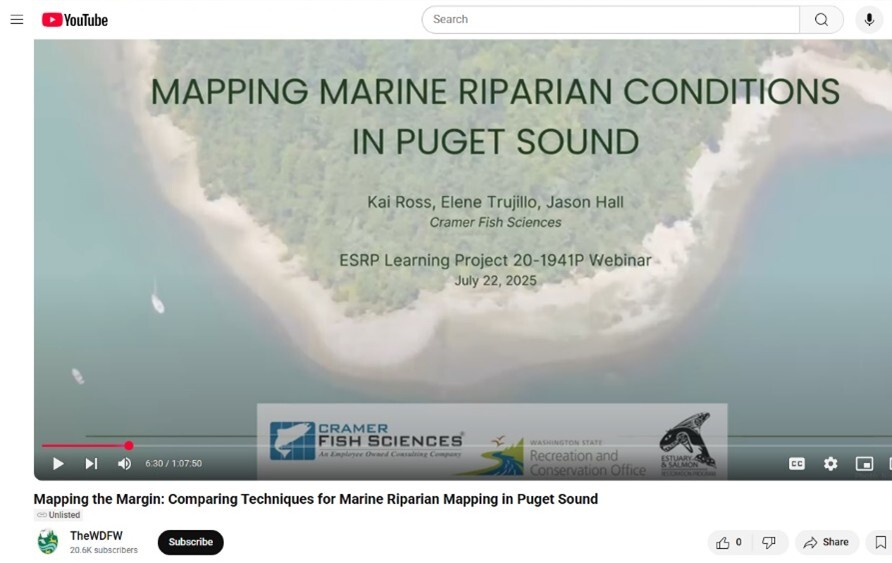
ESRP includes a Learning Program, which funds science projects of regional importance to advance learning about ecosystem and habitat restoration strategies for the purpose of increasing the efficiency and effectiveness of future capital restoration projects. Each project is required to present a public webinar summarizing the results of the work.
All data, final reports, and recorded webinars for ESRP Learning Projects are housed on the Salish Sea Restoration Platform (SSRP), formerly known as the Salish Sea Wiki. This website provides a cross-agency information sharing platform that supports the ESRP Learning Program and many nearshore restoration partners throughout the region. The SSRP allows WDFW and its partners to combine resources in an “open knowledge network” connecting ESRP Learning products with other sources of evidence to better advance Puget Sound Recovery.
|
|
|
|
|