|
The next set of razor clam digs is here! |
|
Mocrocks, Long Beach, Twin Harbors, and Copalis hosting digs
Washington Department of Fish and Wildlife shellfish managers have confirmed the season's next round of razor clam digging opportunities at Long Beach, Twin Harbors, Copalis, and Mocrocks, now through Jan. 3. Tentative dig dates are also scheduled through Feb. 1, 2025.
“We are waving goodbye to 2024 and welcoming 2025 with razor clam digging,” said Bryce Blumenthal, WDFW’s recreational razor clam manager. “Please celebrate the new year responsibly while out on the coast, following all beach rules, so everyone can have a safe and enjoyable experience.”
Drivers should follow the beach speed limit of 25 mph and avoid driving on razor clam beds. Fireworks are only allowed from 6 p.m. Dec. 31 to 1 a.m. Jan. 1. Please note that fireworks and bonfires must be kept at least 100 feet from flammable dune grass.
The set of digs at Long Beach, Twin Harbors, Mocrocks, and Copalis now through Jan. 3 will proceed after marine toxin results from the Washington Department of Health showed razor clams are safe to eat at those beaches.
WDOH requires two test samples taken seven to 10 days apart, and domoic acid levels must fall under the guideline level before a beach can open for digging. Domoic acid, a natural toxin produced by certain types of marine algae, can be harmful or fatal if consumed in sufficient quantities.
On all open beaches, the daily limit is 15 clams per person. Each digger’s clams must be kept in a separate container, and all diggers must keep the first 15 clams they dig, regardless of size or condition.
When you're at the beach, remember to keep a watchful eye on the waves, especially during night tides. Sneaker waves and incoming tides can be a hazard.
Not all beaches are open for every dig, so diggers are encouraged to make sure their intended destination is open before heading out.
For more information on these digs, go to WDFW's razor clam webpage.
|
|
 Below are the approved and tentative dates for razor clam digs, along with low tides and beaches. Most successful digging occurs between one and two hours before the listed time of low tide. No digging is allowed before noon during digs when low tide occurs in the afternoon or evening.
APPROVED, EVENING TIDES ONLY:
- Dec. 30, Monday, 6:14 p.m.; -0.7 feet; Long Beach, Twin Harbors, Mocrocks
- Dec. 31, Tuesday, 6:51 p.m.; -1.0 feet; Long Beach, Twin Harbors, Copalis
- Jan. 1, Wednesday, 7:29 p.m.; -1.0 feet; Long Beach, Twin Harbors, Copalis
- Jan. 2, Thursday, 8:08 p.m.; -0.8 feet; Long Beach, Twin Harbors, Mocrocks
- Jan. 3, Friday, 8:48 p.m.; -0.3 feet; Long Beach, Twin Harbors, Mocrocks
Final approval of marine toxin testing usually occurs about a week or less – sometimes two to three days – prior to the start of each digging series. More information about domoic acid, as well as current levels at ocean beaches, can be found on WDFW's domoic acid webpage.
ADDITIONAL TENTATIVE DATES:
- Jan. 10, Friday, 3:47 p.m.; -0.3 feet; Long Beach, Twin Harbors, Mocrocks
- Jan. 11, Saturday, 4:39 p.m.; -0.8 feet; Long Beach, Twin Harbors, Mocrocks
- Jan. 12, Sunday, 5:27 p.m.; -1.0 feet; Long Beach, Twin Harbors, Copalis
- Jan. 13, Monday, 6:10 p.m.; -1.1 feet; Long Beach, Twin Harbors, Copalis
- Jan. 14, Tuesday, 6:50 p.m.; -0.9 feet; Long Beach, Twin Harbors, Mocrocks
- Jan. 15, Wednesday, 7:28 p.m.; -0.6 feet; Long Beach, Twin Harbors, Mocrocks
- Jan. 16, Thursday, 8:03 p.m.; -0.2 feet; Long Beach, Twin Harbors, Copalis
- Jan. 26, Sunday, 4:34 p.m.; 0.1 feet; Long Beach, Twin Harbors, Mocrocks
- Jan. 27, Monday, 5:15 p.m.; -0.4 feet; Long Beach, Twin Harbors, Mocrocks
- Jan. 28, Tuesday, 5:54 p.m.; -0.8 feet; Long Beach, Twin Harbors, Copalis
- Jan. 29, Wednesday, 6:31 p.m.; -1.0 feet; Long Beach, Twin Harbors, Copalis
- Jan. 30, Thursday, 7:07 p.m.; -1.0 feet; Long Beach, Twin Harbors, Mocrocks
- Jan. 31, Friday, 7:44 p.m.; -0.7 feet; Long Beach, Twin Harbors, Mocrocks
- Feb. 1, Saturday, 8:21 p.m.; -0.1 feet; Long Beach, Twin Harbors, Copalis
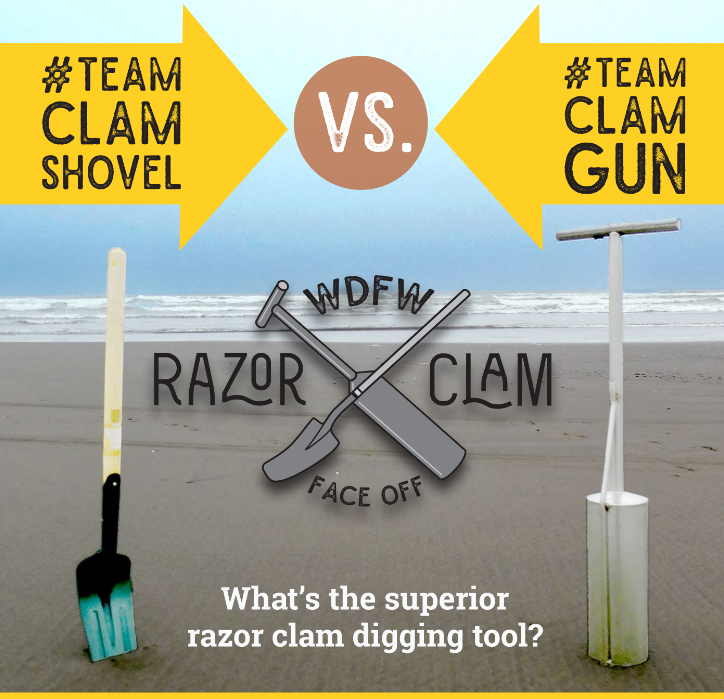 Enter your razor clamming photos!
Are you a clam gun guru or a shovel superstar? It’s time to put your razor clamming prowess on display!
Join the Razor Clam Face-Off and show off your skills. Snap a photo of your epic clam-digging adventure and submit it on our site using the hashtag for your team, #TeamClamGun or #TeamClamShovel, from the “Promotion” dropdown menu.
Every week, we’ll feature a standout photo on our social media. The team with the most submissions will win bragging rights.
So, grab your license and gear, hit the beach, and let’s dig in!
|
|
The gear
Getting started digging razor clams can be pretty straightforward. Here’s what you’ll need:
-
Clam gun or shovel
-
Container/net to store your clams
-
License
-
Flashlight, headlamp, and/or lantern for night digs
-
Rain gear and a towel can come in handy
-
As can knee boots, hip waders, or chest waders
-
Watchful eye: Keep an eye on waves, especially during night tides
|
|
Licenses
All diggers age 15 or older must have an applicable 2024-25 fishing license to harvest razor clams.
Licenses range from a three-day razor clam license (starting at $9.70) to an annual combination fishing license or Fish Washington license. They are available from WDFW online and from some 600 license vendors around the state. Search for license dealers near you using our webpage.
|
|
|
|
|