April Reminders and Links
Preschool Expansion: Phase One
The Preschool Expansion: Phase One application was released on March 17. The Request for Application (RFA), resources and Addendums #1 and #2 – Frequently Asked Questions can be found on the DEL Procurements web page.
Timeline for Phase One is as follows:
Ongoing webinars to answer questions of potential Applicants (please attend or view prior to filling out application)
-
DEL will post each recorded webinar within 2-3 business days here.
-
March - Preschool Orientation and Expansion Overview (recorded webinar)
-
Preschool Expansion Budget Q and A (recorded webinar)
-
April 17 - Preschool Certification
April 17, 2014 - Deadline to submit second round of questions regarding the RFA process
May 19, 2014 by 4:00 p.m. - Applications Due
Engrossed Substitute House Bill 2519 – Certification of Enrollment - recently passed legislation. ESHB 2519 adds two categories of services a child could receive that would make them eligible for ECEAP. If a child is receiving child protective services (CPS) or family assessment response services (FAR), then the child is eligible and prioritized for ECEAP.
Eligibility in 2014-15 includes:
- Children who are at least three years old, but not yet five years old by August 31
- Family income is at or below 110% of the federal poverty guidelines
- Family income exceeds 110% poverty guideline and is impacted by specific developmental or environmental risk factors linked by research to school performance
- Children receiving child protective services or family assessment response services (new for 2014-15)
Prioritization for 2014-15 includes:
- Children four years old by August 31 of the school year
-
Families with the lowest income
- Children who are homeless or in foster care
- Children who are eligible and from a family with multiple needs
-
Children receiving child protective services or family assessment response services (new for 2014-15)
The current ECEAP minimum adult-to-child ratio is 1:9. With the release of the RFA, the maximum class size of 20 students now has a minimum adult-to-child ratio of 1:10. This ratio applies to all new and existing classrooms. Contractors must meet the minimum square footage for a classroom of 20 students.
DEL will release a revised set on standards in 2014. The 2014 ECEAP Performance Standards will include:
-
Changes to ECEAP eligibility and prioritization noted above,
-
The new 1:10 adult/child ratio, and
-
Updated wording (removing DECA, adding Teaching Strategies GOLD®, changing Benchmarks to Guidelines, etc.) to reflect current practice.
During the 2014-15 school year, DEL will continue work on a common set of standards across licensing and ECEAP, using Early Achievers as the foundational framework.
See the News page, in ELMS, for the complete list of ELMS changes released on April 1.
ELMS is ready for the 2014-15 school year:
Starting the New School Year in ELMS summarizes the steps to set up classes and begin enrolling children.
Check the school year when you use ELMS between April 1 and June 30. between April 1 and June 30. It will open as 2013-14 through June 30. Beginning July 1, ELMS will open as 2014-15. You can change the year in the upper right corner of your screen.
Child records for all of this year’s 3-year-olds are now available in ELMS for 2014-15.
-
If they were enrolled at any time in 2013-14, they are on the waiting list for the same site and ready to enroll for 2014-15. You will not re-verify eligibility. If they were on the waiting list in 2013-14, you’ll find them on the same list for 2014-15.
- If they were never on a waiting list, you will find them in Child Search.
- If they did not attend class in 2013-14, you will need to re-verify their eligibility and update their application before enrolling them for 2014-15.
Paper child applications are updated. Further updates will be available by the end of May.
Bulk enrollments is working again, ready for the new year, so you can enroll more than one child at a time from a site waiting list.
If you enroll a child in 2014-15, then want to change classes you will exit the child as “never attended,” add them to the new waiting list and re-enroll. You cannot “transfer” a child until they’ve attended class.
New ECEAP eligibility and prioritization rules passed by the legislature will be added to ELMS and to applications forms by the end of May. All children in foster care and all children in families currently receiving CPS or Family Assessment Response services will receive 100 DEL priority points. This means they are in the top priority category whether they are 3 or 4 years old. Preview the new 2014-15 priority points at http://www.del.wa.gov/publications/eceap/docs/2014-15_ELMS_Priority_Points.xlsx
Adult:child ratios are changing to 1:10 for the 2014-15 school year, to allow easier integration with child care.
Well-child exam and dental screening documentation needed:
- Make sure you have entered dates for all exams and screenings in ELMS Child & Family Updates
- To count in health reports, you must enter dates in ELMS for all exams and screenings and check the box for “ECEAP received copy of results.”
- If you marked “yes” on the child application, but have not yet entered the dates, the health reports are not counting this child.
DEL is sponsoring six free, advanced one-day trainings for ECEAP lead teachers, ECEAP managers and Directors this spring. (See the “Training” section below for location information and dates.)This training is for experienced users of Teaching Strategies GOLD® or those who directly mentor teachers. Please register at least two weeks before the training.
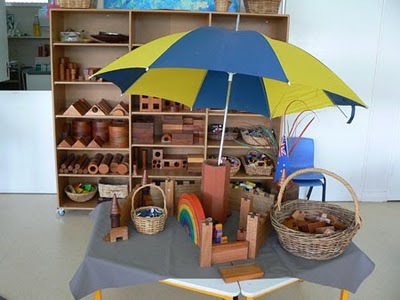
According to Frank Lloyd Wright, his life as an architect began with a gift of blocks from his mother. “I sat at the little kindergarten tabletop … and played … with the cube, the sphere, and the triangle … I soon became susceptible to constructive patterns evolving in everything I saw. I learned to ‘see’ and when I did, I did not care to draw casual incidents of nature. I wanted to design.”
Children playing in the block center have the opportunity to learn science, engineering and math skills and vocabulary. They can plan and design structures with little teacher direction.
Read a book such as “On My Street” by Koos Meinderts and Annette Fienieg. Ask children what they need to build a house. List their suggestions on large paper and post for all to see. Supply some materials and watch architects at work.
Scaffold children’s learning by commenting or asking open-ended questions “Tell me what you are working on now.” “If you don’t like the tipping, what can you do to stop it?” “What else can you use since all the long blocks are being used?" Record their comments. Encourage children to document their work. Put paper on clipboards or trays in the block area and invite children to draw their structure or their favorite part of it. Add blueprints and sketches of buildings; this can encourage children to plan what they want to build.
To invite new players to the block area, add fabric pieces, doll furniture, silk flowers, tiles, dolls, animals, or a picnic basket as props. Create unique play figures by taking pictures of children and putting them on blocks with clear contact paper.
Ask children questions about the size or height of their buildings. “How high do you think that is now?” “What could we use to measure it?” Look around the classroom and see the variety of materials that can be used for measurement. Traditional materials like unit blocks or small blocks such as Unifix© cubes are used for measuring. Lengths of string or children’s shoes can be used as a unit of measure as well.
Support new vocabulary by using words like balance, structure, symmetry, length, stability, vertical, parallel, length, measure and architecture. Look around, you could have the next great architect, scientist or mathematician in your classroom today. How are you cultivating their curiosity and knowledge?
Teaching Strategies® GOLD Advanced
- April 24, 8:30 a.m. to 4 p.m., Vancouver
- April 25, 8:30 a.m. to 4 p.m., Renton
- May 1, 8:30 a.m. to 4 p.m., Tacoma
- May 2, 8:30 a.m. to 4 p.m., Bremerton
- May 2, 8:30 a.m. to 4 p.m., Yakima
- May 15, 8:30 a.m. to 4 p.m., Spokane
DEL is sponsoring six free, advanced one-day trainings for ECEAP lead teachers, ECEAP managers and Directors this spring. This training is for experienced users of Teaching Strategies GOLD® or those who directly mentor teachers. DEL will reimburse travel costs. Morning refreshments and lunch will be provided. Please register at least two weeks before the training.
Infant and Early Childhood Conference (IECC) 2014
The conference provides high-quality, evidenced-based workshops and networking opportunities for families and child care providers to come together to learn, share and advocate on behalf of all young children. Clock hours and STARS credit are available. Register for the conference here.
NAEYC’s 2014 National Institute for Early Childhood Professional Development
“Excellence for Every Child: Standards Without Standardization” is the theme focus for the institute. Additional topics range from professional development systems, program administration, linguistic and cultural diversity.
Starting Strong – 6th Annual P-3 Institute – Save the Date and Call for Presenters!
The two-day conference features keynote speakers and breakout sessions on P-3 alignment and implementation, WaKIDS, the Early Learning Guidelines, Common Core, Community Collaboration and more. Registration begins in April.
WAEYC Conference 2014 – Save the Date!
- Nov. 13-15, Seattle-Tacoma Marriott and Convention Center
Classroom
We Give Books – nonprofit partnership with Penguin Books and the Pearson Foundation to make books available digitally. Many of the books are available in several languages – English, Spanish and Chinese.
Language Castle offers information, research and practical tips for teachers working with dual language learners.
Family Support
The United States Interagency Council on Homelessness’ document, Family Connection: Building Systems to End Family Homelessness, offers a systematic approach to ending family homelessness.
The Center for the Study of Social Policy offers Strengthening Families protective factors resources:
-
A five part Strengthening Families framework - Parental Resilience, Social Connections, Knowledge of Parenting and Child Development, Concrete Support in Times of Need, and Social-Emotional Competence of Children to ensure that children and families are on a pathway to healthy development and well-being.
-
The Protective Factors Literature Review: Early Care and Education Programs and the Prevention of Child Abuse and Neglect.
Tips for school and home
Ready, Set, Go! 5210 - This community-based initiative offers helpful tips on how to enjoy five or more fruits and vegetables daily, tame your television, be active every day to feel better and ways to drink less sugar. Proven for Kids, Recommended for Adults
Current Practice and Research
Play, Mathematics and False Dichotomies - Douglas H. Clements and Julie Sarama of the University of Denver explore the importance of play-based learning in developing early math skills in a recent blog from NIEER.
Early Childhood Science Education – a National Science Teachers Association position statement affirms the importance of exploratory play in a child’s early years.
The Urban Institute released three fact sheets on supporting immigrant families’ access to prekindergarten.
Strategies for Enrolling Traditionally Underserved Families in Early Childhood Programs – an evaluation by University Of Illinois at Urbana-Champaign research team of six Illinois agencies recruitment strategies.
The Center for Public Education’s post on what is the appropriate “role of technology in early education.”
Professional Development
Practice-based Coaching resources from the National Center on Quality Teaching and Learning.
"April hath put a spirit of youth in everything." ~William Shakespeare
|