|
ECEAP expansion provides an opportunity to expand on the existing mixed delivery system and incentivize contractors to offer full-day high quality early learning opportunities aligned with Early Achievers. DEL is in the process of ensuring the priorities for the ECEAP expansion application (formerly referred to as the RFP) align with that goal.
- The expansion will focus on quality (as defined in Early Achievers), continuity of care (full-day experiences for families who want them), and access (communities with low saturation of ECEAP and Head Start slots).
-
DEL will not require a minimum of 240 slots for new contractors as proposed in the ECEAP expansion plan. We will determine the minimum number of slots for which a contractor may apply to ensure sufficient infrastructure and that the system remains efficient from a state administration perspective.
- We are in the process of determining locations eligible for expansion. We will get that information to you as soon as possible.
Please look for a communication from us in January for more information about the ECEAP expansion process and next steps. We look forward to partnering with you in the expansion process.
The final Joint Task Force on Child Care Improvements for the Future Report and Recommendations to the Legislature is available online. The task force was charged with examining and making recommendations on several early learning issues, including: incentivizing quality, integration of preschool and child care, stability of care, continuity of care, and financial stability for providers and parents.
- Feb. 14, 10 a.m. to noon
-
Directors or their representatives must register in advance.
Join us for informative discussion on ECEAP expansion, DEL updates and more! You will receive log-in information and handouts by email at least 24 hours before the meeting.
Annually, DEL provides ECEAP contractors with names and addresses of DSHS client families with children who may be eligible for ECEAP. If you want to receive this family contact information send DEL:
Innovative Nutritional Practices
The Walla Walla school district (WWPS) participates in several different nutritional programs that reach out to children and families.
- The school district asks families to share some of their favorite recipes with nutrition service staff, who then select from the entries. They test the top recipes and adjust them to meet nutritional guidelines. Then the nutrition services staff makes the dish and asks children and staff for feedback. Dishes that are well-liked are then placed on the menu.
- The Head Start/ECEAP program has a strong relationship with the director of the nutrition service for the district. She asks staff about foods the kids liked the most. Then she incorporates these ideas into a balanced menu.
- This year the Head Start/ECEAP program is paying to participate in the Fresh Fruits and Vegetables program. Head Start/ECEAP children get to taste a different fruit or vegetable twice a week. This gives our kids the opportunity to try some new foods.
- Taste of Washington is another meal program the Walla Walla School District program participates in. Several times a year local farmers provide the school district and Head Start/ECEAP program with locally grown food. Staff prepare meals using these ingredients. Examples of locally grown foods the kitchens have prepared are ground beef from local cattle ranchers to create meatballs, vegetables such as corn, purple potatoes, kale and fruits like apples and pluots.
- WWPS Head Start/ECEAP also partners with WSU Food Sense program. Once a month WSU staff come into preschool classrooms and teach lessons about healthy food choices. These lessons are provided in English and Spanish. WSU has also partnered with the program for Family Night Healthy Snack preparation nights.
ELMS from the Contractor’s View
Joe Varano from Snohomish County has become an ELMS monster (in a good way!). He was one that never looked in ELMS but now he is using all of the reports and making sure the County Coordinators are also using it. When he meets with each of them he lets them know that they will be looking at ELMS data together. He can’t say enough good stuff about the system!
A rulemaking proposal was filed with the Office of the Code Reviser to update Chapter 246-105 WAC “Immunization of child care and school children against certain vaccine-preventable diseases.” The proposal clarifies what is already required for children to enter schools and child care centers: it does not create additional requirements. Public comments are now being accepted through Jan. 2, 2014. The State Board of Health will hold a public hearing on Jan. 8, 2014. For more information and to submit comments, go to the Department of Health website.
Biology is the study of all living things. Biology includes Botany, the study of plants and Zoology, the study of animal life. Classroom curriculum and environments can combine both these “ologies.” Invite families to bring in dandelions and the attached dirt. Children can examine the dandelions with magnifying glasses. Can they find insects living on the plants? Are there bugs or worms living in the dirt? Teachers and children can discuss what makes a plant different from an animal. They can discuss foods insects and worms eat and how they are similar or different from what people eat.
Ecology is the study of the environments in which people, plants and animals live. Washington State offers much different environments to study with preschoolers. Teachers can set up an area of their classroom as a mini ecosystem, using materials such as wood, grasses, rocks, water and animal life (or toy animals). Encourage open-ended questions about what children notice or smell or hear. Ask children for their ideas about why certain animals or plants live in certain places. Adding new materials as children discover them in the outside environment can stimulate new discoveries.
Climatology is the study of weather and how it changes during the different seasons of the year. Children can learn about different types of weather through direct outdoor experiences or by viewing the sky. They can learn to distinguish different types of weather by observing the sky and seeing which types of clouds produce rain, snow or lightning. Encourage children to make predictions about weather as the seasons progress or when clouds appear and the sky gets darker. Support children in learning new concepts and vocabulary such as “thermometer,” “frost” and “precipitation.”
Geology is the study of the earth through natural materials, especially rocks. Children can explore geological objects, such as rocks, wood and soils. Going on a rock hunt and collecting samples from around the school can provide hours of scientific exploration. Provide collection baggies, small digging tools, tongs or tweezers, magnifying glasses and clipboards for the rock-walk. Add measuring tools and scales to the discovery area for more detailed exploration. Share your interest and enthusiasm about the discoveries. Ask about what they notice. Encourage children to formulate hypotheses. Provide graph paper, pencils and drawing materials to encourage children to record their scientific findings.
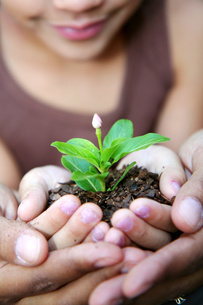 Provide opportunities for children to view an object at different times of the day, throughout different seasons and from different angles. Encourage children to share about colors, shapes, sound and movements. They can document these in a journal and you can create graphs to compare observations and experiences.
- Ask what does it mean when we look at the same thing and see different things? Does that mean that one person is right and the other wrong?
Cover up a photo and only show a small part of it. Have children guess what this is a picture of. After they have guessed uncover the photo to show what is really happening in the photo.
Show children 3-6 objects or items in a pattern then ask them to hide their eyes. While eyes are hidden change the pattern or take an item away. Ask the children what is different now.
|
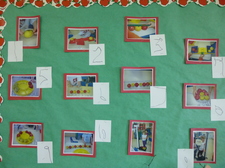 The bulletin board is above a math shelf in a classroom at the Community Child Care Center Program. The teacher stocked this shelf with supplies children needed to experiment. She hoped the children would weigh and measure apples. Children did that and asked the teacher to pull out a scale they could weigh themselves on as well as the apples. Here is a list of some of the STEM activities the children explored with apples:
- Created patterns with them
- Sorted them
- Measured them with rulers and measuring tape by lining them up
- Measured the circumference of one apple and the circumference of a group of apples
- Balanced and weighed them
- Counted the apples they lined up
- Weighed the apples and then weighed themselves on the scale
- Wrote numbers for the bulletin board
Thanks for your thoughtful planning and openness in following the children’s lead teacher Roanne!
|
The webinar will include a focus on science and math and how to use GOLD online to plan.
Save the Date! Early Achievers Institute for Head Start and ECEAP
- Feb. 18 and 19; TBD – Seattle area
Details and registration information coming soon!
This Conference will focus on strategies for teaching all children including students with multiple challenges and gifted learners from pre-K through 12th grade.
Content will include an overview of GOLD and the GOLD report functions.
Classroom
-
Children’s Investment Fund’s video, Building the Third Teacher, highlights quality space and the developmental impact environments have on children and the adults who care for them. More quality space videos are available on their website.
-
Dr. Seuss and Read Across America Day – March 3, 2014.
-
Early Childhood Investigations website offers free webinars about various early childhood education topics. The site lists upcoming 2014 webinars as well as previously recorded webinars.
STEM Resources
Family Support
-
The CDC’s Learn the Signs. Act Early webpage provides numerous resources on developmental and behavioral screening.
-
The Impact of Family Involvement on the Education of Children Ages 3 to 8 report summarizes research over the past 10 years on the effects of family involvement on literacy, mathematics and social-emotional development. The report also provides new information on the impact of family involvement for preschool children and the practices necessary to help prepare parents and children for the transition from preschool to kindergarten.
Health
Current Practice and Research
Professional Development
"There can be no keener revelation of a society's soul than the way in which it treats its children."
Nelson Mandela, Former President of South Africa, 1918-2013
|