 By DEL Director Dr. Bette Hyde
Gov. Jay Inslee has proclaimed the week of Nov. 18-22 as Parent Education Week. Parents are children's first and most important teachers, so we've built parent engagement into ECEAP, our state-funded preschool program, and Early Achievers, our child care quality rating and improvement system.
DEL's Strengthening Families Washington has a key role in parent engagement in Washington. Strong families are key to creating healthy, resilient environments for children. Strengthening Families Washington focuses on helping families strengthen family bonds, understand childhood development, cope with parenting challenges and develop positive discipline skills.
Strengthening Families Washington connects with community groups that help with parent outreach and engagement efforts. Sometimes, that means awarding grants to local organizations that work to strengthen and support families. In other cases, means helping spread the word about parent education classes in Washington communities. We also work directly with families through our parent advisory group, which tells us how we can better serve parents and caregivers. In February, we will honor parents and other primary caregivers who make a difference for their families and communities with our Unsung Heroes awards. We are accepting nominations for those awards until Jan. 4, 2014.
Parents and caregivers can find parent education at 20 of the state's 34 community and technical colleges, at churches and community centers, Head Start and ECEAP
centers, housing developments, as well as public, private and tribal
schools.
Here are some resources to help parents and caregivers find information:
|
The Department of Early Learning (DEL) reported gains in student achievement and the lowest-ever turnover rate for children who attend Early Childhood Education and Assistance Program (ECEAP), Washington's state-funded preschool program.
During the 2012-13 school year, DEL administered ECEAP through 40 contracts with educational service districts, school districts, community colleges, local governments and nonprofits. ECEAP served children in 37 of 39 Washington counties at 269 sites.
In the 2012-13 school year:
- ECEAP had space for 8,391 children. ECEAP served 9,328 children. The ECEAP turnover rate has decreased each year to 11 percent in 2012-13, the lowest in ECEAP’s recorded history.
- At its peak in May 2013, the ECEAP waiting list had 1,186 4-year-olds and 1,281 3-year-olds, totaling 2,467 children.
- Approximately 32,322 children in Washington were eligible for ECEAP and were not served by ECEAP or the federal Head Start program. Head Start and ECEAP serve 37 percent of Washington children who are eligible for ECEAP.
-
ECEAP received 9 out of 10 quality points from the National Institute for Early Education Research (NIEER) for our state early learning guidelines, comprehensive family and health services, staff professional development requirements, class sizes, staff–to-child ratios, meals and DEL’s monitoring of program quality. The 10th quality point would require ECEAP lead teachers to have a bachelor’s degree. DEL currently requires an associate or higher degree with 30 quarter credits of early childhood education.
During the 2012-13 school year, ECEAP children progressed from below age level to at or above age level during their time in ECEAP:
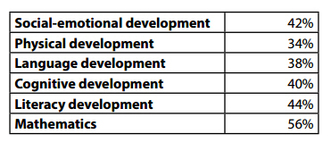 Read the 2012-13 ECEAP Outcomes report.
Starting this school year, ECEAP is expanding thanks to the 2013 state operating budget, which increased the number of slots and the per-slot funding for ECEAP children. This school year, ECEAP added 350 slots; next year ECEAP will add 1,350 slots and increase the per slot-funding for ECEAP. Each subsequent year after 2014, ECEAP will add up to 2,400 slots until 2018-19, when it becomes an entitlement for all Washington children who qualify.
Read the ECEAP expansion plan.
Early Achievers was only launched just over a
year ago, but already the reach of this system-wide initiative has been
phenomenal. Thanks to the hard work and dedication of the Child Care Aware teams around the state, and
the enthusiasm and commitment to children of Washington’s early learning
providers, more than 1,700 participants have now enrolled in Early Achievers,
serving more than 53,000 children! (See performance tracker below.)
One of the most
exciting parts of the strong enrollment data is that Early Achievers is
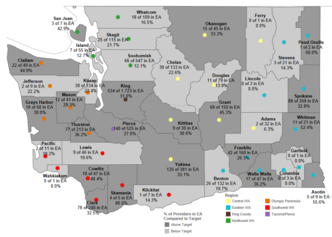
reaching nearly every county in the state. This map shows participation by
county as of August 31, 2013.
Read more in the October Race to the Top-Early Learning Challenge Update.
 Find out if your child care provider is participating in Early Achievers by searching for them in Child Care Check, DEL's child care licensing information system. The Early Achievers icon is in the upper right corner with the provider's participation status listed, as shown below.
Did you know you can be awarded money for your education?
Amounts vary between $100-$600 for having your education verified and being
placed on the Washington
State Career Lattice.
To get started:
- Log into your MERIT account.
- Complete an Education Application in MERIT
(found under the Applications Tab).
-
Follow these Four Easy
Steps to complete your education verification.
- Once your education is verified and you are
placed on the Career Lattice, complete the Career Lattice/Education Award
Application in MERIT (found under the Applications Tab).
Your verified education will become a part of your MERIT
professional record.
Once your Career Lattice/Education Award application has
been approved, please allow 2-4 weeks for delivery of your award.
Monetary awards have been made available through
the Race to the
Top – Early Learning Challenge Grant.
Questions? Contact merit @del.wa.gov.
DEL's Strengthening Families Washington is accepting nominations for its 2014 Unsung Heroes awards. Each February, we honor 28 primary caregivers -- parents, foster parents, adoptive parents, grandparents, guardians -- who are an Unsung Hero to their families or their communities. We will honor each hero with a short bio that will be posted on Seattle's Child website and at a recognition event in late February.
Nominations are due Jan. 4, 2014. Fill out the nomination form and submit it to us by email, fax or mail.
The University of Washington College
of Education is accepting applications for the Washington Certificate in
P-3 Executive Leadership. This first-in-the-nation program is designed for
PreK-8 principals and early learning directors/program administrators who are
working to close achievement gaps by the end of third grade.
The Certificate is intended to build
and support a cadre of administrators – in both early learning and elementary
education – who are well-equipped to ensure Washington’s young children have a
high-quality continuum of learning that begins at birth and extends through
elementary school.
The certificate is gained through a
year-long, executive style course of study designed for working professionals
all across Washington.
There are 25 spaces
available for principals and 25 spaces available for early learning
administrators. Priority consideration will be given to applications submitted
by November 30, 2013. For additional information, please visit the UW COE website.
Questions? Contact Kimberly Kinzer, Program Director, at kinzek@uw.edu.
Secretary
of Health and Human Services Kathleen Sebelius spent some time explaining how
the Affordable Care Act protects women’s access to quality health care.
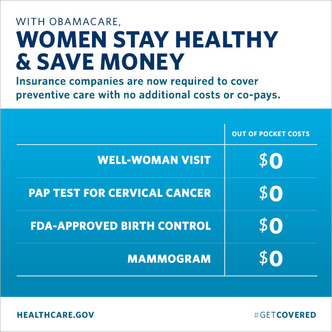
Under
the Affordable Care Act, no one can be denied health insurance coverage because of a
preexisting health condition, such as breast cancer, pregnancy, or being a
victim of domestic violence -- and preventive services including mammograms are
now available to women at no additional cost.
Learn more about the ways the Affordable Care Act helps women get
covered.
 The Affordable Care Act requires many privately run health insurance companies to offer benefits to parents and kids, including:
-
26 free preventive services, such as immunizations; screening tests for conditions like autism, obesity, depression, and hearing problems; iron and other vitamin supplements for kids with deficiencies; drug counseling; and more. Certain uninsured pregnant women also may benefit from preventive services, although this benefit may not fully be in effect until 2014.
-
"Essential health benefits" include ambulatory and ER care, hospital stays, maternity and newborn care, mental health and substance abuse services, prescription drug plans, rehabilitative care, and lab work. Dental and vision care is covered until a child reaches age 19.
- Medical, dental, and vision coverage for a child under age 19, even if he or she has a disability or pre-existing medical condition like diabetes or asthma.
-
Coverage under a parent's plan until an adult child is 26.Adult children under age 30 who outgrow this service and are uninsured may qualify for what's called "catastrophic insurance" — insurance that helps minimize the cost of medical care for those on limited incomes.
Read more from kidshealth.org.
Sources: whitehouse.gov, kidshealth.org.
|
Starting in late October, the Washington Department of Early Learning (DEL) is piloting a program in partnership with Frontiers of Innovation (FOI), an initiative of the Center on the Developing Child at Harvard University, that will provide professional development about executive function in adults and young children to approximately 70 teachers, child care professionals and practitioners who support children and families.
Since 2011, DEL has been working with FOI to explore how training about executive function for early learning professionals can help young children’s development. Executive function is the brain’s “air traffic control system” that allows us to manage multiple streams of information at the same time, control impulses and revise tasks as necessary. Acquiring the early building blocks of these skills is critical to school readiness and social development through middle childhood, adolescence, and into early adult life.
"This partnership is very exciting for Washington early learning,” said DEL Director Dr. Bette Hyde. “Executive function is the biological foundation for school readiness. Children are not born with these skills, but they are born with the capacity to develop them. It’s crucial that we prepare the adults who care for and work with young children to be able to help children develop the skills they need to make good decisions, participate in school, and adapt flexibly to new situations."
Facilitators who lead each training group were selected based on their expertise with adult learners, interest in early brain development and ability to reach their local communities. They are:
- Amber Havens, Educational Training Partners, Thurston/Pierce County
- Kerry Beymer, Encompass Northwest, East King County
- Renee Rinderknecht, GRE Consulting, Spokane
- Maggie Mendoza, ESD 105, Yakima
- Corina McEntire, ESD 112, Vancouver
- Darcie Donegan, Whatcom Community College, Bellingham
Groups will meet for 15 weeks following a framework designed in partnership with leading executive function researchers from across the nation. Group facilitators will help participants build awareness and knowledge of executive function, and deeply explore how to support executive function in early learning settings. Participants will receive early learning continuing education credit and a certificate of completion from DEL and FOI.
Early learning advocate and Washington Rep. Ruth Kagi said, "Science and research provide the foundation of early learning policy in Washington. Our partnership with the Center on the Developing Child at Harvard is helping Washington find new ways to use the science at the practice and program levels, using innovative strategies to serve children and families more effectively."
Some examples of activities that support the development of executive function in young children include:
- Back-and-forth, “serve-and-return” interaction between young children and adults, in which adults notice and respond to children’s efforts to vocalize and engage in playful activities.
- Play in which children are able to take on roles and “play out” a developed scenario that is supported by teachers.
- Structuring a daily schedule that allows time for children to use their developing skills, and allowing children to practice these skills with adult supervision but without adult intrusion.
- Ensuring that early learning settings are arranged so that children have time to work individually with adults who have carefully observed their potential and capacities.
- Creating a safe emotional climate in early learning settings that creates opportunities for children to practice their social skills with each other and with adult support to reduce conflict and promote problem-solving.
- Meditative or mindfulness-based practices for both adults and children.
- Ensuring that children and adults have enough sleep and exercise to support healthy brain development.
- Playing games that allow children to learn rules and then switch them, called cognitive flexibility. A good example is Simon Says.
DEL is partnering with The University of Washington to evaluate the impact of the learning communities and with researchers at the University of Minnesota to collect data about the development of the children who participate in the trainees’ early learning environments.
Early
learning partnerships help ensure all Washington children have what they need for
school and life success. Through thoughtful partnerships with parents, private organizations,
the public sector and others, DEL is setting up a lasting, comprehensive and
interconnected early learning system that supports children and parents. Partnerships that connect expertise and goals
are particularly powerful.
In 2010, the
Washington State Department of Health’s (DOH) home visiting statewide needs
assessment showed higher health and social risks factors for American
Indian/Alaska Native pregnant women than any other racial group in our state.
Also in 2010, the American Indian Health Commission’s (AIHC) Healthy
Communities: A Tribal Maternal-Infant Health Strategic Plan identified maternal
and infant health disparities and culturally appropriate strategies to
addressing these concerns. Washington’s Early Learning Plan,
published in 2010, discussed increasing home visiting accessibility for at-risk
families, and cited Tribal-state efforts in meeting the objectives laid out in
the plan.
DEL is partnering AIHC
through the federally funded Maternal, Infant Early Childhood Home Visiting program.
AIHC has been working for the past 18 months to engage the 29 federally recognized
Indian Tribes and two Urban Indian Health Organizations (UIHOs) in Washington to
identify:
- Home visiting
services currently provided in Tribal communities.
- Home visiting effectiveness
and areas of improvement.
- Gaps and barriers
experienced by Tribal families participating in home visiting and early
learning services.
- Culturally
appropriate strategies to develop the quality and the capacity of Tribal home
visiting interventions.
- Funding and
leveraging opportunities to support Tribal home visiting infrastructure and
services.
Last month, AIHC presented
its phase 1 project report Healthy
Communities: Tribal and Urban Indian Maternal Infant Early Childhood Home Visiting ,
a comprehensive exploration of Tribal home visiting services, gaps and
barriers, and culturally appropriate next steps.
Recommendations
include:
- Engaging in
intentional outreach and education with Tribal communities to deepen the
understanding of home visiting services and how home visiting connects to
healthy, resilient parents and children.
- Continuing to support
building culturally appropriate practices in current home visiting programs.
- Exploring home visiting
models shown to be effective with Tribal families.
- Identifying opportunities
to continue linking Tribal and State driven initiatives.
- What can happen when
dedicated partnerships focus on encouraging and supporting parents as their
child’s first and most important teacher in culturally relevant and accessible
ways? Watch for:
- Community
development that reflects the wisdom of individual community members.
- Voluntary,
family-focused services based on the parent and child’s interests and needs.
- Our state’s
youngest learners entering kindergarten with a solid foundation for school and
life success.
DEL looks forward to
learning and growing with AIHC and other state partners in this important work.
From USA.gov
Keeping your kids healthy is one of your top priorities as a parent, but it’s
not always an easy task. Between staying on top of their normal checkups and
trying to get them to wash their hands before dinner, there are a lot of things
that could slip through the cracks. Use these tips from USA.gov
to make managing your kids’ health a little easier.
-
Stay up-to-date with your children’s immunizations and developmental
milestones with an easy
tracking chart you can download for free from Publications.USA.gov. It
reminds you of all the necessary immunizations from infancy through age six. It
also highlights developmental milestones—like recognizing a caregiver’s voice
and learning to talk—that you can monitor as your children grow up.
-
If you’re struggling to pay for health insurance for your kids, they may be
eligible for the Children’s Health Insurance Program (CHIP). CHIP offers free
or low-cost medical coverage for kids up to 19 years old. Coverage for eligible
children includes checkups, hospital visits, dental coverage, immunizations and
more. Find out if they’re eligible at InsureKidsNow.gov/chip.
-
Sometimes your kids don’t want to listen to mom or dad, but you want them to
get information from a trusted source. Point them to the health
resources on Kids.gov, where they can learn about everything from keeping
their eyes safe to understanding germs and where they can play fun games that
drive home the importance of brushing their teeth or getting their shots.
-
Find more free
guides on managing your children’s health from infant to teen at
Publications.USA.gov.
|