 |
|
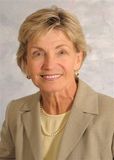
DEL Director
Dr. Bette Hyde |
The Department of Early Learning (DEL) is observing National Child Abuse Prevention Month in April by raising awareness in the community about child abuse and neglect prevention. In support of our work, Gov. Jay Inslee has proclaimed April as Child Abuse Prevention Month in Washington.
Strengthening Families Washington, which is part of the work we do here at DEL, is also the Prevent Child Abuse Washington State Chapter. We've organized an initiative called Pinwheels for Prevention, which uses pinwheels—a timeless symbol of childhood—to represent its campaign to raise awareness of the campaign to prevent child abuse and neglect.
DEL has distributed more than 9,500 pinwheels to communities around the state. They’re popping up in front yards and at community events. The Capitol grounds in Olympia will turn silver and blue with pinwheels planted in the ground the week of April 15-19.
Pinwheels for Prevention is a reminder that it is not enough to respond to child abuse and neglect—we must build and support strong families through community engagement, programs, and policies. This grassroots movement works towards developing communities that are healthy, safe, and nurturing for all children and all families.
Follow this work--and more--on DEL's Facebook page.
What you can do to support strong families
- Whether you are a parent, an early learning provider or a community member, you can help build and support strong families in your community every day in simple ways. Check out these calendars that offer an idea a day, such as offering a board game library in your facility for families, and holding family potlucks or movie nights at community centers with time for discussion.
- Tell us what's happening in your community to support strong families. Email strengtheningfamilies@del.wa.gov.
- Join us at the fountain!
Where: Tivoli Fountain, on State Capitol Grounds near Capitol Way, Olympia
When: April 15, 2013 at noon
Help raise awareness by taking a pinwheel and sharing with us how you’ve helped a child.
|
New state benefit income guidelines begin April 1
Income guidelines for state benefit insurance programs (Medicaid/CHIP)
and food assistance programs (Basic Food) increased on April 1. Families
who may not have qualified in the past may now qualify under the new income levels.
Review
the new guidelines.
Free developmental screening
Help
Me Grow WA offers free developmental screening for all families with children under age
5. There are no income guidelines or waiting list. Additional services include age-specific activities and games;
connections to community resources and state benefit programs; and verified
referrals into the early intervention system. Access to these systems
significantly improves a child’s chances for healthy development and school readiness.
Nominations accepted for Golden Apple Award
Do you know someone who deserves a Golden Apple? There are thousands of great teachers,
administrators, staff, volunteers, community organizations and businesses
working to make Washington state’s schools innovative and exciting places to learn. The KCTS 9 Golden Apple Awards recognize
outstanding contributions made by these people and programs serving children in
preK-12th grade. Golden Apple winners
will receive a cash award and be featured in a statewide primetime special on
public television.
If you know of a deserving teacher or programs making a difference
in our schools, please visit KCTS9.org/goldenapple or call 1.800.766.0900 to
obtain a nomination form. All
nominations must be postmarked by May 6, 2013.
Chicks, ducklings can carry salmonella, put kids at risk
Each year, people
get infected with Salmonella after handling chicks or ducklings. Last year, 10 people in Washington got sick with Salmonella illness
after handling chicks, ducklings, and other poultry from a hatchery linked to an
11-state outbreak. Half of the cases in Washington were children under 13 years
old. Nationally, more than 450 illnesses were linked to Salmonella
outbreaks related to live poultry.
Spring is the season when many people who keep chickens or ducks in backyard
flocks order baby birds. Children should be supervised carefully when they’re
touching these animals or their environments, to make sure they wash their hands
right away. Make sure children don’t nuzzle or
kiss animals.
Kids under age 5, elderly adults, and people with weakened immune systems are
most likely to get very sick from Salmonella. People in these groups
should avoid handling live poultry.
Salmonella infection can cause diarrhea, fever, stomach pain,
nausea, and vomiting. Symptoms usually last several days. Severe cases may
require hospitalization, and occasionally result in death.
Raising chickens or other poultry for their eggs is becoming more popular. By
following the recommendations of the Washington
State Department of Agriculture people can keep their families, and their
birds, healthy.
More tips for avoiding
Salmonella infection from chicks and ducklings are available from the state Department of Health.
Immunization town hall in Seattle on April 23
Infant
Immunization Week is an annual observance to highlight the importance of protecting
infants from vaccine-preventable diseases and promoting healthy communities. WithinReach is co-hosting a lively discussion with The
Panic Virus author Seth Mnookin and ‘Seattle
Mama Doc’ Wendy Sue Swanson to discuss Vaccine Myths, Parents & Modern
Health Information. They will discuss how parents can find accurate vaccine
information and make the right decisions for their families. Learn
more and register here.
EPA provides environmental health resources for child care providers and families
EPA has launched
a new website containing environmental health information for child
care providers, parents, and state and local agencies at www2.epa.gov/childcare. The site includes fact sheets, presentations, training,
assessment tools, reports, prevention and intervention guidance about asthma, chemical hazards, environmental tobacco smoke, green cleaning, indoor
air quality, lead, mercury, mold, pesticides and plastics. The information is available in English, Spanish, Chinese, Vietnamese and Korean.
 |
|
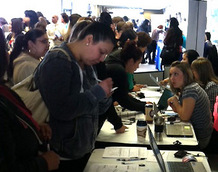
At the end of March, DEL licensors and staff helped child care professionals from the Washington State Migrant Council register for portable background checks in Yakima. All child care professionals must have a portable background check by July 1. Read more about portable background checks. |
|
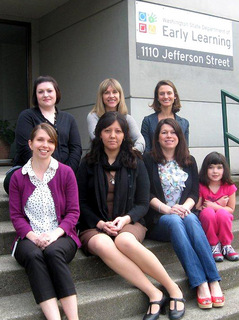 DEL's Early Achievers team. Back row, from left: Kasondra Kugler, Char Goodreau, Adie Fatur. Front row, from left: Justine Waymire, Carrie Gonzalez, Amy Russell, Ava Russell.
The Early Achievers team at the Department of Early Learning
is committed to supporting Washington’s early learning professionals and the
children and families they serve. The
team brings a combine century of early learning experience--some have worked in licensed child care centers, family
homes, tribal centers, school-age settings and Head Start. We asked the team what they like most about
working on Early Achievers and here are their responses:
Carrie Gonzales, QRIS
Customer Support Specialist: What I enjoy most about
working with Early Achievers is the knowledge that my work really does make a
difference; it’s an opportunity to help build a new program for Washington
which will improve the quality of care for our youngest residents, provide
resources and incentives for participants, and give parents an exciting new way
to make informed decisions about where their children will learn and grow.
Kasondra Kugler, QRIS Intake Supervisor: I love working on a system that will benefit our children and
providers by helping providers gain recognition for the hard work they already
do. I love working with technology and am so excited to assist providers
in working with the technological aspects of Early Achievers in MERIT and
the WELS Provider Portal.
Adie Fatur, QRIS Manager: As someone who was involved in the
QRIS field test, it is especially rewarding to see the hard work and input of
so many stakeholders, including child care providers reflected in the system that
will ultimately benefit so many children and families. I feel fortunate to be involved with the
statewide rollout of Early Achievers.
Amy Russell, QRIS Project Coordinator: I enjoy working with people who are
truly passionate about creating positive change for our youngest learners. As a parent of a young child, I am honored to
take part in building a system that will make high quality childcare the norm and help parents make informed choices.
Justine Waymire, QRIS Specialist: What I like most about working on
Early Achievers is knowing that children across Washington will have access to
a high-quality care.
Char Goodreau, QRIS Administrator: Early Achievers is one of the
unique programs that has a universal impact. Child care providers receive support and resources to build upon the
great work that they are already doing; families receive information about high-quality care and can help drive quality improvement efforts in their child’s
early learning facility; and most importantly, all children will have access to
high-quality early learning opportunities, which has a lifelong benefit.
Funding available for community-based child abuse prevention programs
The Department
of Early Learning’s Strengthening Families Washington is pleased to
announce that funding is available for community-based family support and child
abuse prevention programs throughout Washington state. We are requesting
letters of interest from Washington state organizations that are engaged in
child abuse prevention activities. We want to work with local communities to
increase program capacity to use and expand the Strengthening Families
Protective Factors Framework for children birth through age 5.
Please share this opportunity with community partners and organizations
throughout the state.
The letter of interest template, application cover sheet, and more
information is available on
our website. The letter is due to DEL by April 30.
Public comment accepted on CCDF plan
The Child Care and Development Fund (CCDF) is a federal grant administered
by the U.S. Department of Health and Human Services Administration for Children
& Families Child Care Bureau (ACF).
As the lead state agency for the CCDF block grant, DEL must submit a plan
every two years for how the funding will be used to improve accessibility and
quality of child care in our state. In Washington, CCDF pays for Working
Connections Child Care subsidies, child care resource and referral and other
research and technical assistance.
DEL has posted its draft plan for federal fiscal year 2014-15. We are
accepting public comment on the proposed 2014-15 plan until May 20,
2013.
DEL legislative update
View the most recent update on
the status of the bills that DEL is tracking this legislative
session.
FAQs for school-age rules
DEL has compiled answers to frequently-asked questions about the new school-age rules that took effect in December 2012. The revised rules pertain to the 450 licensed school-age programs around the state, which serve up to 20,000 children ages 5 through 12 with before- and after-school care. The rules were last updated in 2001.
You can read a summary of the revised rules on the DEL blog.
|