 |
|
DEL Director
Dr. Bette Hyde |
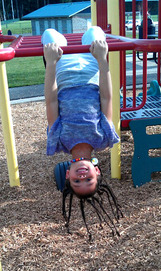 Childhood obesity has become an early learning issue in recent years. The Centers for Disease Control and Prevention statistics state that childhood obesity has more than doubled in children and tripled in adolescents in the past 30 years. According to the University of Washington, as many as one in five U.S. children is obese, which increases children’s risk of health issues like asthma and early puberty.
As a result, childhood obesity has taken a place on the national stage. First Lady Michelle Obama launched the Let’s Move! initiative to address childhood obesity. There are many childhood obesity programs out there, from universities to medical organizations to child advocates to educators to public policy groups.
There are two steps to preventing childhood obesity: Good nutrition, which is also important to help young brains and bodies develop and grow; and physical activity, which also helps our youngest learners develop large muscle groups and gross motor skills.
Here at the Department of Early Learning, we have taken some steps to help families and child care providers be aware of and help lower the risk of childhood obesity.
-
Our child care licensing rules have specific requirements around the types of food and the way children are served meals and snacks, moving around and limiting screen time.
-
Our ECEAP performance standards support healthy choices, including active play and healthy eating.
- We are updating the STARS basic child care training to include a module on nutrition and fitness, which will address developmental needs of children for physical activity, exercise and sleep.
- Child care providers can earn points in Early Achievers for completing a self-assessment and developing a plan for engaging parents in supporting positive health and nutrition practices.
-
The Washington State Early Learning and Development Guidelines address active play in each development milestone from birth to age 8.
-
The Early Learning Advisory Council in January heard from health experts at Seattle and King County Public Health about ways to prevent childhood obesity and to promote healthy eating and activities among child care providers and families.
This conversation will continue to evolve. DEL will present on our efforts to curb childhood obesity during a House Early Learning & Human Services Committee work session on March 15.
DEL also will be speaking at the first-ever all-day childhood obesity conference in Seattle next month and we will continue to share information with child care providers about ways to encourage physical activity and health eating habits with children and their families.
Finally, this week my friend and colleague Nina Auerbach has
announced she will be leaving her post as President and CEO of Thrive by Five
Washington this summer. Nina has been everything we at DEL needed in a partner:
collaborative, generous and forward-thinking. It will be with sadness and fondness that I bid her farewell and wish her well on her next adventure. Please join me in thanking her
for her work on behalf of children and families in Washington.
|
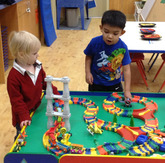 Early Achievers, Washington’s quality rating and improvement
system, is a voluntary program that gives participating child care providers
training, coaching and scholarships to help them provide high-quality child
care. Later this year, families will be able to use the ratings that providers
earn as a tool for selecting care for their children.
DEL partners with Child Care Aware of Washington to work
with child care providers who participate in Early Achievers. This month, we
hear about their work in Eastern Washington.
The
Spokane-based Early Achievers crew puts a lot of miles on their cars. That is
especially true for April Westermann, who travels from Spokane once a month to
Usk, 50 miles away. Westermann is an
Early Achievers Technical Assistance Specialist, and it is her job to guide and
coach child care providers as they navigate Early Achievers.
The
Camas Early Learning Center became the first tribal child care facility to sign
up for Early Achievers in October 2012.
The center, located in the Camas Center for Community Wellness on tribal
land in Usk, is operated by the Kalispel Tribe. Cheryl Sample, the director for
the Camas Early Learning Center, says one of the things she appreciates is that
coaches like Westermann come to her center, rather than asking her to make the
50-plus mile drive. As Sample put it,
"After working a 10-hour day, you can't drive to Spokane."
The
Early Achievers staff in Spokane understands that, and that’s why they set out
to reach child care providers in 11 Eastern Washington counties to ensure that
rural child care providers had easy access to the program. Early Achievers
Technical Assistance Specialists were added to offices in Pullman, Walla Walla,
and Pasco and were empowered to hit the road.
The
strategy is working. By the end of 2012,
six months into the program, the Eastern Washington team had signed up 94 providers, including the Camas Early
Learning Center, which couldn't wait to get started. Westermann says goals were
established at her very first visit. "They’re excited do to this," she
said.
"Knowing
the rewards, it was definitely something we wanted to do," Sample said.
She likes Early Achievers because it is based on best practices. Even with the time commitment, she says
participating in Early Achievers is worth it, for her staff of nearly 50 and
those they serve. "This is a great benefit to children and families in our
community," she said.
Photo courtesy Camas Early Learning Center
|
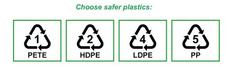 Washington's 2010 ban on the use of the chemical BPA in
baby bottles, children's cups and sports bottles appears to be working. The
Department of Ecology (Ecology) recently tested a number of these products on
retail shelves in Washington and found that BPA has nearly
disappeared. BPA, which stands for Bisphenol A, is a health concern for
children.
In July 2012, Ecology tested 74 products purchased from
nine Washington retailers. BPA levels must be less than 20 ppm. Products
included baby bottles, sippy cups, toddler containers (bowls and plates), and
plastic and metal sports bottles. Nearly all the products collected were
labeled "BPA-free." Most of samples (96 percent) did not contain BPA
levels above20 ppm.
Only one sample turned up with a high enough BPA level
for Ecology to take regulatory action--a polycarbonate sports bottle sold at a
discount store that contained a BPA level of 100 ppm. It was not marketed as
BPA-free, and it was the only bottle of its kind left on the store shelf.
Ecology is working with the retailer, who no longer sells sports bottles, to
ensure that they understand the requirements of the law and do not sell
BPA-containing bottles in the future. The two other bottles containing
detectable BPA were well below Ecology's enforcement limit.
Read
more about BPA on Ecology’s website.
|
|
Child care subsidy training is available
Licensed family home and family, friend and neighbor
(FFN) child care providers who bill the state for child care subsidies are
required to receive child care subsidy training by June 30. The training is
provided by DEL’s partner, Child Care
Aware of Washington.
Take this
training online or request the training be mailed to you by calling
1-866-416-4321 ext. 108.
Portable background checks
On July 1, 2012, the Department of
Early Learning (DEL) instituted portable background checks, which are valid for
three years and are attached to the individual, even if they change employers.
All individuals who are required to undergo a background check must apply for
the new portable background check before July 1, 2013. Individuals must first register in MERIT
and apply for a STARS ID if they do not already have one. More information
about portable background checks is available on DEL’s website.
Upcoming ELAC meetings
There are two upcoming Early Learning Advisory Council
(ELAC) meetings:
-
A special meeting will be held March 25, 9 a.m.
to 2 p.m. at the Lacey
Community Center. The purpose of the meeting is to develop an ELAC work
plan for 2013.
- The next quarterly ELAC meeting is April 8 from
9 a.m. to 3 p.m. The location is to be determined.
Find out more about
ELAC on DEL’s website.
DEL launches online training library
DEL recently launched an online training library to help
early learning professionals find learning resources in one location. The
training categories align with the Washington Core Competencies for Early Care
and Education content areas. Not all of the trainings were developed by DEL;
the page includes trainings from other organizations.
To find out which trainings can earn you STARS credit, search
the MERIT training list.
Visit DEL’s training
library for early learning professionals.
Play
yard safety rules took effect Feb. 28
The U.S. Consumer Product Safety Commission (CPSC) is changing
safety rules about play yards, also known as pack-and-plays or portable cribs.
Beginning Feb. 28, 2013, manufacturers and importers of infant and toddler play
yards are required to test their play yards to ensure that they meet new
federal safety standards.
-
Read more about the new standards on the CPSC blog.
-
Download a poster with the new requirements in English and Spanish.
University of Washington looking for bilingual families
for studies
The University of Washington (UW)
Institute for Learning and Brain Sciences (I-LABS) is looking for
Spanish-English bilingual adults who are healthy, right-handed and between the
ages of 22 and 30. The study will involve two visits of less than two hours
each and participants will receive up to $125. Parking and other transportation
costs will be reimbursed.
I-LABS is also
looking for families who speak English and Spanish at home and have babies four
to 14 months old. Participants must be able to make a one-hour visit to the UW
campus. Participants receive $25 and will be reimbursed for parking, bus fare
or other transportation.
Please contact
I-LABS at 206-616-6221 or kuhllab@u.washington.edu for more information.
Healthy Habits for Healthy Kids: Practical Approaches for
Preventing Childhood Obesity conference will be held April 3 at the Seattle
Center.
This
conference provides practical tools and resources for those working with in
preschool and early learning. Expert speakers will address issues
on establishing healthy eating habits and behaviors to help
maintain a healthy weight. There are sessions focused on regulation and
policy work as well as descriptions of community intervention
programs to expand access to healthy foods and promote positive behavior
change in Washington.
The
conference provides 6.5 hours of continuing education units. Cost to
attend is $125 for Nutrition First members and $145 for non-members (includes
annual membership to Nutrition First).
Register here or visit www.nutritionfirstwa.org/events.
2013-14 preschool and
child care immunization requirements
The Washington State Department of Health (DOH) has issued
the 2013-14 immunization requirements for child care facilities and preschools.
The requirements are the same as 2012-13.
-
Find the new 2013-14 vaccines required for child
care/preschool attendance chart here.
-
he simpler chart for parents showing required
immunizations for child care/preschool attendance is available here.
If you have questions about a flu outbreak in your child
care or preschool, please contact
your local health department.
Are you eligible for
the Earned Income Tax Credit?
Thousands of working families and individuals in Washington
fail to apply for the in Earned
Income Tax Credit (EITC) each year, missing out on up to $5,800 because
they don’t realize they are eligible. If you earned less than $50,000 last
year, you may qualify. To earn this tax credit, you must file a federal tax
return. If you need help, call 2-1-1 and ask for the free tax preparation
center nearest you or click here.
Infant and Early Childhood Conference
The Infant and Early Childhood Conference will be held
May 1-3 at the Greater Tacoma Convention Center. It offers a wide variety of
topics covering every aspect of early childhood education in 125 sessions
featuring local, regional and national speakers. The conference provides high-quality,
evidenced-based workshops, and networking opportunities for families and
providers to come together to learn, share and advocate on behalf of all young
children.
Participants may earn up to 24 clock hours or STARS credits.
A limited number of $100 scholarships are available to people who are required
to earn STARS credits and who work in a DEL-licensed child care facility.
For additional information and to register, visit www.ieccwa.org.
Autism training is
available
The Seattle Children’s Autism Center and the Autism Outreach
Project have partnered to offer Washington state continuing education clock
hours for the Autism 200 Series in 2013.
Designed to provide information and support to families and
professionals working with children with autism spectrum disorders, Autism 101
and Autism 200 are free 90-minute lectures presented at Seattle Children’s and offered
by teleconference to locations around the state. Autism 101 is offered
quarterly and the Autism 200 Series is offered the third Thursday of each month
from 7 to 8:30 p.m.
See the Seattle
Children’s website for additional information and a list of
teleconferencing sites.
Don’t miss early
learning events!
The DEL calendar contains many early learning events in
Washington and beyond. Take
a look at the calendar.
|