
District Leadership for Racial Equity: Lessons From School Systems That Are Closing the Gap
This research brief presents cross-case findings from a study of leaders advancing racial equity in four school districts in the southern United States: Edgecombe County Public Schools in North Carolina, Hoke County Schools in North Carolina, Jefferson County Public Schools in Kentucky, and Pflugerville Independent School District in Texas. We investigate the policies and practices district leaders implemented to reduce persistent disparities in opportunities and outcomes for students of color, including improved test scores, higher graduation rates, and lower rates of exclusionary discipline. These leaders all pursued five key racial equity district leadership strategies: (1) creating a strategic plan for equity; (2) building adult capacity, commitment, and accountability; (3) using data to drive progress toward racial equity; (4) acquiring and allocating resources equitably; and (5) sustaining leadership efforts over time. This brief is based on the book District Leadership for Racial Equity: Lessons From School Systems That Are Closing the Gap.
Read the full brief, published by Linda Darling-Hammond Larkin Willis Desiree Carver-Thomas:
District Leadership for Racial Equity: Lessons From School Systems That Are Closing the Gap
|
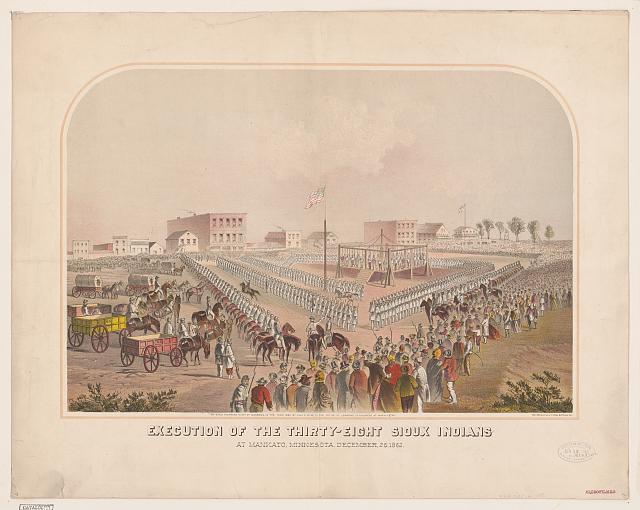 |
Sketch of the public execution of the thirty-eight Sioux Indians, at Mankato, Minnesota, December, 26, 1862.
Each week, DCYF ESIT Tribal Program Consultant, Brian Frisina, provides a key topic to help us get to know our Tribal Nation Partners better.
This week’s term is:
History We Don't Teach
Mankato Hangings an Uneasy Topic for Minnesota Schools
"When is it appropriate to... tell kids this story because it's so difficult? And my answer is always the same, when is it appropriate to lie to them?"
Listen to the Minnesota public radio episode discussing discrepancies over how history is taught, or avoided, in schools (4:31):
History we don't teach: Mankato hangings an uneasy topic for Minnesota schools
It's a troubling piece of Minnesota's past: Thirty-eight Dakota men hanged from Mankato gallows in December 1862. Their deaths scarred generations of native people and cemented Minnesota as home to the largest mass execution in U.S. history.
A widely used sixth grade social studies textbook published by the Minnesota Historical Society describes how U.S. Army officers "rushed through" trials of the Dakota men who "had no lawyers to present their case" and calls it "the largest mass execution in U.S. history, before or since."
But while it's made it into textbooks, responsibility for teaching everything in the standards rests with individual school districts. Read full article.
Media Recommendations
-
Dakota 38 (Film): In the spring of 2005, Jim Miller, a Native spiritual leader and Vietnam veteran, found himself in a dream riding on horseback across the great plains of South Dakota. Just before he awoke, he arrived at a riverbank in Minnesota and saw 38 of his Dakota ancestors hanged. At the time, Jim knew nothing of the largest mass execution in United States history, ordered by Abraham Lincoln on December 26, 1862. “When you have dreams, you know when they come from the creator…” Four years later, embracing the message of the dream, Jim and a group of riders retrace the 330-mile route of his dream on horseback from Lower Brule, South Dakota to Mankato, Minnesota to arrive at the hanging site on the anniversary of the execution.
-
Lakota spiritual leader Jim Miller, founder of Dakota 38+2 ceremonial ride, dies at 74 (article) by Hannah Yang, New Ulm, Minn, March 10, 2023: “He was the voice for people had been forgotten from an event that had been forgotten and buried. Without shaming, without villainizing he stated the facts and he said, "We're gonna forgive everyone everything. And we're gonna pray for everyone when we do this, this isn't just about us, it's about helping to heal the world.’”
Sources

A Step Ahead Pierce County (ASAPC) is a shining example of what it looks like when Early Support for Infants and Toddlers (ESIT) Guiding Principles move from words on a page to meaningful action in the lives of children and families. Under the leadership of Director Lindsey Hartman, ASAPC supports families through a wide range of programs—including ESIT, Boost, Playful Connections, and Bountiful Benefit—all designed to meet families where they are and ensure they feel seen, supported, and empowered.
Lindsey doesn’t just witness the Guiding Principles at work in her professional role—she has lived them.
When Lindsey and her husband Jake welcomed their daughter, they were immediately faced with significant medical challenges. Their newborn was diagnosed with Developmental Dysplasia of the Hip, Torticollis, and Syndactyly. After undergoing a lip and buccal tie revision, she continued to struggle with breastfeeding and could not take a bottle at all. The family turned to ASAPC’s ESIT program, where a team of specialists provided in-home, evidence-based therapy and essential therapeutic feeding tools.
Within just four months, their daughter was breastfeeding and bottle-feeding successfully.
For Lindsey and Jake, this experience illustrates Guiding Principle 1 in action: Families are equal partners who bring to the team, skills, experience and knowledge; are the final decision-makers as to what will work best for their family. When Lindsey and Jake shared what was—and was not—working, they felt truly heard. Jake recalls how affirming it was to be trusted by the team, which in turn helped him feel more confident supporting his children at home.
|
Principles
Submit Your Nomination!
The ESIT state leadership team plans to highlight individual providers or ESIT provider agencies that are demonstrating one or more of the Seven Key Principles in their work in a new section of the ESIT Weekly titled Key Principles in Action. This new section will help us recognize the high-quality agencies and efforts of individual providers across the ESIT statewide system. Nominators will remain anonymous (though we may contact you for more details about your nomination). To make a nomination, please complete the form linked below:
Nominate an ESIT Program or Colleague
There will be no December session for the Supporting Providers Working with Immigrant and Refugee Families series, co-hosted by DCYF and King County, due to holiday scheduling conflicts.
Please take a moment to complete our short scheduling/feedback survey to help us continue improving this space:
Supporting Immigrant and Refugee Families Feedback Survey

Mark your calendars! Join the ESIT State Leadership Team for the upcoming January SICC meeting:
Annual Performance Review (APR)
Wed., Jan. 21, 2026 | 9 a.m. - noon
Jan. SICC APR Zoom Meeting Link
Meeting ID: 833 8594 6074
Passcode: 036938
Agenda TBA
October SICC Draft Minutes Posted
The draft October Meeting Minutes have been posted on ESIT's Meetings page for review.
SICC Direct List
Sign Up for SICC DL to receive meeting materials in advance of upcoming SICC meetings.
Questions?
Contact ESIT Community Collaboration Coordinator, E Renae` Antalan.
|

2026 Unsung Hero Award Nominations Now Open!
DCYF is now accepting Unsung Hero Award nominations for 2026! Do you know a parent, caregiver, guardian, or community member you’d like to recognize? Send in your nomination to strengtheningfamilies@dcyf.wa.gov. Nominations must be received by Jan. 6, 2026.
Read the full message in Español and Soomaali.
|
Since time immemorial, Indigenous Peoples have lived in what we now call the United States, constituting distinct political nations with their own systems of governance. This talk will seek to explore the key concept that underpins the existence of Tribal Nations: sovereignty. It will also cover various aspects of history that have shaped the way in which Tribal Nations have come to operate, including the history of colonization in the Americas, the impact of westward expansion on federal Indian law and policy, and the basic legal concepts that underpin modern government-to-government relationships between the Tribes and the United States.
Hybrid Format
Come in person to Lacey City Hall, Council Chambers or join online. Registration required for online attendance only. Doors open at 6:00 p.m.
Thursday, Dec. 18 | 6:30 - 7:30 p.m.
Lacey City Hall, Council Chambers, Lacey, WA, USA
Register to Join Online Event
Speaker
Kyle Pittman is a Nez Perce descendant and life-long resident of Washington State, having been raised on the Puyallup Indian Reservation in Tacoma. He currently serves as a full-time faculty member at The Evergreen State College teaching in the Native Pathways Program where he offers classes on federal Indian law and policy, Tribal governance, and American Indian histories.

We hope that you will join the 2026 Infant and Early Childhood Conference (IECC), May 4–8, 2026 hosted completely virtual via Zoom.
IECC Partnership Opportunity
IECC is so thankful for its many community partners. Due to their support IECC has been able to shift its platform and offer the conference registration complimentary for all attendees the past few years. In order to continue this complimentary option, IECC needs additional funding and support. If your organization would be willing to partner with us, please email the conference coordinator, Amanda Cardwell, directly at amandacardwell@frontier.com.
|
For more updates, subscribe to these newsletters:
|