|
What’s working in family support and strengthening around Washington state? See what parents and providers have to say.
Federal Impacts on Families (Resources and Guidance)
If you or someone you know is struggling to meet their basic needs, like food, transportation, child care, heating, and other essentials, visit DCYF’s Basic Needs Community Resource Directory.
To locate a local food bank near you, visit:

WA Sees Increase in Families Receiving Child Care Subsidy
Washington children and families are accessing child care more than ever before.
In June 2025, the Department of Children, Youth, and Families (DCYF) reported that more than 63,500 children received child care through the state’s Working Connections Child Care subsidy program, marking the first time the program has served that amount of children since 2010.
“We are thrilled to see increased access to high-quality child care in Washington State, so that it is affordable to more families who need help paying for child care,” says Nicole Rose, DCYF’s Assistant Secretary for Early Learning.
Read the full message in Español and Soomaali.
|
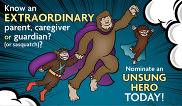
2026 Unsung Hero Award Nominations Now Open!
DCYF is now accepting Unsung Hero Award nominations for 2026! Do you know a parent, caregiver, guardian, or community member you’d like to recognize? Send us your nomination to strengtheningfamilies@dcyf.wa.gov. Nominations must be received by Jan. 6, 2026.
Read the full message in Español and Soomaali.
|
Please Ask: Babies Can’t Wait.
View, download and order the updated Please Ask: Babies Can't Wait brochure from ESIT about early screening and support services for infants and toddlers, including a growth and development screening tool.
Washington State History Museum Opens ‘This is Native Land’ Exhibit: "A new permanent exhibit honoring Native American history debuted in the Washington State History Museum in Tacoma on Sunday. The exhibit, “This is Native Land,” is in the museum’s Great Hall of Washington History." Read the full Seattle Times article.
Two Rivers Documentary Film: “Two Rivers,” an award-winning documentary that was produced in 2003, tells the true story of a Native American Reconciliation group that began in the home of Glenn and Carolyn Schmekel in Twisp in 1997.
Parenting While Rising to Child Developmental Challenges - A Mother’s Perseverance Against All Odds. Nov. 17, 2025, noon – 1 p.m. Sasha Yampolsky is a Speech-Language Pathologist and Reading Specialist who turned all of her skills and devotion toward managing her daughter’s care and recovery after 10-year-old Marina suffered a massive stroke. Register here.
Honoring Sovereignty: Understanding the Roots of Relationship. This foundational session will explore the historical and legal foundations of Tribal sovereignty, helping participants understand Native Nations as distinct governments. Dec. 1 at noon.
The Powerful Impact of Parent Partners in a Major Research Project: The Children’s Trust Fund Alliance’s 11th Annual Birth Parent National Network (BPNN) Virtual Convening. By attending the convening, you will gain a deeper understanding of the Center’s Quality Improvement Center on Helplines and Hotlines, their research activities and early findings; as well as have an opportunity to contribute directly to this meaningful work. Dec. 2, 2025 10 a.m.– noon.
Teachers Troubleshooting Trauma-Based Behaviors: You’re invited to present details about your most challenging situation here. Wednesday, Dec. 3, 2025 at 4 p.m.
Youth Thriving Through Co-Design: Creating Systems of Belonging. Live Online Workshop | Dec. 3, 2025. Join the National Equity Project for a 3-hour virtual interactive session to help you collaboratively design systems where young people truly thrive.
Reflecting and Responding: Staying in Relationship When Behavior Challenges Us. This workshop will provide practical tools and strategies that complement your existing behavior management techniques, ensuring that your responses promote learning, growth and relationship deepening opportunities. Dec. 9, 9 a.m. – noon, $100.
Standards of Quality Certification Training from National Family Support Network: The nationally-adopted Standards of Quality for Family Strengthening & Support are used across the country by public departments, foundations, networks, community-based organizations, and families as a tool for planning, providing, and assessing quality practice. This training provides a certification in the standards. Dec. 16 and 17, 8 a.m. to 2 p.m. $257.94.
National Substance Use Disorder Summit 2026, The First 1,000 Days: Shifting Policy and Practice Together with Families in Recovery. Join the Brazelton Touchpoints Center (BTC) for its fifth National Substance Use Disorder (SUD) Summit on Wednesday, Feb. 11, 2026, from 8 a.m. – 2:30 pm. $75 early bird registration rate until Dec. 31.
Washington State Department of Health secures USDA funding to maintain WIC benefits through mid-to-late November: The Washington State Department of Health (DOH) has received additional funding from the U.S. Department of Agriculture (USDA), allowing the state to continue providing food benefits and supporting its currently reduced 11-member administrative team for the state’s Women, Infants and Children (WIC) Nutrition Program through mid-to-late November.
Nourished and Active in Early Learning: Nourished and Active in Early Learning is a collaboration between the Department of Health and partners to offer trainings, materials and resources that help early learning programs adopt best practices in nutrition, physical activity, breastfeeding and media use. Check out all the resources on the Department of Health webpage.
Supporting Behavior Through Connection: This practical resource for families and early childhood practitioners shifts the focus from compliance to connection. It offers simple, relationship-centered strategies to respond to challenging behavior in ways that help children feel safe, valued, and supported. The resource describes three practices, including examples and prompts, that can be used in everyday routines to build trust and connection with children.
Self-Care is Critical for Caregivers with Unique Challenges: November is National Caregivers Month. Caring for individuals with disabilities or complex medical needs can be emotionally and physically draining, making intentional self-care essential for long-term well-being. Simple practices like mindfulness, getting enough sleep, going for a walk, or taking a few deep breaths can help reduce stress and build resilience. Read more about self care for caregivers from PAVE.
2025 State of Mental Health in America: Mental Health America has published the 2025 State of Mental Health in America Report, which highlights the latest national data and state-level rankings on mental health and well-being in the U.S.
The Children’s Trust Fund Alliance Birth Parent National Network is looking for more members! “We are a national network of hundreds of birth parents and organizations working together to strengthen families, communities and systems by engaging the voices of parents.” Seeking application from parents, organizations, and stakeholders.
Join a University of Washington Study: A PhD student from the UW School of Nursing is conducting a study to better understand how childhood hardships might shape the way parents think and feel about their preterm child’s chronic medical conditions (such as heart, lung, stomach/digestive, or brain/nervous system challenges). Learn More Here.
|