|
The Washington State Department of Children, Youth, and Families (DCYF) is now accepting Unsung Hero Award nominations for 2026!
Do you know a parent, caregiver, guardian, or community member you’d like to recognize? Send us your nomination to strengtheningfamilies@dcyf.wa.gov.
Nominations must be received by Jan. 6, 2026. Nomination forms are available in English, Spanish, and Somali.
Twenty-eight new Unsung Hero Award recipients (one for each day of the month) will be honored at an in-person “Parent Recognition Month” dinner event in February.
Since 2011, nearly 400 parents and caregivers across Washington have received the Unsung Hero award.
 Apple Health After-Pregnancy Coverage (APC) Welcoming a new baby brings many changes, but access to health care should remain constant. Washington’s Apple Health APC ensures individuals continue to receive care for up to 12 months after a pregnancy ends—whether through birth or pregnancy loss—when physical and emotional support are most important.
What is APC? APC is a full Apple Health (Medicaid) benefit that helps new parents recover, manage chronic or mental health conditions, and access preventive care. It provides peace of mind so individuals can focus on healing and caring for their families.
What Services Are Covered? APC offers the same coverage as during pregnancy, including:
- Primary and specialty care
- Hospital services
- Prescription drugs
- Mental and behavioral health care
- Preventive visits and screenings
- Family planning services
Who is Eligible? You may qualify if you:
- Were pregnant in the last 12 months
- Live in Washington State
- Have an income at or below 210% of the Federal Poverty Level
- Are not eligible for another Apple Health program Note: Immigration status does not affect eligibility.
How to Apply
-
Already on Apple Health? Report your pregnancy. APC begins automatically the month after it ends and lasts 12 months, even if income or household size changes.
-
Not enrolled during pregnancy? You can still apply within 12 months after your pregnancy ends.
Why It Matters Many serious health conditions can arise after pregnancy. APC provides stability and access to the right care at the right time.
Learn more at hca.wa.gov/apc or apply online through Washington Healthplanfinder.
FRIENDS National Center for Community-Based Child Abuse Prevention (CBCAP) works alongside the Children’s Bureau to help states, Tribes, and local programs strengthen families and elevate parent voice in child abuse prevention efforts. To bring this vision to life, FRIENDS created a Parent Advisory Council (PAC) made up of parents and family members who share their lived experiences to help shape national training and support. FRIENDS is looking for parents or family members with lived experience in prevention services to join the PAC! Nominations are open Oct. 1-31, 2025. Please follow this link for more information: FRIENDS PAC Call for Nominations - Friends NRC

Resources for Families in Need During Federal Shutdown
Although the current government shutdown is not directly impacting DCYF programs or services, many benefits like SNAP are accessed by the children, youth, and families we serve.
Read more for ways to access food and other basic needs resources.
|

WA Sees Increase in Families Receiving Child Care Subsidy
Washington children and families are accessing child care more than ever before.
In June 2025, the Department of Children, Youth, and Families (DCYF) reported that more than 63,500 children received child care through the state’s Working Connections Child Care subsidy program, marking the first time the program has served that amount of children since 2010.
“We are thrilled to see increased access to high-quality child care in Washington State, so that it is affordable to more families who need help paying for child care,” says Nicole Rose, DCYF’s Assistant Secretary for Early Learning.
Read more at the DCYF What's New blog.
|
Resources for Families Impacted by Immigration-Related Concerns
We are excited to announce that the Family Separation Rapid Response Team Resource Flyer is now available in multiple languages on our website. This is a comprehensive list of trusted resources for families at risk of separation due to immigration-related detention or deportation.
View and download the flyer here: Resources for Families Impacted by Immigration-Related Concerns.
Free virtual Home Visitor Training series with presenters from a wonderful team of experienced and wise home visitors and WSCADV staff!
The two-day DV Assessment and Response training is offered three times per year, and Safety Planning is offered three times as well.
- First - please register for a DV Assessment and Response training
- Second - please register for a Safety Planning training
|
DV Assessment and Response (Zoom Webinar)
Sept. 29, 2025 (part 1) Sept. 30, 2025 (part 2)
10-11:30 a.m., both days
|
|
|
| |
|
DV Assessment and Response (Zoom Webinar)
Jan. 22, 2026 (part 1) Jan. 23, 2026 (part 2)
10-11:30 a.m., both days
|
|
|
|
|
Safety Planning with Families (Zoom Meeting)
Oct. 17, 2025 9:30 a.m.-2:30 p.m. Break from Noon - 1 p.m.
|
|
|
| |
|
DV Assessment and Response (Zoom Webinar)
Feb. 24, 2026 (part 1) Feb. 25, 2026 (part 2)
10-11:30 a.m., both days
|
|
|
|
|
Safety Planning with Families (Zoom Meeting)
March 20, 2026 9:30 a.m.-2:30 p.m. Break from Noon-1 p.m.
|
|
|
|
|
Safety Planning with Families (Zoom Meeting)
May 27, 2026 9:30 a.m.-2:30 p.m. Break from Noon-1 p.m.
|
|
|
|
Home Visitor Peer Connection
Home Visitor Peer Connections provide an open space for home visitors across the state to connect with each other about their work. During this time there will be a focus on the Washington State Home Visiting Core Competencies.
The latest peer connection in September focused on Core Competency 2: Effective Home Visiting. Participants reflected on what makes home visiting effective and shared examples from recent visits. Key themes included the importance of communication, emotional safety, and trusting relationships. Breakout groups highlighted the specific skills and approaches that contributed to success. For future planning, facilitators will align discussion questions with the Core Competency Team Discussion Guide to reinforce learning and deepen reflection.
Our next session will be held on Wednesday, Nov. 19 (11-Noon)
Participation is flexible—you’re welcome to join sessions as your schedule allows. Each session stands on its own. Register Here
*Note: Peer connections are offered every other month. Upcoming dates will be posted on an ongoing basis.
Contact Adrienne Matthias (amatthias@startearly.org) or Alex Patricelli (apatricelli@startearly.org) with any questions.
Perinatal Mental Health in Practice: Extended Learning Opportunity (ELO) is open to all home visitors and supervisors who carry a caseload. In this one-hour session, facilitated by Mia Edidin LICSW, home visitors and supervisors receive real-time support and learning opportunities. Participants will have the opportunity to take part in case consultation and resource sharing, ensuring home visitors have the tools they need to provide high-quality, family centered screening and support.
Groups are held from Noon-1 p.m.:
ELO: November 18
ELO: December 4
ELO: February 26
ELO: April 9
Change Concept – A general notion or approach to change that has been found to be useful in developing specific ideas for changes that lead to improvement.
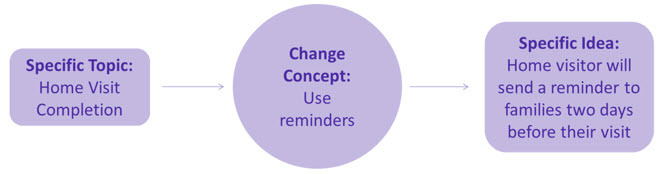 9 Categories of Change Concepts
- Eliminate Waste
- Improve Workflow
- Optimize Inventory
- Change the Work Environment
- Enhance the Client Relationship
- Focus on Time
- Manage Variation
- Mistake Proofing
- Focus on a Product/Service
Each month, DCYF ESIT Tribal Program Consultant Brian Frisina will provide a key topic to help support us all in getting to know our Tribal Nations partners better.
This month’s topic is:
Unlearning Columbus Day Myths: Celebrating Indigenous Peoples' Day
Many students learn the phrase, "In 1492, Columbus sailed the ocean blue". But Columbus was not the first foreign explorer to land in the Americas. Neither he nor those that came before him discovered America—because Indigenous Peoples have populated the Western Hemisphere for tens of thousands of years. European contact resulted in devastating loss of life, disruption of tradition, and enormous loss of lands for Indigenous Peoples in the Americas. It is estimated that in the 130 years following first contact, Native America lost 95 percent of its population. Learn more:
Native Knowledge 360° Essential Understandings about American Indians
Indigenous Peoples Day celebrates a difficult history
This second Monday of October honors the history and culture of Indigenous Peoples in our country. It’s been an official national holiday since last year, replacing Columbus Day in most of the U.S. San Diego County is home to 17 tribal communities, the most of any county in the country. KPBS Education Reporter M.G. Perez takes us to a local high school celebrating a difficult history (watch time 2:44):
Indigenous Peoples Day celebrates a difficult history
Book Recommendation
-
Fighting for the Puyallup Tribe: A Memoir, by Ramona Bennett Bill: A relentless advocate for Native rights, Ramona Bennett Bill has been involved in the battles waged by the Puyallup and other Northwest tribes around fishing rights, land rights, health, and education for over six decades. This invaluable firsthand account includes stories of the takeover of Fort Lawton as well as events from major Red Power struggles, including Alcatraz, Wounded Knee, and the Trail of Broken Treaties [...] her experiences at the Puyallup fishing camp established during the Fish War of the 1960s and 1970s, which led to the federal intervention that eventually resulted in the Boldt Decision [...] the 1976 occupation of a state-run facility on reservation land and the lobbying that led to the property’s return to the tribe.
Sources
October is LGBT History Month
Background
In 1994, Rodney Wilson, a Missouri high school teacher, believed a month should be dedicated to the celebration and teaching of gay and lesbian history, and gathered other teachers and community leaders. They selected October because public schools are in session and existing traditions, such as Coming Out Day (Oct. 11), occur that month.
Learn more about the background of LGBT history month and the featured LGBTQ+ icons of 2025:
About LGBT History Month
History of Pride Since The 1800s
A living history of the LGBT movement (watch time 5:41):
History of Pride Since The 1800s
Home Visiting Yearbook Now Available
The National Home Visiting Resource Center (NHVRC) has released its 2025 Home Visiting Yearbook, a nationwide and state-by-state look at early childhood home visiting. The publication presents 2024 data from evidence-based and emerging home visiting models and from state agencies and the Administration for Children and Families to highlight—
—Where programs operate, the families they serve, and the families who could benefit but are not being reached
— Profiles of states, models, and Indigenous-led organizations
Users can navigate the NHVRC website to access data and download short publications, including the Yearbook Summary. The 2025 Yearbook includes virtual and in-person home visit data to reflect the field’s hybrid approach to delivering services. It also includes links to national data sources for maternal and child health indicators to offer insight into family well-being and the potential need for services.
Below are resources and opportunities to engage:
Cultural Appropriation vs. Appreciation
What is Cultural Appropriation?
What is culture? How can it be appropriated? Thankfully, we have Dr. Danielle Bainbridge, host of Origin of Everything, to guide and inform us (watch time 9:38):
Can Culture Be Appropriated?
Yes, let's acknowledge each other's cultures. Yes, there are ways to honor them and appreciate them. But what is the difference between appreciating someone's culture and co-opting it? This episode of What I Hear When You Say lays it out with clear present-day examples (6:38):
Cultural Appropriation vs. Appreciation
|