|
The Perinatal Period can last from pregnancy through the first years of a child’s life. During that time, 1 in 5 women and 1 in 10 men experience a perinatal mental health issue. Finding help can be hard. There are many ways to support your emotional well-being. If your symptoms get in the way of your daily functioning, it is time to seek help. Strengthening Families Washington, at the Department of Children, Youth, and Families, has partnered with Perinatal Support Washington (PS-WA) to update the previously titled brochure Speak Up When You're Down: Recognizing Postpartum Depression. It has been renamed Every Feeling Matters: Supporting families impacted by Perinatal Mood and Anxiety Disorders (PMADs) and now addresses the spectrum of mood disorders that can impact all parents. You can find a digital copy of the new brochure online. In addition, we are working quickly to get these new brochures, available in both English and Spanish, on MyPrint.wa.gov. These will be available to order for free, with a limit of 250 per order.
Open the Door: Talking with Fathers who Want to Change their Controlling, Coercive and Abusive Behavior
When experienced home visitors have an opportunity to engage with fathers about their parenting and its impact on relationships, it can be challenging to know what to say or do when the father is using coercive or abusive behavior with family members.
With the leadership, guidance and content expertise provided by experienced home visitors and domestic violence advocates, WSCADV has facilitated the development of The Father Engagement Tool: Open the door: talking with fathers who want to change their controlling, coercive and abusive behavior in English and Spanish as a free PDF download from the WSCADV website. The tool was created to help experienced home visitors by providing guiding questions and suggestions for home visitors, survivors of domestic violence, and fathers to consider before, during, and after conversations.
If want to know how to use this tool, please watch the webinar training led by three authors of the Father Engagement Tool who share their thinking about the purpose of the tool for experienced home visitors. Please note: The presenters speak in English, and English captions are available. The PowerPoint slides are in Spanish. We recommend using the English PowerPoint slides to follow along with the training for English speakers. The authors review each panel of Father Engagement tool during the webinar. Also, on the WSCADV website, home visitors will also find companion resources to support parenting for fathers and the whole family.
When you go to the WSCADV website, home visitors will find additional resources including how to partner with their local domestic violence advocacy organization while working hand in hand with dv advocates to support survivors, their families, and communities to be safer, stronger, and more connected.
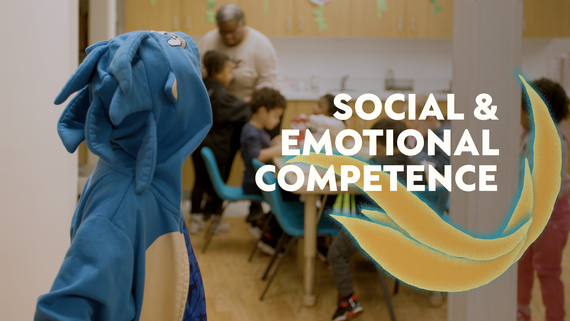 We are so excited to share the latest of our films focusing on the Protective Factors done by First Sight Productions. This video, Social and Emotional Competence, focuses on the important role that a child (and parent's) social and emotional intelligence plays in the growth and development of childhood.
Multicultural Child and Family Hope Center is a Family Resource Center that provides a variety of wrap around services including childcare, diaper bank, parenting classes and more. We are so grateful to partner with them in a variety of ways over the years and for the work that they do daily to support families in the Tacoma area.
There are five protective factors known to help reduce child abuse and neglect: Knowledge of Parenting and Child Development, Social Connections, Resilience, Concrete Support in Times of Need, and Social and Emotional Competence of Children/Nurturing and Attachment. You can watch our earlier videos on Resilience and Social Connections. If you are interested in partnering with First Sight for a later video on Parenting and Child Development, please email Kyra.Ingraham@dcyf.wa.gov.
On July 4, 2025, Congress signed into law a continuing resolution for the federal budget. It contains numerous changes that impact Apple Health and the individual market. (Apple Health is what we call Medicaid in Washington state.) The Health Care Authority (HCA) and our partners are still assessing the full scope of impacts to Apple Health but anticipate significant administrative changes and new state costs associated with implementation. You can find more information about the direct impact to Washington residents in this fact sheet created by Health Care Authority or in this more detailed guide.
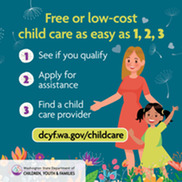
Spread the Word about Free/Low-Cost Child Care
Many families living in Washington state qualify for free or low-cost child care, but they may not know about it. You can help by sharing information with parents, caregivers, and your community.
The Washington State Department of Children, Youth & Families (DCYF) has put together a toolkit with ready-to-use materials that make spreading the word easy!
Visit www.dcyf.wa.gov/childcare/toolkit to access printable flyers, sample social media posts, and email templates.
Whether you work directly with families or want to help your community stay informed, these resources make it easy to connect families to the support they need.
Want to know more about the Working Connections Child Care Subsidy Program? Visit www.dcyf.wa.gov/childcare or call 844-626-8687. Help is available by phone in multiple languages.
|

New State Laws Help Open Doors to More Child Care Access
Great news! Recent legislation reduces barriers to early education and child care providers.
Individuals wanting to become licensed child care providers, and community organizations, such as churches, seeking to use existing facilities for child care programs, can benefit from local siting and zoning changes aimed to expand places where child care can be made available.
Three new laws, that are effective July 27, 2025, were created to ease the burden to do business in Washington state for child care providers, or prospective child care providers. Further, the legislature funded DCYF to provide technical assistance to individuals and organizations that want to become a provider or expand their early learning child care facilities.
To learn more about the new law changes, read the DCYF web article.
|

Washington Continues to Offer Free to Low-Cost Early Care and Education to Families in Need
As you may be aware, the federal government has announced a policy change related to several federal funding streams, including Head Start, that could impact the ability for undocumented families to access educational programs for young children.
We are still assessing the impact of this federal policy shift. However, families — regardless of their immigration status--continue to have access to the following free to low-cost child care and early learning programs offered by the Washington State Department of Children, Youth, and Families (DCYF).
View this bulletin to learn more about Working Connections Childcare (WCCC) and ECEAP.
|

Washington State Makes it Easier for Relatives to Become Licensed Caregivers
The Washington State Department of Children, Youth, and Families (DCYF) launched new licensing standards that make it easier for relatives to become licensed caregivers, which provides additional supports to care for children and youth in foster care.
The new Kinship Licensing Standards — launched July 1 — include 50% less forms for applicants to fill out.
The new standards also established a kinship home study with less questions than the current community foster care licensing process.
Read more by visiting our What's New Blog.
|

Sign Up for the New JR Family Newsletter and Alerts
DCYF knows that when families stay connected and support young people in Juvenile Rehabilitation (JR), this produces better outcomes and more successful futures.
To that end, this month, DCYF is launching the JR Family Newsletter for families and friends of those in juvenile rehabilitation. The online newsletter will contain information about programs, safety, and news, and serve as a tool to help better connect you all with what is going on in JR.
To learn more and to subscribe, visit the What's New blog.
|
The following are examples of tests that were conducted during Q4 by CQI topic:
Enrollment and Outreach
- Refine referral to enrollment process with the goal of enrolling interested families sooner.
Staff Engagement and Retention
- Create safety protocol for home visitor which includes agency badge (if available) and home visit schedule availability for supervisor.
- Appoint home visitor of champion of upcoming data system changes to provide professional development and empowerment.
- Supervisor formally embeds data review into Reflective Supervision.
Family Engagement and Retention
- Conduct parent survey to better meet needs of enrolled families.
Caregiver Mental Health
- Utilize visit checklist to ensure assessments are completed at appropriate visit.
- Utilize assessments due form to track timelines for individual families.
Home Visitor Peer Connection
Home Visitor Peer Connections provide an open space for home visitors across the state to connect with each other about their work. During this time there will be a focus on the Washington state Home Visiting Core Competencies.
Competencies are observable actions that require a combination of knowledge, skills, and attributes necessary to perform a major task or function in the work setting. Each session will focus on one competency area to support the enhancement of skills, knowledge, and attributes of home visiting work. Participation is flexible—you’re welcome to join sessions as your schedule allows. Each session stands on its own.
Our next session will be held on Thursday, Sept. 25th (10:30-11:30 a.m.)
Register Here *Note: Peer connections are offered every other month. Upcoming dates will be posted on an ongoing basis.
Contact Adrienne Matthias (amatthias@startearly.org) or Alex Patricelli (apatricelli@startearly.org) with any questions.
Each month, DCYF ESIT Tribal Program Consultant Brian Frisina will provide a key topic to help support us all in getting to know our Tribal Nations partners better.
This month’s topic is:
A Native Perspective on the Buried History of America
The Doctrine of Discovery: Unmasking the Domination Code
Vatican documents issued by various popes during the fifteenth century created global patterns of domination, leading ultimately to the current ecological crisis. The wisdom teachings of original nations and peoples provide a way forward for the well-being of the planet and our future generations. Watch the trailer (watch time 3:34) and learn more about where to view the film:
The Doctrine of Discovery: Unmasking the Domination Code
The Doctrine of Domination
The Doctrine of Discovery is rooted in papal bulls and European charters, claiming Christian nations' right to dominate and dispossess indigenous peoples (watch time 19:31):
The Doctrine of Domination by Steven Newcomb
Dismantling the Doctrine of Discovery
The Doctrine of Discovery originated with the Christian church and was based on Christian scripture, including the Great Commission, the divine mandate to rule based on Romans 13, and the narrative of a covenantal people justified in taking possession of land as described in the Exodus story. Learn more:
Dismantling the Doctrine of Discovery
Media Recommendations
- (Book) The Indigenous Paleolithic of the Western Hemisphere, by Paulette F.C. Steeves: The Indigenous Paleolithic of the Western Hemisphere is a reclaimed history of the deep past of Indigenous people in North and South America during the Paleolithic. Paulette F. C. Steeves mines evidence from archaeology sites and Paleolithic environments, landscapes, and mammalian and human migrations to make the case that people have been in the Western Hemisphere not only just prior to Clovis sites (10,200 years ago) but for more than 60,000 years, and likely more than 100,000 years.
- (Video) A Native Perspective on the Buried History of America (watch time 58:09): Most people are unaware that the Declaration of Independence, 30 lines below the statement "all men are created equal" refers to the Native Americans as "merciless Indian savages." Mark Charles (Navajo) [...] is currently working to bring about a national dialogue on race, specifically regarding the Doctrine of Discovery and its influence on the very foundations of our nation, including the Declaration of Independence, the Constitution and the United States Supreme Court.
Sources
-
The Doctrine of Discovery: Unmasking the Domination Code, posted on Vimeo from Original Free Nations Advocates, Dec. 8, 2020, TM + © 2025 Vimeo.com, Inc.
-
The Doctrine of Domination by Steven Newcomb, posted on YouTube by Indigenous Values Initiative, Aug. 14, 2020.
-
Dismantling the Doctrine of Discovery, © Beloved Community Initiative.
-
The Indigenous Paleolithic of the Western Hemisphere, by Paulette F.C. Steeves, published July 1, 2021, by University of Nebraska Press, © 2025 Goodreads, Inc.
-
A Native Perspective on the Buried History of America, posted on YouTube by Franklin & Marshall College, Oct. 17, 2016.
Improving Recruitment and Uptake for Home Visiting Services: A new report from Child Trends shares the results of an evidence review—funded by the Conrad N. Hilton Foundation—on ways to improve recruitment and uptake for home visiting services.
MyWABenefits: All Your Washington Benefits Now in One Place. The MyWABenefits platform launched in early June. The goal is to provide clarity about application for benefits, easily navigate the process, and receive benefits, including child care subsidy copays.
Better Sleep, Healthy Brain: Healthy sleep habits are important for adults—but for babies who are constantly taking in new information about the world, getting sufficient sleep to process and develop memories is paramount. Surprisingly, research shows adequate, routine sleep doesn’t just promote the health of pregnant mothers, but also their babies. Listen to the ‘The Brain Architects podcast.
Below are resources and opportunities to engage:
Just Ask!: Be Different, Be Brave, Be You by Sonia Sotomayor - Read Aloud: Feeling different, especially as a kid, can be tough. But in the same way that different types of plants and flowers make a garden more beautiful and enjoyable, different types of people make our world more vibrant and wonderful (watch time 7:13).
Just Ask by Sonia Sotomayor Learn more about the book: Just Ask!: Be Different, Be Brave, Be You by Sonia Sotomayor.
Culturally-Informed Approach to Mental Health: Dr. Jessica Dere explains how culture makes a difference when thinking about mental health and mental illness. Across mental health research, clinical care and teaching, there are profound rewards to be had by truly understanding individuals in context (watch time 17:57).
|