What’s working in family support and strengthening around Washington state? See what parents and providers have to say.
Kitsap Community Resources collaborates with DCYF: This week, we highlight a story from a Parent-Child Educator with the KCR Home Visiting team, Lou Baum:
In the role of Home Visitor, our families come to trust us as family advocates and know that we want what is best for their entire family. When families are working with DCYF, our team becomes the conduit between the two parties.
For many of our families, the presence of a social worker will bring up anxious feelings and past trauma. Home Visitors become a support system to families who are uncomfortable being alone with DCYF. Parents want to make sure they ask the right questions, answer questions fully, and know what they need to do next. When we are with our families, we take notes and help parents remember everything that occurred.
After meeting with DCYF, we talk through what has happened, what it all means, and what the family needs to do. We affirm the parents' ability to be their child's best advocate. If changes need to be made, we discuss those changes. If additional support is needed, we work to connect the right resources to the family. We will try to connect with the DCYF employee to make sure the parent is on track and what else DCYF may need to move forward.
I think it's important to remember that Kitsap Community Resources vision is: We envision a community in which everyone thrives. We live this vision every day in our role of Home Visitor. We want our families to have the support and the confidence needed to thrive in our community. When our families feel supported and confident, they are more likely to make decisions that will positively impact their families.
Have a story to share? Email it to Joy Lile at strengtheningfamilies@dcyf.wa.gov.
|

New State Laws Help Open Doors to More Child Care Access
Great news! Recent legislation reduces barriers to early education and child care providers.
Individuals wanting to become licensed child care providers, and community organizations, such as churches, seeking to use existing facilities for child care programs, can benefit from local siting and zoning changes aimed to expand places where child care can be made available.
Three new laws, that are effective July 27, 2025, were created to ease the burden to do business in Washington state for child care providers, or prospective child care providers. Further, the legislature funded DCYF to provide technical assistance to individuals and organizations that want to become a provider or expand their early learning child care facilities.
To learn more about the new law changes, read the DCYF web article.
|
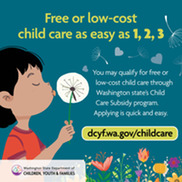
Need Help Paying for Child Care?
You may qualify for free or low-cost child care through Washington state’s Child Care Subsidy program. It’s available to more families than ever, and signing up is as easy as 1, 2, 3.
If you qualify, you’ll pay no more than $165 a month. Some families pay nothing at all!
Apply online or by phone. Visit www.dcyf.wa.gov/childcare or call 844-626-8687. Help is available by phone in multiple languages.
Help spread the word! Pass this on to a family you know.
|
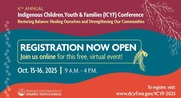
Register now for the 6th annual Indigenous Children, Youth and Families conference!
Free, online, virtual event. October 15-16, 9 a.m. – 4 p.m. Register at: The Alliance Training Portal.
|

WA Continues to Offer Free to Low-Cost Early Care and Education to Families in Need
As you may be aware, the federal government has announced a policy change related to several federal funding streams, including Head Start, that could impact the ability for undocumented families to access educational programs for young children.
We are still assessing the impact of this federal policy shift. However, families — regardless of their immigration status--continue to have access to the following free to low-cost child care and early learning programs offered by DCYF.
For information, please read the full message from DCYF Secretary Tana Senn.
|

DCYF launches JR Family Communications Webpage
DCYF has launched a new webpage for families and friends of those in juvenile rehabilitation (JR). The webpage will include family specific resources and communications to support the families of those in JR. Read more on our What's New Blog.
|
Please join us to reflect on lessons from the Washington State Crisis Respite Project
Parenting can be overwhelming, and sometimes families need a safe place for their children while they take a moment to rest, handle a difficult situation, or respond to an unexpected event. Crisis respite offers short-term care for children when parents and caregivers need support and have no safe alternatives.
During the pandemic, the Strengthening Families WA team at the Washington State Department of Children, Youth and Families heard the need for crisis nurseries or crisis respite expressed. In these sessions, we'll share what we've learned exploring these services including our accomplishments so far, lessons from the journey and our hopes for the future. You'll hear from our community partners who are helping build this important safety net for families.
Please join us for one of two sessions.
- Aug. 28, 10–11:30 a.m.
- Sept. 25, 2–3:30 p.m.
Contact Marilyn.Gisser@dcyf.wa.gov to register.
Somos Latine Families from Brazelton Touchpoint Center. Explore what it means to be a parent as part of the Latine community, raising Latine children while navigating U.S. mainstream cultures, and connecting Latine cultural identities to physical and mental well-being. A four-part series: Sept. 8, Oct. 6, Oct. 27, Nov. 10, Noon-1 p.m.
KIDS COUNT® data project economic justice briefs: The economic indicators we are highlighting in these briefs explore issues including the child poverty rate, Basic Food enrollment, and median family income for Washington families and counties.
Strengthening Relationships with Families of School-age Children from Brazelton Touchpoints Center. This 5-part workshop series dives deep into concrete, strengths-based and relationship-focused strategies that school and out-of-school-time staff can use to partner with families in cooperative support of their children. Wednesday, Sept. 17, @ 12:30 p.m.
2024 Help Me Grow Impact Report: Lunch & Learn Webinar. Join us for a Lunch & Learn Webinar to learn more about the 2024 Help Me Grow Washington Impact Report and progress made on the Help Me Grow Washington Strategic Plan! Aug. 13, 2025 02 p.m.
Navigating Challenging Conversations Series. Join BTC for three virtual workshops that explore how individual contexts and preconceived notions may affect when and how we experience conversations as challenging. Thursdays, Aug. 14, 21 and 28, Noon–1:30 p.m. PT, $126
Transformational Leadership in Advancing Infant and Early Childhood Mental Health (IECMH) Policy from Zero to Three. Sarah Barclay Hoffman, Program Manager with the Community Mental Health CORE team at Children’s National and Director of Policy for the Early Childhood Innovation Network, brings a rich background in perinatal and early childhood mental health, pediatric care integration, and collaborative policy development across systems. Aug. 26, 2025, 11 a.m.-Noon
The 2025 Peaks to Coast: United Opioid & Polysubstance Response Summit. Recognizing the critical role of skilled professionals in the fight against opioid addiction, the summit focuses on equipping individuals with the knowledge, skills, and resources they need to deliver effective and compassionate care to those struggling with substance use disorders. Sept. 4 and 5, $25.
Dad Allies Provider Learning Series: How We Get Off the Trauma Triangle That Fuels Gender Polarizations of Villains, Victims and Heroes. This talk is a compassionate and trauma-informed approach of how we got here and how we can get unstuck from the unhealthy cycle of the trauma triangle that fuels polarizations around gender and perpetuates inequalities. 11:30 a.m. to 1 p.m., Thursday, Sept. 18, 2025.
Family Support Summit: Focus on Fathers and Parent Leaders from National Family Support Network. The second installation in the 2025 Family Support Summit series with powerful, topic-driven gatherings designed for the field, by the field. Oct. 22-23, 8 a.m. – 2:30 p.m.
A Call to Action to Change Child Welfare: 2025 Conference. This virtual conference is designed for a call to action – to spur creativity, insight, and catalyze change. Oct. 6-9, 2025.
Washington Fatherhood Council staff positions at DSHS eliminated due to budget cuts. “This does not mean the work is stopping. The council will continue to meet, and we have put a transition team in place to support our next developmental leap.” Full message from outgoing Council Director, Anne Stone.
Voices of Families report: In 2024, Zero To Three conducted listening sessions with 35 parents from across Washington state who were involved with child welfare. The Voices of Families report shares these parents’ perspectives on several different themes.
Culturally relevant suicide prevention resources: The Health Care Authority (HCA) has compiled resources for culturally relevant suicide prevention guides and programs. These resources aim to support people with specific identities, experiences, and cultural backgrounds for suicide prevention.
A Longitudinal Analysis of a Rural Family Resource Center and the Cost Benefits to the County-Based Welfare System: a new article in the Summer 2025 edition of the Family Justice Journal, in collaboration with the National Family Support Network.
International Overdose Awareness Day (IOAD) is Aug. 31: See the toolkit. This year’s theme, One big family, driven by hope, highlights the power of our community when we all stand together.
OCVA Healing, Support & Transition Services Grant: Statewide Coordination. OCVA is looking for proposals from qualified organizations that can help bring together and support service providers across the state. The goal is to organize and lead statewide meetings, quarterly, for programs that offer healing, support, and transition services, as well as related services. Closes Aug. 18.
Applications for multifamily rental housing projects seeking capital financing from the Washington State Housing Trust Fund (HTF) and the federal HOME and National Housing Trust Fund (NHTF) programs are open until Oct. 16.
Families at the HEART Funding Opportunity: Perigee Fund is pleased to announce a new funding opportunity Families at the HEART, a national initiative designed to support the growth of community-rooted mental health models that, once expanded, will increase access for families during pregnancy and early childhood. The intent of this initiative is to transform systems by strengthening the models that are already successfully serving families, models that are teachable, replicable, and accessible.
Early Learning Facilities Program: The Early Learning Facilities (ELF) program supports Washington’s commitment to develop additional high quality early learning opportunities for children from low-income households.
Women Helping Women Foundation is hosting a virtual Grant Information Session for prospective grant applicants. During this session, they will cover eligibility criteria, grant timeline, and helpful tips.
VOCA By and For Victim Services grant: Funding is now available to develop and enhance healing-centered, culturally and community specific support services for BIPOC, LGBTQIA+, and unserved individuals who have experienced hurt, harm or crime. Services and activities must be provided by organizations that are operated by and for the community to be served.
2026 Community Based Care Coordination Partner Submission of Interest: BHT is now expanding our approach to Community Care Hubs by opening the opportunity to partners who are currently providing community based care coordination in eastern Washington. Our hope is to build a strong network of care, centralize data sources so we can identify equity gaps, and support partner capacity and growth so our region can thrive. Closes Oct. 1.
|