|
Please note that there will be no issue of the ESIT Weekly sent out next week, Fri., Jan 24, in observance of the Martin Luther King Jr. Day (Jan. 20). The ESIT Weekly will resume its regular schedule on Fri., Jan. 31.
Thank you!

What Side Are You On? A Tohono O'odham Life across Borders by Michael Steven Wilson and José Antonio Lucero
Renowned human rights activist Michael "Mike" Wilson has borne witness to the profound human costs of poverty, racism, border policing, and the legacies of colonialism. From a childhood in the mining town of Ajo, Arizona, Wilson's life journey led him to US military service in Central America, seminary education, and religious and human rights activism against the abuses of US immigration policies. With increased militarization of the US-Mexico border, migration across the Tohono O’odham Nation surged, as did migrant deaths and violent encounters between tribal citizens and US Border Patrol agents. When Wilson's religious and ethical commitments led him to set up water stations for migrants on the Nation's lands, it brought him into conflict not only with the US government but also with his own tribal and religious communities. Read more about the book and the authors:
|
“Indian tribes are part of the constitutional structure of government. Tribal authority was not created by the Constitution—Tribal sovereignty predated the formation of the United States and continued after it—but tribes were acknowledged by the Constitution in the reaffirmation of previously negotiated treaties (most of which were with Indian Tribes), the two references to “Indians not taxed,” and the Indian Commerce Clause. Relations were then cemented through the treaties and treaty substitutes. The modern presidency, Congress and Supreme Court continue squarely to acknowledge this third source of sovereignty in the United States …’ —Charles F. Wilkinson
Each week, DCYF ESIT Tribal Program Consultant, Brian Frisina, provides a key topic to help us get to know our Tribal Nation Partners better.
This week’s term is:
Danish film-makers of Nomad Films (Copenhagen) in the year of the Washington (Statehood) Centennial [1989] came to the Nisqually Indian Reservation and the Franks Landing Indian Community's WaHeLut Indian School to document status of tribal rights and life dependent upon salmon resources since time immemorial and secured under Treaties with the United States (watch time 23:21):
“The Indian nations had always been considered as distinct, independent, political communities, retaining their original natural rights, as the undisputed possessors of the soil, from time immemorial.”
-The final ruling in the Marshall Trilogy, Worcester v. Georgia
What Do Tribal Governments Do?
In this video created by Native Governance Center and the Minnesota Humanities Center, you'll learn about how Tribal governments are structured and the ways in which they serve both Native and non-Native people. Original artwork by Marlena Myles. Voiceover by Leah Lemm. Animation and video production by callsign51 (watch time 2:07):
Sources
Amanda Ernst, Early Support Specialist at South Sound Parent to Parent, has demonstrated exceptional commitment to ESIT Guiding Principle 2:
Early Intervention recognizes that family relationships are the central focus in the life of an infant or toddler.
Her dedication to recognizing and fostering family relationships was evident when she advocated for a child on her caseload facing a potential move to a new caregiver. Amanda wrote a heartfelt, factual letter to the courts, discussing the child's care in their current placement and offered her expertise to ensure that any possible transition would support the child and follow best practices. Amanda's actions exemplify her professionalism and deep commitment to prioritizing the social and emotional needs of the children she serves.
In her role, she acts as the lead within South Sound Parent to Parent's CHERISH team, Amanda is known for her earnest dedication, humility, and approachability. She is clear and conscientious in her communication, a strong listener, and an advocate for families, always ensuring that parents are included in the process. Amanda's nominator highlighted her exceptional qualities, noting her tendency to go the extra mile for families and her willingness to seek support and guidance when needed. Amanda's humility often means she does not seek recognition, making her nomination for the ESIT Guiding Principles in Action recognition even more fitting.
 |
Amanda's journey into early intervention was driven by a lifelong passion for working with children, especially those considered "challenging" by others. Her professional development, including training in Promoting First Relationships and an infant mental health endorsement, demonstrates her commitment to supporting family relationships.
For Amanda, integrating Guiding Principle 2 into her daily work is not just a practice but a core belief. She values the unique family cultures she encounters and finds immense reward in witnessing the positive responses of children when families try new strategies.
Looking forward, Amanda hopes to continue making a significant impact on the lives of infants, toddlers, and their families by building their capacity and confidence. Her leadership role has allowed her to mentor and train others, supporting the delivery of high-quality services. Amanda's ultimate goal is to help caregivers recognize their importance in their children's lives, fostering advocacy and support for their future development.
The upcoming February SICC meeting is already around the corner, so mark your calendars!
Wed., February 19 | 9 a.m. - 3 p.m.
Teams Meeting Link
Meeting ID: 279 098 113 554
Passcode: Bk7pk9rn
Agenda TBD
Dial in by phone
+1 564-999-2000,,672998631# United States, Olympia
(833) 322-1218,,672998631# United States (Toll-free)
Find a local number
Phone conference ID: 672 998 631#

Posted for Public Review
Thanks to all who were able to attend the Special January SICC Annual Performance Report (APR) Meeting! The draft January APR meeting minutes and APR presentation will be posted soon. The draft October meeting minutes have been posted to ESIT's SICC Meetings page for review.
SICC Direct List
If you would like your email added to the SICC direct email list to receive the agenda and meeting materials in advance of upcoming SICC meetings, email ESIT Accountability & Quality Improvement Manager, Tammy McCauley, with the subject: Add me to SICC DL.
Upcoming 2025 SICC Meeting Dates
- Wed., Feb. 19 | Virtual
- Wed., April 16 | Virtual
- July 15 – 16| In person, Seattle area (location TBD)
- Tues., July 15 – PIE Graduation
- Wed., July 16 – SICC Meeting
- Wed., Oct. 15 | TBD
Questions?
Please contact ESIT Accountability & Quality Improvement Manager, Tammy McCauley.
|
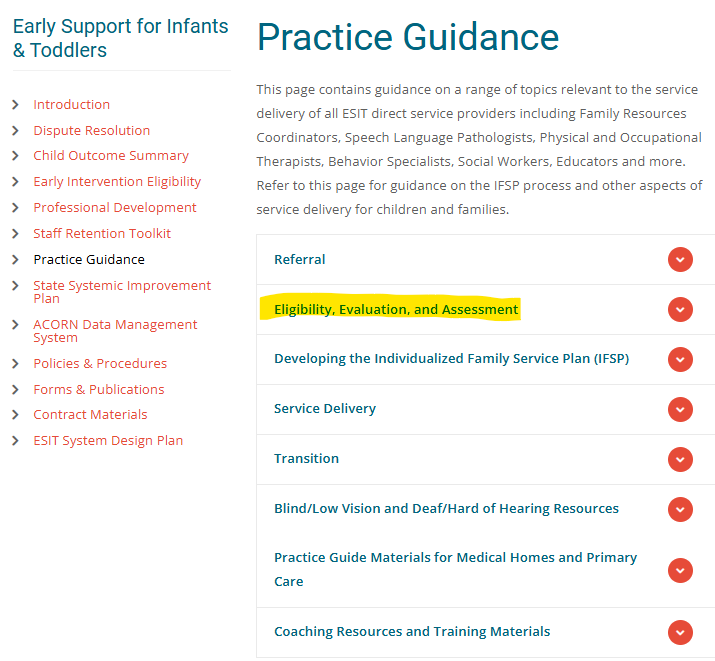
The updated Children Receiving Inpatient Medical Care-Eligibility and Enrollment guidance is now available on the Practice Guidance page of the ESIT website under the Eligibility, Evaluation, and Assessment dropdown.
The purpose of this document is to clarify Early Support for Infants and Toddlers (ESIT) eligibility and enrollment processes for infants and toddlers residing in inpatient medical settings at the time of referral.
 Summary of Changes Made
Substantive changes
- Changed Natural Environments section to indicate that inpatient medical settings are not NEs.
- Added a scenario for a toddler referred while residing in a long-term care facility with no plans to discharge to the family home.
Incidental terminology and formatting changes
- Broadened from “hospitalized” to all inpatient medical settings
- Removed “intervention”
- Updated terminology around providers, agencies and our data management system
- Changed “standardized” to “norm-referenced”
- Reformatted tables to improve accessibility
- Added IDEA and WAC citations
- Some sentences edited for clarity
Please send questions about the Practice Guide to your regional Technical Assistance Specialist or ESIT Service Delivery Technical Assistance Manager, Laurie Thomas, at laurie.thomas@dcyf.wa.gov.
The ESIT state leadership team is highlighting individual providers and ESIT provider agencies that are demonstrating one or more of the Seven Key Principles in their work in a new section of the ESIT Weekly titled Key Principles in Action. This new section will help us recognize the high-quality agencies and efforts of individual providers across the ESIT statewide system. Nominators will remain anonymous (though we may contact you for more details about your nomination).
Principles
- Families are equal partners who bring to the team skills, experience and
knowledge about their child; and, are the final decision makers as to what
will work best for their family.
- Early intervention recognizes that family relationships are the central focus in the life of an infant or toddler.
- Infants and toddlers learn best through everyday experiences and interactions with familiar people in familiar settings.
- The early intervention process, from initial contact to transition, must be responsive, flexible and individualized to reflect the child’s and family’s priorities, learning styles and cultural beliefs.
- All families, with the necessary supports and resources, can enhance their children’s learning and development.
- The role of the service provider is to work in a team to support Individualized Family Service Plan functional outcomes, based on child and family needs and priorities.
- Early intervention practices must be based on the best available current evidence and research.
Read and download ESIT's Guiding Concepts.
Submit Your Nomination!
To make a nomination, please complete the form linked below:
 |

CPS Impacts – Understanding How the Past Shapes the Present
Why are Black and Native American families impacted disproportionately? Who was the child welfare system and child protective services (CPS) made for and why? How does the past live on in the present? Has it made things better for children and their families? Are these impacts accidental or planned? Join us online:
Click here for more information on our expert panelists!
Save the Date
This webinar will be followed by an in-person training in Lacey, WA in March 2025. Click the registration link below for more details:
Accessibility Requests
Note: The last date to request interpretation for the webinar training is Thurs., January 16. The Washington State Coalition Against Domestic Violence will not be able to guarantee interpreters requested after that date. If you have a preferred interpreter, please let us know in the Accommodation Detail section of registration. This webinar will have auto-generated captioning turned on.
Questions?
For questions about the training, email Leigh Hofheimer at leigh@wscadv.org.
|
For more updates, subscribe directly to these great newsletters:
|