The Nation Within by Vine Deloria Jr. and Clifford M. Lytle
Deloria and his co-author focus on John Collier's struggle with both the U.S. Congress and the Indian tribes to develop a New Deal for Indians fifty years ago. It is a blow-by-blow historical account, perhaps unique in the literature, which may be the only way to show the full complexity of American Indian relations with federal and state governments. This makes it possible in two brilliant concluding chapters to clarify current Indian points of view and to build onto initiatives that Indians have already taken to suggest which of these might be most useful for them to pursue. The unheeded message has been clear throughout history, but now we see how.
Tribal sovereignty in the context of Vine Deloria Jr.'s book ... refers to "the inherent right of Native American tribes to govern themselves, maintain their own laws and customs, and have a degree of self-determination within their tribal territories," a concept that Deloria strongly advocates for throughout the book.
|
“As the salmon disappear, so do our cultures and treaty rights. We are at a crossroads,
and we are running out of time.”
- Billy Frank Jr. Nisqually, Nisqually Elder, environmental leader and advocate of treaty rights
Each week, DCYF ESIT Tribal Program Consultant, Brian Frisina, provides a key topic to help us get to know our Tribal Nation Partners better.
This week’s term is:
Learn About Northwest Treaty Tribes
Tribes. Treaty Rights. That’s what we’re all about. The Northwest Indian Fisheries Commission has been around since 1974, supporting tribes in the exercise of their treaty rights. One way we’ve helped is by telling the story of the tribes protecting and restoring natural resources. So, NWIFC launched a communications effort called Northwest Treaty Tribes: Protecting Natural Resources for Everyone.
The 20 treaty Indian tribes in western Washington are leaders in efforts to protect and restore natural resources in the region. At the heart of those efforts are rights reserved by the tribes in treaties with the U.S. government. Tribes reserved rights to harvest fish, shellfish, wildlife and other natural resources in exchange for most of the land that makes up the region today. Because all natural resources are connected, and because of their role as co-managers with the state, treaty tribes are active in every aspect of natural resources management in western Washington. As a result, tribal treaty rights and natural resources management efforts are protecting and enhancing natural resources for everyone. Learn more:
“The Indian nations had always been considered as distinct, independent, political communities, retaining their original natural rights, as the undisputed possessors of the soil, from time immemorial.” 17
The final ruling in the Marshall Trilogy, Worcester v. Georgia
What is Tribal Sovereignty?
Tribal sovereignty is a phrase we often hear, but what does it really mean? In this video created by Native Governance Center and the Minnesota Humanities Center, you'll learn about how Tribes exert their sovereignty to govern their citizens and why sovereignty matters. Original artwork by Marlena Myles. Voiceover by Leah Lemm. Animation and video production by callsign51 (watch time 2:36):
Sources
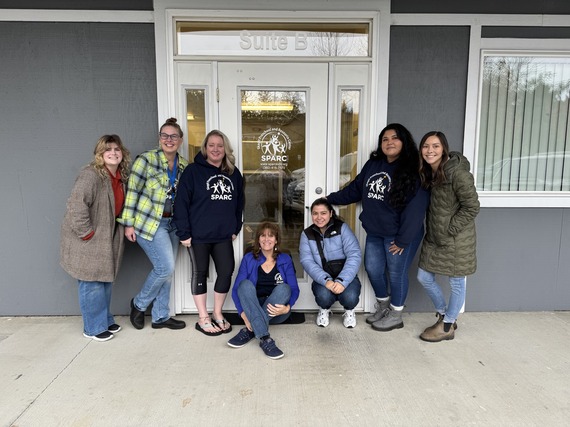
SPARC was founded 60 years ago by a group of mothers who were told by doctors that their children’s needs couldn’t be met – a message they refused to accept. They took matters into their own hands, determined to create a solution. This spirit of resilience and innovation continues to guide SPARC today. According to Stephanie Hokanson, Birth to Three Manager at SPARC, the staff constantly work through obstacles, passionately dedicated to solving problems for the families they serve.
SPARC was nominated for their work through Principle 1: Families are equal partners who bring to the team skills, experience and knowledge about their child; and are the final decision makers as to what will work best for their family.
 One of the hallmarks of SPARC is their deep sense of community. As Stephanie puts it, "We communicate with families like they are people." SPARC's staff sees their clients as neighbors, and the organization is committed to understanding and supporting each family’s unique situation. In recent times, more families are facing the challenge of homelessness and SPARC’s response has been to provide flexible services that meet the families where they are. They focus on building on the strengths of each family, adjusting services to accommodate parents’ availability and home circumstances, and ensuring that every interaction is compassionate and considerate of the family's current needs.
The staff at SPARC don’t just do their jobs—they deeply understand the impact of their work and remain flexible and responsive in a way that is meaningful for each family they serve.
Stephanie emphasizes the incredible dedication of SPARC’s team, noting that their passion for the work they do and their unwavering commitment to supporting families, is what drives them to go above and beyond.

You are invited to ESIT's upcoming Special January SICC Annual Performance Report (APR) Meeting!
Wed., January 15 | 9 a.m. - 12 p.m. | Agenda TBA
Teams Meeting link
Meeting ID: 236 593 311 475
Passcode: aN7gn3S8
Dial in by phone
+1 564-999-2000,,678651788#United States, Olympia
(833) 322-1218,,678651788#United States (Toll-free)
Find a local number
Phone conference ID: 678 651 788#
Posted for Public Review
The updated October SICC Meeting Materials packet and draft October meeting minutes have been posted to ESIT's SICC Meetings page for review.
SICC Direct List
If you would like your email added to the SICC direct email list to receive the agenda and meeting materials in advance of upcoming SICC meetings, email ESIT Interim Partnership & Collaboration Manager, Tammy McCauley, with the subject: Add me to SICC DL.
Upcoming 2025 SICC Meeting Dates
- Wed., Feb. 19 | Virtual
- Wed., April 16 | Virtual
- July 15 – 16| In person, Seattle area (location TBD)
- Tues., July 15 – PIE Graduation
- Wed., July 16 – SICC Meeting
- Wed., Oct. 15 | TBD
Questions?
Please contact DCYF ESIT Interim Partnership & Collaboration Manager, Tammy McCauley.
|

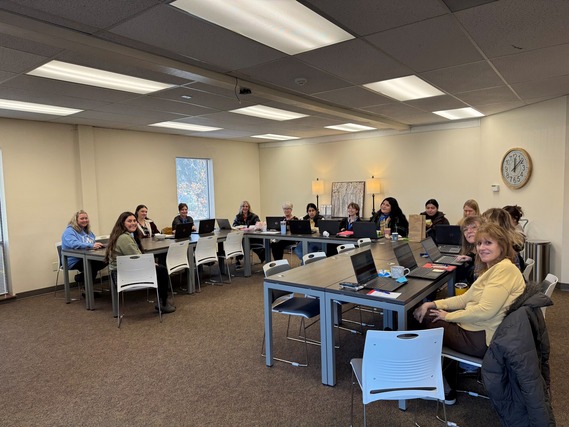
The new year means new ACORN training opportunities. The ESIT Data Systems and Analysis Team is hosting regular ACORN training sessions on several topics. You can sign up for the following training sessions today!
ACORN for Beginners
This session is ideal for users who haven’t begun exploring the ACORN platform. We’ll cover user roles, the login process, basic navigation skills, and more. Click below to register!
Intake & Referrals in ACORN
This session is designed to teach Intake Coordinators, FRCs, and Lead FRCs how to add a newly referred child in ACORN. Topics of this training will include the lookup process and a screen-by-screen tutorial. Click below to register!
Evaluations & Eligibility in ACORN
This session is designed to teach users how to use the Eval Info and Eligibility tabs in ACORN. Topics of this training will include the evaluation and screening process, medical histories, and eligibility determination. Click below to register!
Don’t worry if you aren’t able to make it to one of these sessions. The Data Systems and Analysis Team will be sending out additional training topics and dates soon! Please note, sessions with fewer than 10 registered participants will be canceled 24 hours before the scheduled time.
Questions?
If you have specific questions about ACORN development and support activities, please contact ESIT Data Systems and Analysis Manager, Kim Hopkins, at Kim.Hopkins@dcyf.wa.gov.
For technical assistance with accessing and/or navigating the ACORN training environment please contact ESIT.Help@dcyf.wa.gov.
|
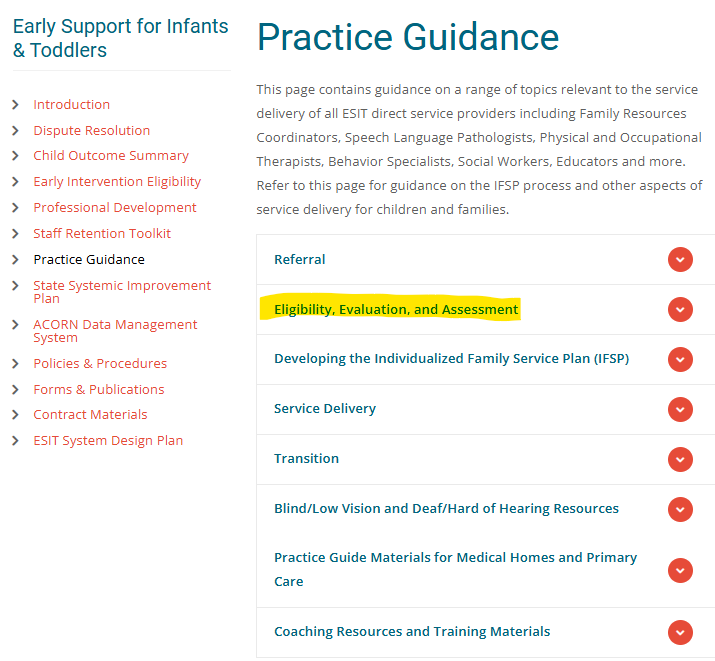
The updated Children Receiving Inpatient Medical Care-Eligibility and Enrollment guidance is now available on the Practice Guidance page of the ESIT website under the Eligibility, Evaluation, and Assessment dropdown.
The purpose of this document is to clarify Early Support for Infants and Toddlers (ESIT) eligibility and enrollment processes for infants and toddlers residing in inpatient medical settings at the time of referral.
 Summary of Changes Made
Substantive changes
- Changed Natural Environments section to indicate that inpatient medical settings are not NEs.
- Added a scenario for a toddler referred while residing in a long-term care facility with no plans to discharge to the family home.
Incidental terminology and formatting changes
- Broadened from “hospitalized” to all inpatient medical settings
- Removed “intervention”
- Updated terminology around providers, agencies and our data management system
- Changed “standardized” to “norm-referenced”
- Reformatted tables to improve accessibility
- Added IDEA and WAC citations
- Some sentences edited for clarity
Please send questions about the Practice Guide to your regional Technical Assistance Specialist or ESIT Service Delivery Technical Assistance Manager, Laurie Thomas, at laurie.thomas@dcyf.wa.gov.
The ESIT state leadership is highlighting individual providers and ESIT provider agencies that are demonstrating one or more of the Seven Key Principles in their work in a new section of the ESIT Weekly titled Key Principles in Action. This new section will help us recognize the high-quality agencies and efforts of individual providers across the ESIT statewide system. Nominators will remain anonymous (though we may contact you for more details about your nomination).
Principles
- Families are equal partners who bring to the team skills, experience and
knowledge about their child; and, are the final decision makers as to what
will work best for their family.
- Early intervention recognizes that family relationships are the central focus in the life of an infant or toddler.
- Infants and toddlers learn best through everyday experiences and interactions with familiar people in familiar settings.
- The early intervention process, from initial contact to transition, must be responsive, flexible and individualized to reflect the child’s and family’s priorities, learning styles and cultural beliefs.
- All families, with the necessary supports and resources, can enhance their children’s learning and development.
- The role of the service provider is to work in a team to support Individualized Family Service Plan functional outcomes, based on child and family needs and priorities.
- Early intervention practices must be based on the best available current evidence and research.
Read and download ESIT's Guiding Concepts.
Submit Your Nomination!
To make a nomination, please complete the form linked below:
Save the Date
We hope that you will join us for the 2025 Infant and Early Childhood Conference (IECC), May 5 - 9, hosted completely virtual via Zoom.
Call for Presenters
IECC is currently seeking proposals for its 2025 conference. The IECC Conference is well known within the State of Washington for providing high quality, evidence-based training for families and professionals working with young children (ages birth to eight) and their families.
- If you or someone you know may be interested in submitting a proposal - please submit proposals no later than Monday, January 13. To apply online, click here.
- IECC will be evaluating session proposals using a Rubric developed by DEC - we encourage presenters review our selection criteria before submitting their proposal.
IECC Partnership Opportunity
IECC is so thankful for its many community partners. Due to their support IECC has been able to shift its platform and offer the conference registration complimentary for all attendees the past few years. If your organization would be willing to partner with us please email the conference coordinator, Amanda Cardwell directly at amandacardwell@frontier.com.
|
 |

CPS Impacts – Understanding How the Past Shapes the Present
Why are Black and Native American families impacted disproportionately? Who was the child welfare system and child protective services (CPS) made for and why? How does the past live on in the present? Has it made things better for children and their families? Are these impacts accidental or planned? Join us online:
Click here for more information on our expert panelists!
Save the Date
This webinar will be followed by an in-person training in Lacey, WA in March 2025. Click the registration link below for more details:
Accessibility Requests
Note: The last date to request interpretation for the webinar training is Thurs., January 16. The Washington State Coalition Against Domestic Violence will not be able to guarantee interpreters requested after that date. If you have a preferred interpreter, please let us know in the Accommodation Detail section of registration. This webinar will have auto-generated captioning turned on.
Questions?
For questions about the training, email Leigh Hofheimer at leigh@wscadv.org.
|

Olympia, WA – The Washington State Department of Children, Youth, and Families (DCYF) has updated its Mandatory Reporter training to highlight the distinction between families in need of support versus signs of child abuse and neglect, and the importance of connecting those families to resources.
“When poverty or other family circumstances are mistaken for neglect, this creates disparities in reporting, impacting some individuals or groups more than others,” said DCYF Assistant Secretary of Partnership, Prevention, and Services Vickie Ybarra. “In Washington, Native American/Alaska Native families, and some communities of color are disproportionality impacted by poverty and the child welfare system.”
The updated training includes:
- Distinctions between poverty and neglect and available resources that mandatory reporters can use to help families
- Modules that address bias with the opportunity to learn how biases contribute to systemic racism
- Videos highlighting the impact of child abuse and neglect reports
- Knowledge checks that allow mandatory reporters to practice complex, real-life scenarios in a no-risk environment
“We hope this training increases the number of mandatory reporters that connect children and families with valuable community resources — preventing intake calls for issues that could be better addressed by ongoing community supports,” said DCYF Assistant Secretary of Child Welfare Natalie Green.
For the past two years, DCYF staff from across the agency collaborated with medical, public education, court, and law enforcement professionals, Tribal partners, parent representatives, lived experts, The Alliance for Professional Development, Training, and Caregiver Excellence, as well as many others to shape this eLearning and inform changes made to DCYF web content and publications that focus on recognizing and reporting child abuse and neglect.
In 2023, more than 129,000 calls were made to the DCYF Intake Line, nearly 74% of the calls were made by mandatory reporters. Of the total calls, more than 85,000 were screened out, meaning they did not meet the legal threshold needed for child welfare intervention. According to the new training, each of these screened out calls could be an opportunity to strengthen a family – connecting them with resources to meet basic needs and increase protective factors.
To learn more, visit the updated reporting abuse and neglect and mandatory reporting webpages or begin the eLearning today.
Contact
Nancy Gutierrez, Communications Administrator|360-742-6418 |nancy.gutierrez@dcyf.wa.gov.
|
For more updates, subscribe directly to these great newsletters:
|