|
Our next office hours will be Oct. 17, 2024, 3 p.m. Join here.
It is once again time to celebrate and honor all the incredible parents, caregivers and community members creating safe, happy and healthy childhoods for children. Do you know an incredible person or family who should be honored? Nominate them here!
Registration for the Fall 2024 Virtual All HVSA is Now Open!
November 12/13
9 a.m. to 12:30 p.m.
Tue Nov 12: HVSA Supervisors and Administrators Meeting
Wed Nov 13: All HVSA – All LIA Home Visitors and Staff Welcome
Fall All HVSA Registration
Please have all participating staff register using this form. Home Visitors and other LIA staff are invited to participate on Wednesday – because we’re virtual, all are welcome. Stay tuned for agenda at the end of this month. Questions? Please email nina.evers@dcyf.wa.gov.
Spaces still available! Reflective Supervision Advanced Practice – Managing Groups Virtual, 3 -hour webinar with Dr. Barbara Stroud Maximum # Participants: 50 (for more information about Dr. Stroud, click here: Dr. Barbara Stroud Register Here: Tuesday | October 8 | 9 a.m. – 12 p.m.
This virtual, 12-hour workshop focuses on key principles and practices of Reflective Supervision and is facilitated by Martha Stebbins-Aguiñiga, Counselor, MA, LMHC, IMH-E III. Maximum # Participants is 10 and the learning experience is offered in conjunction with participation in a small monthly Supervisor RSC group, designed to support supervisors as they implement RSC with their staff. Please note: Supervisors participating in this September’s Supervisor FAN are not eligible for this training. Register Here: Fridays | January 10, 17, 24, 31 | 9 a.m. – 12:30 p.m.
DOH Visit Tracker Training
DOH will also be hosting Visit Tracker 101 and Visit Tracker Q&A Training at the end of October.
Visit Tracker 101 Oct. 29 from noon -2 p.m.
Q/A Oct. 30 from noon-1:30 p.m.
These trainings will be open to all models using Visit Tracker and will be virtual and posted to the Data and Collection webpage.
Visit Tracker Training 101 will take place virtually on October 29th 12-2 PM. Please Register here
Visit Tracker Q&A will take place virtually on October 30th 12-1:30 PM. Please Register here
Women, Infants, and Children (WIC) Nutrition Program celebrates 50th anniversary
To mark the anniversary, Gov. Jay Inslee, Secretary Shah, and representatives from the U.S. Department of Agriculture’s Food and Nutrition Service program gathered in Mount Vernon, WA, to recognize the program’s success, including the crucial support WIC provided during the COVID-19 pandemic.
As the development of Technical Assistance (TA) plans progresses, LIAs are required to incorporate a CQI goal into their TA plans. The accompanying visual illustrates a structure for CQI project timelines for SFY25:
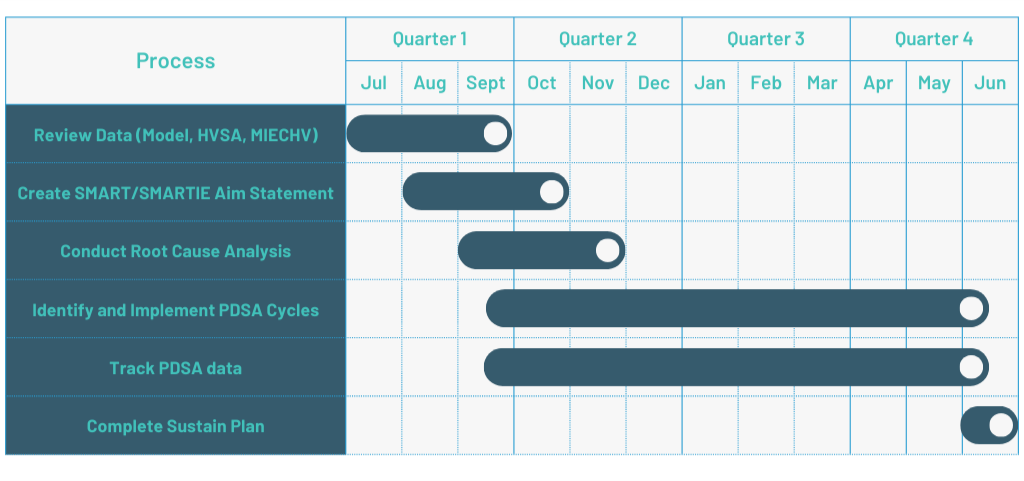 To support progress toward your CQI goal(s), the following opportunities are available:
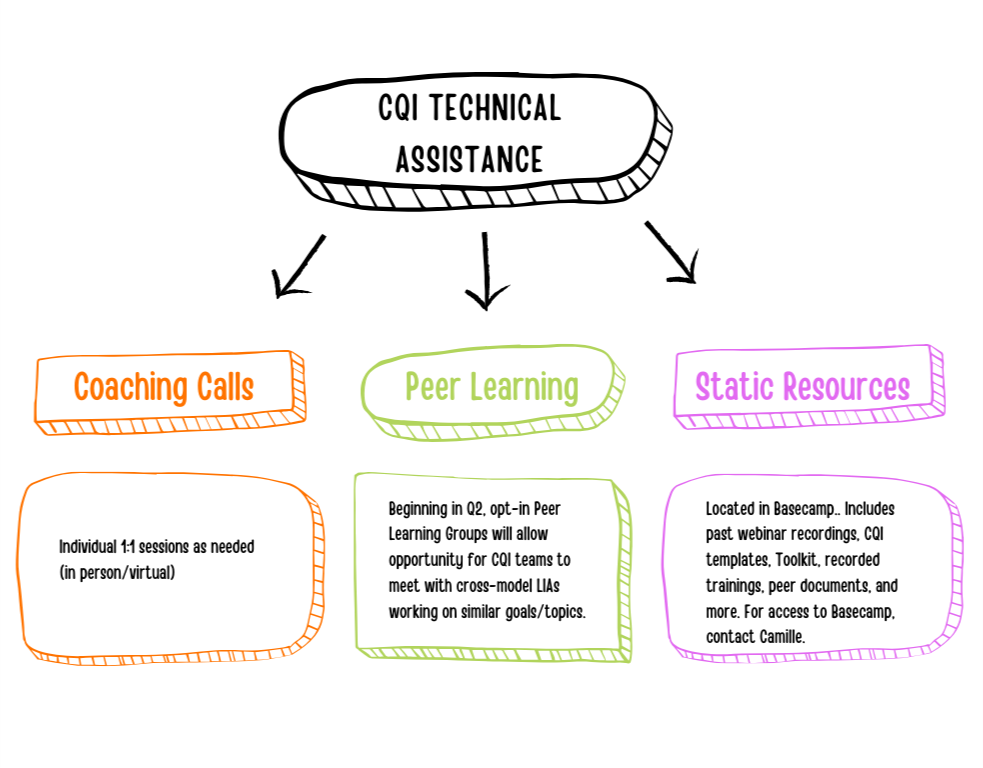 In response to the feedback gathered from our annual TA survey and post-webinar evaluations, we will pause our monthly webinars in SFY25. Instead, we will implement peer learning groups in Q2. These groups will build upon the breakout room format, offering LIAs enhanced opportunities to collaborate across different models and work on shared objectives.
Resources (found on Basecamp – CQI Project Folders)
Basecamp Resource Folder
CQI Project Timeline PDF
FY25 August CQI Webinar Recording
Past Monthly CQI Webinar Recordings
For questions, support or to be added to CQI communications:
Camille Carlson: ccarlson@startearly.org
Home Visitor Peer Connections provide an open space for home visitors across the state to connect with each other about their work. Topics for each section are co-created based off of themes identified by participants. In the September session, the group expressed the most interest in strategizing with peers and needing space to share their experiences. The home visitors chose to focus on the breakout group prompt, what has it been like to manage day-to-day responsibilities?
Themes of their conversation included:
-
Organization is key. The group shared organization helped them to recognize priorities, address urgent matters, and stay on top of their work. Resources they use to organize are their program/model tools and data systems to track progress and make decisions about what they have accomplished, what are the most pressing needs, and what are the next steps they need to take.
-
Adaptability and strong relationships are necessary. Understanding who the family is, what their expectations of the program and home visitor are shape the way in which the home visitors engage/support families. Willingness to adapt to meet the family where they are at is important to help manage the day-to-day. Additionally, the HVPC group recognized the importance of good communication with families.
Peer connections are held quarterly and are open to all Washington home visitors. Our next session will be held on Wednesday, October 23rd (12:30-1:30) – to sign up, please click here and contact Adrienne Matthias (amatthias@startearly.org) or Alex Patricelli (apatricelli@startearly.org) with any questions.
Each month, DCYF ESIT Tribal Program Consultant Brian Frisina will provide a key topic to help support us all in getting to know our Tribal Nations partners better.
This month’s topic is:
Indian Boarding Schools in the Pacific Northwest
Assimilation Through Education: Indian Boarding Schools in the Pacific Northwest
Essay by Carolyn J. Mar
Part 1: Indian Boarding School Movement
The Indian boarding school movement began in the post Civil War era when idealistic reformers turned their attention to the plight of Indian people. Whereas before many Americans regarded the native people with either fear or loathing, the reformers believed that with the proper education and treatment Indians could become just like other citizens. They convinced the leaders of Congress that education could change at least some of the Indian population into patriotic and productive members of society. One of the first efforts to accomplish this goal was the Carlisle Indian School in Pennsylvania, founded by Captain Richard Henry Pratt in 1879. Pratt was a leading proponent of the assimilation through education policy. Believing that Indian ways were inferior to those of whites, he subscribed to the principle, "kill the Indian and save the man." At Carlisle, young Indian boys and girls were subjected to a complete transformation.
Read Mar's full essay, Assimilation Through Education:
The Dawes Act and Residential Boarding Schools: Assimilation or Annihilation
At the end of the 19th century the federal policy against the Indian tribes changed from one of “the only good Indian is a dead Indian” to “kill the Indian and save the man.” This was in essence a change from annihilation to assimilation…..The major force behind this change was the Dawes Act. The Dawes act had several factors----the first was to break the community aspect of tribal life and remake the natives into the western image of individual property owning farmers. Dr. Lisa Uhlir has a wide variety of interests which led her to degrees varying from Russian Studies to Philosophy and International Economics. She graduated from George Washington University, the University of North Texas, and the University of Texas at Arlington. In a personal search of her Ojibwa history, her research and publications on Indigenous topics have focused primarily on Native American Boarding Schools and the history of Black Indians (watch time 15:06.)
Watch Lisa Uhlir's Ted Talk about The Dawes Act and Residential Boarding Schools:
Sources
- Quote: Federal Indian Boarding School Initiative, U.S. Department of the Interior.
- Image: Uncle Sam's Indian Wards, image provided by University of Nebraska-Lincoln Libraries, Lincoln, NE, The North Platte semi-weekly tribune (North Platte, Neb.), February 25, 1916, Image 6. Chronicling America: Historic American Newspapers. Library of Congress, Free to Use and Reuse.
-
Assimilation Through Education: Indian Boarding Schools in the Pacific Northwest, Essay by Carolyn J. Marr, Bibliography, © University of Washington Libraries.
-
The Dawes Act and Residential Boarding Schools: Assimilation or Annihilation | Lisa Uhlir, TEDxTCCD, posted to YouTube by TEDx Talks, May 10, 2023.
Hispanic Heritage Month
From September 15 to October 15, we celebrate Hispanic Heritage Month in the United States each year. This tradition began in 1968, when President Lyndon B. Johnson first issued a proclamation to celebrate Hispanic Heritage Week. Later, Congress passed a bill to extend the celebration to last an entire month, which was signed into law by President Ronald Reagan in 1988, and National Hispanic Heritage Month has been celebrated every year since 1989.
The dates for Hispanic Heritage Month were chosen to coincide with the Independence Day celebrations of many Latin American nations — Costa Rica, El Salvador, Guatemala, Honduras and Nicaragua — that declared their independence from Spain on September 15, 1821.
For more reading, video and audio resources, events and exhibitions and educator resources:
Hispanic Heritage Month
The More You Know
A Cascade of Impacts: A Discussion on the Many Ways Water Affects Early Childhood Health and Well-being
Wednesday, October 2 at 9 a.m. PST
|
As climate change, pollution, and other practices threaten water supplies, we must understand the role of water in early childhood development and examine how disparities in access are placing communities at risk. On October 2nd, join our panel of experts for this important conversation and hear about actionable strategies and policy solutions that support clean water access for all children and their caregivers. This discussion will be led by the Center’s Chief Science Officer, Lindsey Burghardt, MD, MPH, FAAP, and feature Devon Payne-Sturges, DrPH, Associate Professor with the Maryland Institute for Applied Environmental Health at the University of Maryland, School of Public Health, and Nathaniel Harnett, PhD, Assistant Professor in Psychiatry at Harvard Medical School. This webinar will present the science from the latest working paper from the Early Childhood Scientific Council on Equity and the Environment (ECSCEE), of which all three panelists are members.
|
|
News
Parents Under Pressure (hhs.gov)
|