|
Read by Jahla Brown, DCYF ESIT Partnership & Collaboration Specialist
“It’s a fact of life that progress is almost exclusively generated through people. If you’re not sensitive to the needs of people within your organization, or with whom you have to deal, you’re not going to be effective.” - Reginald F. Lewis, American businessman, first African-American to build a billion-dollar company.
Please note that there will be no issue of the ESIT Weekly sent out Fri., Sept. 6, in observance of Labor Day (Mon., Sept. 2). The ESIT Weekly will resume its regular schedule on Fri., Sept. 13.
Thank you!

Kyng & Kyren's Generational Wealth Building Activity Book
Kyng & Kyren's Generational Wealth Building Activity Book by Kyren Gibson, illustrated by Corey Wright: It’s never too early, or too late, to learn and apply knowledge! And that is exactly what this amazing book will show you. You may have noticed how schools teach a lot of different things, but somehow, they miss certain important aspects of adult life, such as personal finances, how to build wealth and general financial literacy. That is where this book comes in, as this book will teach your child everything that was mentioned, and more.
By buying this book, you’re investing in your child’s future, and giving them a springboard from which they can be successful and prosper in this modern, but often complicated world. (Reading age: 6 years and up.)
|
“I know that this process will be long and difficult. I know that this process will be painful. It won’t undo the heartbreak and loss we feel. But only by acknowledging the past can we work toward a future that we’re all proud to embrace.”
-Secretary Deb Haaland, on the Federal Indian Boarding School Initiative
Each week, DCYF ESIT Tribal Program Consultant, Brian Frisina, provides a key topic to help us get to know our Tribal Nation Partners better.
This week’s term is:
Indian Boarding Schools in the Pacific Northwest
Assimilation Through Education: Indian Boarding Schools in the Pacific Northwest
Essay by Carolyn J. Mar
Part 1: Indian Boarding School Movement
The Indian boarding school movement began in the post Civil War era when idealistic reformers turned their attention to the plight of Indian people. Whereas before many Americans regarded the native people with either fear or loathing, the reformers believed that with the proper education and treatment Indians could become just like other citizens. They convinced the leaders of Congress that education could change at least some of the Indian population into patriotic and productive members of society. One of the first efforts to accomplish this goal was the Carlisle Indian School in Pennsylvania, founded by Captain Richard Henry Pratt in 1879. Pratt was a leading proponent of the assimilation through education policy. Believing that Indian ways were inferior to those of whites, he subscribed to the principle, "kill the Indian and save the man." At Carlisle, young Indian boys and girls were subjected to a complete transformation.
Read Mar's full essay, Assimilation Through Education:
The Dawes Act and Residential Boarding Schools: Assimilation or Annihilation
At the end of the 19th century the federal policy against the Indian tribes changed from one of “the only good Indian is a dead Indian” to “kill the Indian and save the man.” This was in essence a change from annihilation to assimilation…..The major force behind this change was the Dawes Act.
The Dawes act had several factors----the first was to break the community aspect of tribal life and remake the natives into the western image of individual property owning farmers. Dr. Lisa Uhlir has a wide variety of interests which led her to degrees varying from Russian Studies to Philosophy and International Economics. She graduated from George Washington University, the University of North Texas, and the University of Texas at Arlington. In a personal search of her Ojibwa history, her research and publications on Indigenous topics have focused primarily on Native American Boarding Schools and the history of Black Indians (watch time 15:06.)
Watch Lisa Uhlir's Ted Talk about The Dawes Act and Residential Boarding Schools:
Sources
- Quote: Federal Indian Boarding School Initiative, U.S. Department of the Interior.
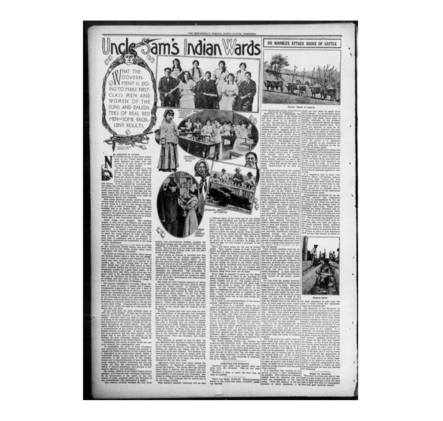
- Image: Uncle Sam's Indian Wards, image provided by University of Nebraska-Lincoln Libraries, Lincoln, NE, The North Platte semi-weekly tribune (North Platte, Neb.), February 25, 1916, Image 6. Chronicling America: Historic American Newspapers. Library of Congress, Free to Use and Reuse.
-
Assimilation Through Education: Indian Boarding Schools in the Pacific Northwest, Essay by Carolyn J. Marr, Bibliography, © University of Washington Libraries.
-
The Dawes Act and Residential Boarding Schools: Assimilation or Annihilation | Lisa Uhlir, TEDxTCCD, posted to YouTube by TEDx Talks, May 10, 2023.

ESIT is currently recruiting for a Quality Improvement Social Service Training Specialist! Applications due Fri., Sept. 6.
In your role as a Quality Improvement Social Service Training Specialist, you will be responsible for coordinating and managing complex and multi-dimensional accountability structures and assisting the Accountability & Quality Improvement Manager in development, implementation, and evaluation of a comprehensive, risk-based ESIT-Statewide Integrated Monitoring System (E-SIMS) with a balanced focus on compliance, continuous quality improvement, fiscal accountability, and outcomes throughout the state.
Read more for position details and application:
|

The Early Support for Infants and Toddlers (ESIT) program is recruiting for the Parent Institute for Engagement (PIE) program. PIE is a 12-month leadership program for parents and caregivers of children who have received services through ESIT. We will help you build and strengthen your skills, and support you to become strong leaders, advocates, public speakers and active members in your state.
If you are interested in this opportunity, please submit an application by Fri., Sept. 20. We will notify selected individuals the week of Sept. 23.
Check out, download and share the flyer:
For more information on how to apply, contact Vanessa Allen, ESIT Family Engagement Coordinator at Vanessa.allen@dcyf.wa.gov.
|

Back in February, DCYF ESIT successfully introduced the ESIT Credential for Family Resources Coordinators. It is now time to develop an ESIT Credential for Educators, and your input is essential. Regardless of your “title” at your agency, if you provide special instruction on IFSPs, we want to hear from you. This includes all:
- Educators
- Paraeducators
- OSPI Certified Teachers
- ESIT exemption holders
Please join us for an hour-long focus group opportunity. This will be a time to share your experiences as an ESIT Service Provider and offer the ESIT State Leadership Team a glimpse into ways we can better support this important role through the credentialing process.
Register for one
Thurs., September 5 | 3 - 4 p.m.
OR
Mon., September 9 | 9 - 10 a.m.
Questions or Accommodations?
Please contact ESIT Workforce Development Specialist, Lori Holbrook, at dcyf.ESITtraining@dcyf.wa.gov or call 360-999-7558.
ASL interpretation and other supports are available to fully access this event. Complete this form to make a request. DCYF may not be able to accommodate requests made less than two weeks prior to the webinar.
|
The Family Outcomes Surveys will be distributed to families beginning Wed., August 28.
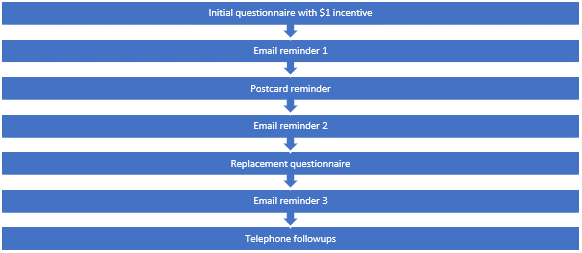
We have contracted with WSU for another year and their team will be sending the surveys and facilitating data collection and analysis. The team at WSU will follow the process outlined below:
WSU Data Collection Process
Data collection
- First questionnaire with incentive | August 28
- Email reminder 1 | Sept. 3
- Postcard reminder | Sept. 9
- Email reminder 2 | Sept. 12
- Replacement questionnaire | Sept. 24
- Email reminder 3 | Sept. 27
- Telephone contacts | Oct. 7 – Nov. 8
Data collection will close on November 8 and we will present preliminary information during the January SICC Annual Performance Report Meeting. If you have questions about the ESIT Family Survey, please contact ESIT Data Systems and Analysis Manager, Kim Hopkins, at kim.hopkins@dcyf.wa.gov.
Updated SAW FAQ Available
An updated SAW FAQ is available on ESIT's ACORN Data Management System page. Please use this updated guide to help create your SAW account and access ACORN. The changes to the process outlined in this document will help us reduce the number of duplicate accounts in ACORN and will reduce errors with caseload migration.

Optional ACORN Mini Training Webinar Series
The ACORN mini webinar on August 28 concluded the mini-webinar series. You can find the mini-webinars posted to the ESIT ACORN page.
Moving forward, we will begin to focus on training to specific sections and roles in ACORN. The first of these optional trainings will be the School District Training. The dates and times for these 2–3-hour webinars will be announced in the next ESIT Weekly.
To meet ACORN training required for users, you must complete the modules available on the DCYF Training Portal.
|
ACORN Trainings
These supplemental training resources are great for users who have completed the required modules and are ready to learn more. They are currently available on our website:
Questions?
If you have specific questions about ACORN development and support activities, please contact ESIT Data Systems and Analysis Manager, Kim Hopkins, at Kim.Hopkins@dcyf.wa.gov.
For technical assistance with accessing and/or navigating the ACORN training environment please contact ESIT.Help@dcyf.wa.gov.
 |

Registration
Newborn Behavior International is hosting a Leaders in the Field First Wednesday Webinar Series, held the first Wednesday of each month! Register for September's Leaders in the Field webinar:
Reimagining the Field of Infant and Early Childhood Mental Health
Speaker Dr. Barbara Stroud
Wed., September 4 |1 p.m.
This training is free. You must register to attend. After registering, you will receive a confirmation email containing information about joining the meeting.
About the Speaker
Barbara Stroud, PhD, is a licensed psychologist and author, with over three decades of culturally informed clinical practice in early childhood development and mental health. She is a founding organizer and the inaugural president (2017-2019) of the California Association for Infant Mental Health, a ZERO TO THREE Fellow, and holds prestigious endorsements as an Infant and Family Mental Health Specialist/Reflective Practice Facilitator Mentor. Dr. Stroud has written a book chapter entitled ‘The Concept of Attachment to the Mother Country from the Perspective of The BIPOC Family’ in the text ‘Honoring voices within infant and early childhood mental health: Relationship-based stories from the field,’ edited by Carla Caringi Barron and Karol Wilson. She is also a contributing author to the text ‘Infant and early childhood mental health: Core concepts and clinical practice’ edited by Kristie Brandt, Bruce Perry, Steve Seligman, & Ed Tronick. Furthermore, Dr. Stroud’s self-published books, ‘How to Measure a Relationship’ and ‘Intentional Living: finding the inner peace to create successful relationships’ have been informing relationship-based practices for over 10 years. In 2018 Dr. Stroud was honored with the Bruce D. Perry Spirit of the Child Award. Embedded in all of her trainings and consultations are the activities of reflective practice, demonstrating cultural attunement, and holding a social justice lens in the work. Dr. Stroud has established a well-resourced and highly informative set of professional training videos which are freely available on her YouTube Channel Dr.BarbaraStroud. To read more about Dr. Stroud and her research, click here.
|

Speech learning starts in the womb and a critical amount of learning already happens before infants turn age 1. My lab conducts research that helps us understand whether and how speech learning during the first year of life can be predictive of later language acquisition and if there are strategies that we can use to help improve speech learning during this period. In a most recent study (Zhao, Boorom, Kuhl & Gordon, 2021), we have demonstrated that how infant brains process speech at 11 months of age is highly predictive of their individual grammar skills at 6 years of age, measured with SPELT-3. More importantly, we were able to identify children who exhibited atypical language development at 6 years of age based on their infant brain data. We are currently conducting a large-scale study to further understand early signs of atypical language development in infant brains, with the hope to improve early diagnosis and early intervention. On the other hand, infant speech learning before the age of 1 is highly malleable by environmental factors, such as the quantity and quality of speech input. In a series of studies (Zhao & Kuhl, 2016, Zhao, Llanos, Chandrasekaran, & Kuhl, 2022), we have shown that even a lab-based music intervention affects infant speech learning. The goal of the course is to give an overview of the state-of-the-art neuroscience research in infant speech learning, and to discuss potential ways to incorporate research findings into SLP clinical practice.
What Can Infants’ Brain Activities Tell Us About Speech Learning?
Wed., September 25 | 7 - 8:30 p.m.
Cost
- WSLHA Members - $35
- WSLHA Non-Members - $50
- ASHA CEU Members - $5
- ASHA CEU Non-Members - $7
For additional information and to register, visit the WSLHA website at: https://wslha.org/.
|

Emergency Broadband Benefit Funds Available
The WA Office of Broadband has funds available to assist families with internet costs. More details on this benefit and how to apply are located here.
Discounted Internet Service Available to Low-Income Households
The federal Affordable Connectivity Program offers eligible households a high-speed internet plan for no more than $30 per month. More details on this program and how to apply are located here.
Digital Navigation Toolkit Available
Digital Health Navigators are individuals who address the whole digital inclusion process - connectivity, devices, and digital skills - to support community members and provide access to healthcare. The National Consortium of Telehealth Resource Centers (NCTRC) has released a new toolkit that provides helpful resource links relating to digital navigation.
|
For more updates, subscribe directly to these great newsletters:
|