|
Over the next several newsletters we plan on highlighting a Strengthening Families Protective Factor that support families to stay strong and prevent child abuse and neglect. For more information, see the Protective Factors brief on our website, or visit the Center for the Study of Social Policy website.
This month we are focusing on Knowledge of Parenting and Child Development as a protective factor.
Knowledge of Parenting and Child Development means that parents understand their role in their children’s lives and have basic knowledge about their child’s physical, cognitive and social and emotional development.
Parents comfortable in their parenting role are more confident and better able to form a bond with their children. They have parenting strategies and tools to enable them to respond to child behaviors and stressors and are likely to have realistic expectations about their children and can provide nurturing supervision and guidance.
It’s important to remember though that just like no two falling leaves are exactly the same, families also are different all across the world and all across our state.
What might seem different for one family will seem normal for another.
There is no one right way to raise a child and having knowledge of child developmental stages can prepare parents for success. Parents are the experts of their own families.
Think about it: Ask questions – to your family doctor, your child’s teacher or family and friends. Take a parenting class or research on your own – at the library, online newsletters or websites about child development.
Enrollment in high-quality early care and education and family support programs among child welfare-involved families with young children is expected to increase this year with expansion of the Child Welfare Early Learning Navigator (CWELN) program at the Department of Children, Youth, and Families.
“Evidence from the pilot shows the intervention is effective,” said Vickie Ybarra, Assistant Secretary of Partnership, Prevention and Services at DCYF. “We have an estimated 44% service penetration rate in Early Childhood Education and Assistance Program, child care subsidy, and Early Supports for Infants and Toddlers—the ‘big three’ DCYF early learning programs—when a CWELN makes a connection with a family; compared with fewer than 25% service penetration rate in non-pilot offices.”
Child Welfare Early Learning Navigators, or CWELNs, work closely with Child Protective Services caseworkers to support and connect families with young children to high-quality early learning and family support experiences available in their communities. They proactively identify and reach out to families; assess their needs for early care and education services; and then match them with community-based programs that are free, voluntary, and ideally with a wrap-around family support component. The goal is to decrease subsequent reports of abuse or neglect and out-of-home placements for families with active child welfare cases, while promoting long-term positive outcomes for children.
“I’m really thinking about relationships. How we can support messaging around the importance of early relational health, both to child welfare workers, as well as to parents,” said Megan Manion, CWELN in the King South West Child Welfare office with the Department of Children, Youth and Families. “We often focus on the importance of early literacy and kindergarten readiness when talking with parents, or about child safety and parenting skills when talking with workers. But, healthy early relationships are the essential foundation for all of those things.”
Manion has been a navigator since the program began its pilot in 2019. She is one of 10 DCYF navigators who have expertise in both child welfare, and early care and education systems. The CWELNs support each family throughout the enrollment process, including assistance with necessary paperwork. They may also communicate with the family and the service provider after a CPS case closes to ensure families successfully start services. In addition, child welfare caseworkers have benefited from having a CWELN available to support referrals.
“I learn more from my Navigator, and we are able to review best options. The amount of knowledge is very beneficial especially when it is hard to remember all the special areas,” one caseworker said as part of a recent survey.
Currently, CWELNs support select child welfare offices in regions across the state. The program was recently awarded additional funds to double the number of navigators so each region has at least one CWELN before the state fiscal year ends in June. The counties listed below are supported by CWELNs currently on staff.
- Erin Mountin supports Grays Harbor, Mason and Pacific counties.
- Allison Rogers supports Lewis and Cowlitz Counties.
- Cindy Taylor supports Yakima county.
- Regan Pierce supports Benton, Franklin and Walla Walla counties.
- Korina Stukes supports King County, alongside Megan Manion.
- Carla Lopez-Wilkerson is a Tribal-focused CWELN and supports children and families who identify as American Indian/Alaska Native in Pierce County.
- Jenny Shortencarrier supports Pierce County.
- Shelby Yada supports Spokane County.
- Amber Wilder supports Whatcom County.
Furthermore, brain science demonstrates that addressing trauma, especially at critical transition points in the lives of youth, helps ensure successful transition into adulthood. Connecting families with young children, who are involved in child welfare, to resources is vital because laying a strong foundation, early in life, critically impacts healthy development. The CWELN team recently completed a handful of interviews with families who have worked with a navigator to learn more about their experiences.
“[The navigator] went above and beyond, in [finding] resources for me and in making us feel comfortable in just doing her job in general. She just went above and beyond … it completely changed how I look at CPS,” one parent shared.
For more information, send an e-mail to minnette.mason@dcyf.wa.gov.
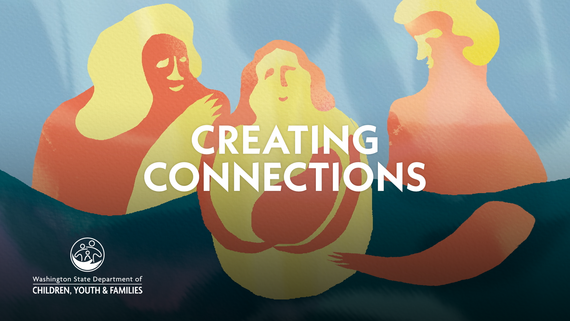
We are so excited to share the latest of our films focusing on the Protective Factors done by First Sight Productions. This video, Creating Connections, focuses on the Social Connections protective factor and the work done through the Mothering Together program at First Steps in Port Angeles.
First Step is a provider of an array of supports and services throughout Jefferson County. This is one of the sites that is providing support for expectant and new parents to support perinatal mental health, funded through the SFWA community-based child abuse prevention (CBCAP) grant, offered in partnership with Perinatal Support WA. They are also a provider of Parents as Teachers, PCAP home visiting. They do specific work with tribes, fathers, and offer many tailored supports for families.
There are five protective factors known to help reduce child abuse and neglect: Knowledge of Parenting and Child Development, Social Connections, Parental Resiliency, Concrete Support in Times of Need, and Social and Emotional Competence of Children/Nurturing and Attachment. You can watch our earlier video on Resilience here. If you are interested in partnering with First Sight for a later video on Social and Emotional Competence of Children, please email Kyra.Ingraham@dcyf.wa.gov.
Strengthening Families Washington is excited to partner with two community based organizations as we explore what it would look like to build capacity for crisis respite in Washington State.
Crisis Respite is short-term care for children for when parents or primary caregivers need a break for any reason, whether they are exhausted and worn-out from the demands of parenting or when they experience difficult life circumstances or other unexpected events and have no safe alternatives for care. Crisis Respite is typically available on short notice, often at any time of day or night, and is usually free of charge. Many Crisis Respite providers offer additional family supports such as concrete goods, support groups, referrals to benefit programs, and other services to further strengthen families and build resilience. Crisis Respite is welcoming and nonjudgmental; it is inclusive and Culturally Responsive to the families it serves. It understands that families are not defined by their circumstances.
These programs go by a variety of names, including crisis respite, urgent, immediate, and emergency respite or care, and crisis nurseries. Crisis respite can alleviate family stressors, reduce the risk of harm to children, and may help prevent otherwise unnecessary child welfare systems involvements and out of home placements. Through managing stress and other difficult life circumstances, parents are afforded greater opportunities to create and strengthen bonds with their children that can last generations.
Crisis respite is not widely available in Washington State. Over the coming year, (July 2024-June 2025), Child Care Action Council in Thurston County will convene a coalition of community partners to explore community crisis respite needs and assets and develop a plan to meet those needs. Multicultural Child and Family Hope Center in Tacoma will offer drop in care on short notice, along hope, resources and support services to address the myriad of challenges families face. Both of these agencies have deep roots and trust in their communities.
Child Care Action Council's mission is to promote and nurture early learning communities where children and families thrive. “By convening and leading a coalition to explore prevention crisis-respite-related needs and assets in the community, we are taking proactive steps to support families in times of need, including applying the Strengthening Families framework assessing risk and protective factors, thereby creating an environment where both children and caregivers can thrive. Additional family support will endeavor to prevent child abuse and neglect by offering caregivers the necessary care and resources to effectively navigate challenging circumstances while ensuring the safety and well-being of their children.”
Multicultural Child and Family Hope Center is a center of hope and support in the Hilltop Community. “At the core of our approach is the belief that every family deserves a safe and nurturing environment where they can thrive. Our key project goals revolve around keeping children and families safe from harm, both physically and emotionally. We aspire to act as more than just a respite care center; we aim to be a lifeline for families, offering immediate help and support tailored to their unique needs.”
Strengthening Families Washington is thrilled to be supporting their work and looking forward to learning with and from them.
Expanded HealthCare for Immigrants
During our recent legislative session, $28.4M was included in the Washington budget to expand healthcare access for undocumented individuals and families with a Medicaid-equivalent. With this additional funding, the number of folks who can access this program will double. Undocumented survivors of domestic violence face many barriers to accessing healthcare, including fear of deportation, language barriers, and financial abuse. This is an important step towards dismantling these barriers and promoting health equity for immigrants and survivors alike. Check with your local Navigator for help enrolling undocumented individuals for Medicaid.
Doulas for All Medicaid Coverage
The Washington legislative budget included funds for the ability of birth doula services to be reimbursed through Medicaid coverage. The approved reimbursement rate of up to $3,500 per doula is the highest rate for birth doulas in the nation. Additionally, $100,000 has been allocated for the development of a “Doula Hub,” which will provide support for doulas navigating Medicaid referral and billing systems. The physical, emotional, and informational support that birth doulas provide during pregnancy and the postpartum period has been shown to significantly improve health outcomes and health equity. Doula services are holistic and culturally responsive, which is particularly important for BIPOC, LGBTQIA+, low-income, and other communities that face barriers or discrimination when accessing the health care system.
Questions? Please contact Leigh@wscadv.org, WSCADV
The Find Shelter tool offered by the U.S. Department of Housing and Urban Development provides information about housing, shelter, health care, and clothing resources in communities across the country. Visit the website, enter your location, and click Search to get started.
News
What happened in the 2024 legislative session? Read the Children’s Alliance Legislative Report to see highlights of bills affecting children and families.
2023 Healthy Youth Survey results offer signs of hope and resiliency among Washington students. “Our students are telling us that they are continuing to recover from the impacts of the pandemic––they are resilient, and hopeful, and they are getting access to the supports they need.” View the press release here.
Macklemore visits Green Hill School to support youth who produced fentanyl-awareness music video, The Chronicle
Fatherhood Survey now available. Participate in the Washington State Fatherhood Survey to inform future policies and programs for Washington dads. You can win a $50 gift card!
DCYF News
Haring Center DCYF Complex Needs "Back to School" Training Series-Fall 2024
The Washington State Department of Children, Youth and Families (DCYF) is offering trainings to support childcare workers who care for young children with complex needs. These trainings will be facilitated by the UW Haring Center and focus on deepening the provider's knowledge in several areas related to Designing Classroom Routines, Transitions, and Schedules, Creating Supportive Learning Environments, Classroom Management, Teaming & Collaboration, Inclusive Large Groups and Supporting Multilingual Learners. All trainings are FREE, and will be held remotely via zoom. In-Service STARS credit will be offered for ALL trainings. All training topics will be offered in English, Spanish and Somali. Please email Phoebe Yeung (pcyeung@uw.edu) if you have any questions!
DCYF OIAA Reports Available: To help bring more clarity to the complex reports produced by OIAA, videos summarizing many of our reports are available. Our recently published report, Fair Start for Kids Act Implementation - 2023, now has a summary video on the DCYF YouTube channel. You can find other OIAA videos summarizing written reports by filtering the DCYF Reports webpage to “Report Type: OIAA Reports” and looking for reports under the column “Additional Info.”
Racial Equity Resources
General Principles of Federal Indian Law
Inherent Sovereignty: The sovereignty, self-governing powers, that tribes have are inherent powers. ‘Inherent sovereignty’ is based on the fact that tribes were already governing themselves before settlers came to America, and the United States recognizes those retained self-governing powers. Felix Cohen, author of the Handbook of Federal Indian Law, summarizes inherent sovereignty well in his quote: “Perhaps the most basic principle of all Indian law supported by a host of decisions….is the principle that those powers which are lawfully vested in an Indian tribe are not, in general, delegated powers granted by express acts of Congress, but rather inherent powers of a limited sovereignty which has never been extinguished. What is not expressly limited [by Congress] remains within the domain of tribal sovereignty.”
Learn more about the complexities of federal Indian law:
General Principles of Federal Indian Law
|