 |
|
Protective Factors – Social Connections: There are five protective factors known to help reduce child abuse and neglect: Knowledge of parenting and child development Social connections Parental resiliency Concrete support in times of need Social and emotional competence of children/nurturing and attachment. This video focuses on the importance of social connections. |
Resilience: Youth incarcerated at Echo Glen share what resilience means them. (Parental) Resilience is one of the five protective factors that can help prevent child abuse and neglect. |
|
 |
 |
|
Walk One Mile: Images created by students at Echo Glen High School, a juvenile detention facility in King County, WA. Poem written by student at Echo Glen as part of the Pongo Poetry Project with voiceover performed by students at Mount Si High School's Digital Media Academy. This film was produced as part of the SHARE Screenwriting Program, Directed by Lindy Boustedt. Editing, sound design, and color correction by Kris Boustedt at First Sight Productions. |
You can learn more about Protective Factors here: https://dcyf.wa.gov/services/child-development-supports/sfwa
All the best,
Joy
Note: The SFL Newsletter will take a break for the first week of July (July 5th) and will return July 12th.
DCYF Prevention Dashboard 2024 Updates: September Webinar
Join us for an upcoming webinar to share and answer questions about the DCYF Prevention Dashboard, DCYF's first-ever data dashboard specifically to support the agency’s efforts to prevent child maltreatment. This year's update includes three new sections which offer new insights to DCYF's child welfare intakes and out-of-home care placements, as well as updates to the existing sections in response to community input. Register to receive slides and a recording, even if you can’t attend.
September 9, 3-4 p.m. – Register Here
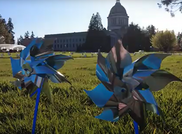
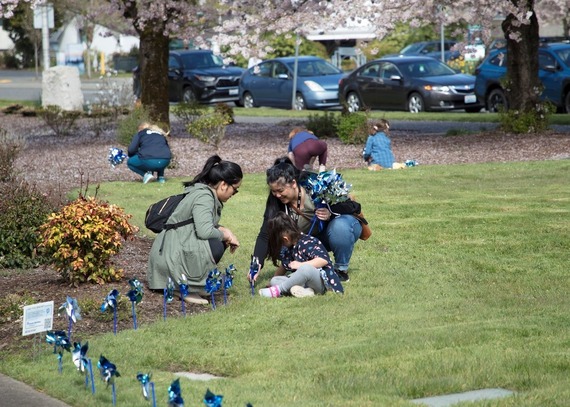
Caption: DCYF staff and their families planted pinwheels in frount of the Capitol building
What have we been hearing from community? In the SFL Project, we are building up our final report and recommendations, so that the insights gained in this 5-year project can continue to enhance and support child welfare and family support systems. Based on feedback from community, I will use this space in the coming weeks to highlight some of the great ideas that have surfaced from our conversations with community through Sensemaking, Community Cafes, and SFL Convenings.
Thoughtful Engagement with Lived Experts: One highlight of the Strengthen Families Locally project outcomes is the importance of collaborating with and lifting up the voices of lived experts in efforts to reduce the harms of child welfare. Community input is both a core value of this project and a continual work in progress. For me, it takes constant, iterative feedback with community to check that we are actually engaging folks in the ways that they want to be engaged.
To do this with inclusivity and authenticity, we can’t just assume that we can fit family or community voice into a project at a certain point, whenever it may be most convenient to do so. It requires engaging lived experts in the very planning of the activities in which they are going to be participating - as co-designers, co-facilitators, and co-leaders in systems change. I am eternally grateful to the partners who push us to slow down and approach community engagement with thoughtful inclusivity. Paying folks for their time, offering peer supports for trauma processing, holding space and time for lived experts to feel comfortable and supported in sharing, and promoting opportunities for systems leaders to sit back and listen are some of the ways that we’ve been able to engage with lived experts in this project. I hope we can continue to serve as leaders in effective partnership and co-design efforts at DCYF.
Community Childcare Forums:
The Community Child Care Forums give child care providers an opportunity to meet DCYF Leadership, connect with local Child Care Licensing Administrators and Licensors, learn about updates and opportunities, and share experiences through questions or discussions. Interpreters will be made available. Light refreshments will be provided. Forums will be co-hosted by DCYF’s Early Learning Division, Licensing Division, and Office of Public Affairs. View all times and locations here.
Check here for news and opportunities specific to our Strengthen Families Locally communities. Send opportunities to strengtheningfamilies@dcyf.wa.gov
Spokane: Apple Health Expansion Enrollment Support. Our team of social workers at Latinos en Spokane can assist you with signing up for the Apple Health Expansion program. If you have any questions regarding eligibility or need guidance through the enrollment process visit our main office to speak to a social worker at 1502 N. Monroe St. Spokane WA. You Can Also Visit Us At Our Spokane Valley Location To Register! Our Social Workers are here to assist our community during weekends, and walk-ins are welcome — no appointment is needed. Spokane Valley Hours: Tuesday - Sunday from 12pm-8pm | Location: 9827 E. Sprague Ave, Spokane Valley WA. See if you are eligible and learn more about applying at www.hca.wa.gov/apple-health-expansion
Northeast WA: Funding Opportunity: Grant Writing Stipends for Community-based Organizations. BHT has allocated up to $220,000 in support of grant-writing efforts in our region. We are offering $5,000 grant-writing stipends for Community-based organizations currently applying for regional, state, or federal funding. The team has been working through applications, but we want more for our region! This is your chance to go after some big grants with support from BHT. Learn more and apply here.
Check out these local resources on Facebook!
Connect (Events and Opportunities)
Ethics in Prevention Foundations: asynchronous or self-paced courses. This two-week, asynchronous moderated course, adapted from the original SAMHSA Center for Application of Prevention Technologies (CAPT) course, explores the six principles of the Prevention Code of Ethics, brought to life with realistic examples designed to enhance participant understanding. The course also introduces a decision-making process to help practitioners apply this code to a variety of ethical dilemmas, and an online discussion area to facilitate discussion with other course participants. July 8-19 or self-paced. View options here.
Partnering With Existing Early Childhood Developmental Screening Initiatives. Identifying developmental milestones early is critical for positive outcomes in young children — but health care providers can face barriers in implementing screening. Presenters will share their experiences with partnering across sectors for screening initiatives in their communities. They will highlight how to leverage local opportunities and create stronger communication between the medical home and broader early childhood system. July 11, 2024 | 4-5:30 PM EDT. Price: Free. Register here.
WSCADV Home Visitor Training Series: DV Assessment and Response for Home Visitors. Please join us for our free virtual Home Visitor Training series with presenters from a wonderful team of experienced and wise home visitors and WSCADV staff! The two-day DV Assessment and Response training is offered three times per year, and Safety Planning is offered three times as well. Yearly schedule: July 25 and 26, 2024| October 11, 2024 | January 23 and 24, 2025 | February 26 and 27, 2025| March 21, 2025 | May 28, 2025
Rethinking Relationships and Bias in Early Childhood, by Olga Lacayo and Eliana Elias. Find out examples of how adults might respond to conversations about race in the classroom. Learn more about how teacher identity impacts the quality of interactions in the classroom. Explore a coaching stance that respects teachers as capable and curious learners. October 17, 2024, 11 a.m. – 12:30 p.m. PST. Learn more and register here.
Learn (Educational Resources)
Dream, Create, Liberate: A Future Without Family Policing is the inaugural creative publication brought to you by the upEND Movement. As we embark on this journey of imagination and liberation, we invited artists to join us in envisioning a world free from family policing. Read the book for free here.
A Cascade of Impacts: The Many Ways Water Affects Child Development, the latest working paper from the Early Childhood Scientific Council on Equity and the Environment (ECSCEE), explores how water affects children’s health, learning, and behavior, and how ensuring access to safe drinking water is necessary to support the healthy development of all children. It offers specific strategies to address disparities in access to clean water and resources to take action in your community. Read the paper here
Act (Ways To Engage Right Now)
Nominate Someone Special for PEAR S.T.A.R. Awards: The Washington State Office of Equity is launching our first ever annual PEAR S.T.A.R. Awards. These awards will be given out to community organizations and state agencies that exemplify PEAR (Pro Equity Anti-Racist) qualities. The acronym S.T.A.R. stands for Show, Transform, Act, and Reflect, which should help you brainstorm when you think about someone who should be uplifted for these awards. A total of 30 awards will be given out, two for each of the 15 Determinants of Equity, with one of each determinants awards going to a community champion and another going to an agency champion. Find the nomination form here.
Apple Health Expansion enrollment update. The enrollment limit for Apple Health Expansion has been met for individuals age 19 - 64. Applications for individuals age 65 and older are still being accepted. Continue to encourage individuals age 19 - 64 to complete an application to be considered if space opens in the program. Learn how to apply for Apple Health Expansion coverage.
Grow (Funding and Resources)
Building Communities Fund grants. Commerce has opened the 2025-27 funding round for the Building Communities Fund. The program awards state grants to tribes and nonprofit community-based organizations to pay for up to 25% of eligible capital costs to acquire, construct, or rehabilitate nonresidential community and social service projects. Under exceptional circumstances, the state share of project costs may exceed these amounts. There is no minimum or maximum grant award amount. 2025-27 funding opportunity closes Aug. 22. Learn more here.
If you have suggestions for what to include in this newsletter, email Joy Lile.
|