|
Note: The SFL Newsletter will take a break for the first week of July (July 5th) and will return July 12th.
DCYF Prevention Dashboard 2024 Updates: Two Upcoming Webinars
Join us for one of two upcoming webinars to share and answer questions about the DCYF Prevention Dashboard, DCYF's first-ever data dashboard specifically to support the agency’s efforts to prevent child maltreatment. This year's update includes three new sections which offer new insights to DCYF's child welfare intakes and out-of-home care placements, as well as updates to the existing sections in response to community input. Both webinars will cover the same material.
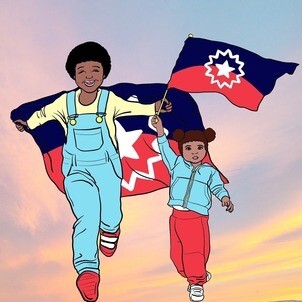
Caption: Celebrate Juneteenth! By Jala Brown, DCYF ESIT Partnership & Collaborative Specialist
What have we been hearing from community? In the SFL Project, we are building up our final report and recommendations, so that the insights gained in this 5-year project can continue to enhance and support child welfare and family support systems. Based on feedback from community, I will use this space in the coming weeks to highlight some of the great ideas that have surfaced from our conversations with community through Sensemaking, Community Cafes, and SFL Convenings.
The Power of Peers - Mentors, Navigators, and Supports: The power of peers with lived experiences in family support and child welfare systems is immeasurable. Many of our families and communities have said that having someone walk alongside them helped them access supports and resources they wouldn’t have otherwise connected to. Several of our SFL funded projects have included peer supports and navigators, and SFL communities have also worked to network navigators so that the folks working in these important positions have access to the vital resources to help families thrive. One tool that helps a navigator succeed is access to a web of community partners, so that they can travel outside of their home agency and bring resources to a family’s front door. Another tool in the navigator tool belt is relationships – building relationships with community members from all walks of life, so that when families need a helping hand they know where to look.
Calling Kinship Caregivers:
We know that children and youth in foster care do better when they are with relatives because they stay connected to their community, their culture, and their family during a very stressful and traumatic time in their lives.
As you may have heard by now, DCYF is developing new requirements, policies, and procedures for kinship caregivers, making it easier for kin to get licensed and receive support.
-
As the experts in this space, I need your feedback. Please take this survey and share your thoughts on the proposed requirements. This survey can take up to 45 minutes to complete but it does not need to be finished in one sitting.
All questions are optional; however, I can assure you every response you provide is valuable to us. Thank you for taking the time and thank you to those who have already provided some feedback. I know Secretary Ross Hunter appreciated some of those personal responses you sent this past month.
If you have any questions, email dcyf.kinshipfeedback@dcyf.wa.gov
Signed, Ruben Reeves, Assistant Secretary of Licensing
New ECEAP Videos
DCYF has developed new videos showcasing the Early Childhood Education and Assistance Program (ECEAP) and its benefits to children and families. The videos, available in English, Spanish, and Somali, include:
Learn more about ECEAP by visiting the ECEAP webpage.
Community Childcare Forums:
The Community Child Care Forums give child care providers an opportunity to meet DCYF Leadership, connect with local Child Care Licensing Administrators and Licensors, learn about updates and opportunities, and share experiences through questions or discussions. Interpreters will be made available. Light refreshments will be provided. Forums will be co-hosted by DCYF’s Early Learning Division, Licensing Division, and Office of Public Affairs. View all times and locations here.
Check here for news and opportunities specific to our Strengthen Families Locally communities. Send opportunities to strengtheningfamilies@dcyf.wa.gov
Bremerton: Kitsap Mental Health Services, Kitsap County, Virginia Mason Franciscan Health, and Kitsap Public Health District will host Strengthening Our Connections: Addressing the Epidemic of Loneliness and Isolation, a forum for community organizations, this coming September. The goal of this solutions-focused forum is for organizations to walk away with tangible ideas for how they can, independently and in collaboration with others, create systems that foster connection and reduce loneliness in our community. Date: Tuesday, Sept. 24; Time: 9 a.m. to noon; Location: Kitsap County Fairgrounds Presidents Hall, 1250 NW Fairgrounds Road, Bremerton WA 98311. The registration link and additional details will be sent in August. Have a question? Email it to cdp@kitsappublichealth.org
Bremerton: Kitsap County Parent Coalition Summer Support Fridays begins June 21st. Virtual and In-Person Office Hours, Most Fridays from 1:00–2:00 pm, No RSVP Needed. We’re available for you to ask questions, get help navigating resources, browse our library, and connect with KCPC staff. You can attend in person or online with Microsoft Teams. Children are welcome. We will provide crayons and a coloring book, but no childcare will be available. Address: 2528 Wheaton Wy Ste 106, Bremerton WA 98310, or join us online with Microsoft Teams (Meeting ID: 276 386 449 987 Passcode: Hs4LCJ) An RSVP is not required, but is appreciated. RSVP at mhughes@wa.easterseals.com or call 206-486-0300.
Spokane: The Spokane Regional Health District is hosting three virtual Town Halls for the public to learn more about and discuss the Treatment Services Feasibility Study. Three Town Halls have been scheduled to give you multiple opportunities to attend:
- Monday, June 17: 5 - 6 p.m.
- Tuesday, June 18: 7 - 8 a.m.
- Thursday, June 20: 12 - 1 p.m.
Utilizing Zoom, interested community members can learn more about the Feasibility Study and ask questions. SRHD’s Dr. Alicia Thompson, Administrative Officer, will present at the Town Halls. For more information, visit: SRHD Treatment Services | Treatment Services Feasibility Study | Town Hall Registration
Spokane: Fatherhood Classes star June 25th, 2024. Tuesdays and Thursdays, 7-9 pm through August 6th, in-person and on Zoom. Register here. Scholarships cover tuition costs. Contracted with DCYF> $20 refundable deposit required. Dinner served at 6:30 for in-person students. For more information call 509-315-8850. Spokane Fatherhood Initiative, 711 E. Third Ave, spofi.org | info@spofi.org
Spokane: DCYF Community Childcare Forum. The Community Child Care Forums give child care providers an opportunity to meet DCYF Leadership, connect with local Child Care Licensing Administrators and Licensors, learn about updates and opportunities, and share experiences through questions or discussions. Interpreters will be made available. Light refreshments will be provided. Forums will be co-hosted by DCYF’s Early Learning Division, Licensing Division, and Office of Public Affairs. Monday, July 29th, 2024. 6:30 – 7 PM. Location: TBD. More information will be published to the DCYF Webpage, or contact Community Engagement.
Check out these local resources on Facebook!
Connect (Events and Opportunities)
Apple Health Expansion webinar: The Health Care Authority (HCA) is excited to announce our upcoming webinar. Join us on June 25 for an hour-long webinar to learn about eligibility, benefits and more regarding Apple Health Expansion (AHE), specific to providers. June 25, 2024 | 11 a.m. to noon. Register here.
Coordinated Upstream Homelessness Prevention: Learnings from the City of Detroit's Centralized Access Model. Join the Harvard Kennedy School Government Performance Lab and Community Solutions for a virtual conversation that will explore promising practices in launching coordinated prevention and discuss insights on testing centralized access models. Jun 25, 12 PM PST. Register here.
P2P Lunch and Learn: The P2P Lunch and Learn is a dedicated time for parents, caregivers, and providers to access presentations and training from PAVE programs and local Pierce County service providers. Presentation/training topics will vary based on the expressed needs of families in the local community. This group takes place during lunchtime, allowing parents to learn while enjoying a meal in a relaxed and informal setting. These lunch-n-learns occur virtually on the 1st Thursday of every month from 12-1 p.m. PT. Register here.
Office of Homeless Youth Prevention Webinar Series - webinar #2, Tertiary Prevention. Wednesday, July 10, 10 am - noon. This second episode will include an overview of the recommendations in the prevention plan focused on tertiary, or late-stage, prevention efforts meant to prevent or address homelessness and housing instability upon exit from systems of care. Tertiary prevention strategies also look to ensure that those who are already experiencing homelessness are able to move quickly into safe and stable housing and receive appropriate support. Register here. View a recording and slides from webinar 1 on the OYH website.
Heal through Relationship-based Care Practices: The cumulative stresses of our times affect everyone’s mental health, from children to families to providers. Ongoing support for social-emotional development enables us to enhance the relationships necessary for everyone’s mental health. This 3-part interactive workshop series explores strategies to cope with the impact on our lives of the challenges our world is facing, and to heal through relationship-based care practices.
Live interactive webinar on Tuesdays, 6:30 – 8:30 a.m. PT
- Development of Social-Emotional Competence in the Context of Trauma July 16, 2024
- Relationship-based Practices for Enhancing Family-Child Relationships and Mental Health July 23, 2024
- Building our Own Resilience and Mental Health July 30, 2024
Register for all here ($170) Certificates will be provided at the end of the series. Spanish translation and closed captioning available.
Facilitating the Touchpoints Parenting Program (JUL24): Learn how to deliver the Touchpoints Parenting Program, a preventive curriculum designed to meet the needs of families with the goal of supporting positive parent-child relationships. Starts July 16. Register and learn more here ($675)
Free perinatal behavioral health resources for clinicians in Washington: Extension for Community Healthcare Outcomes series. A free, CME accredited program for prenatal, substance use, and mental health clinicians in Washington is available for registration. The Mom's Access Project (MAP) Extension for Community Healthcare Outcomes (ECHO) will hold monthly webinars from September 2024 to July 2025. This is an educational opportunity for providers to improve the well-being and outcomes for their pregnant and postpartum patients. Email mcmh@uw.edu for more information. Register here.
We the People 2024 Convening Registration from The Washington State Office of Equity. This event is an exciting opportunity to support state agencies as they co-create with their internal team members, other state agencies, Washington community members, and organizations. Our event fosters sharing and creating innovative approaches around pro-equity and anti-racism (PEAR), Relational Partnerships, systems change in state government, and creating a Washington state that fosters belonging. There is much to be done to create an environment where everyone belongs, and that work requires courage. We’re challenging you – Be Bold, Be Change! Event details: Date: October 15-16, 2024; Location: Yakima Convention Center; Register here.
Learn (Educational Resources)
How is Washington working for kids? The Annie E. Casey Foundation recently released the 2024 KIDS COUNT Data Book and revealed that Washington state ranks 14th in the nation for overall child well-being.
California Evidence-Based Clearinghouse: Secondary Traumatic Stress (STS) Prevention & Intervention Programs The CEBC defines these as programs, interventions, and practices that are designed to prevent the development of STS or to reduce the impact of STS that has already occurred.
Implementation Strategies for Early Childhood Care Coordination and Linkage in Community Health Centers: Dr. Marian Earls, developmental-behavioral pediatrician, and Dr. Liz Isakson, executive director for Docs for Tots — along with partners from the Early Childhood Developmental Health Systems (ECDHS): Evidence to Impact Center — share stories from the field, community health center approaches, an overview of resources and tests of change opportunities to help health center attendees. Watch here.
Act (Ways To Engage Right Now)
HearMeWA, a new, free mental health service for young Washingtonians: Washingtonians up to 25 are eligible to use HearMeWA, a service that offers secure, free support to young people struggling with stress, anxiety, violent threats, bullying, abuse and other issues mental well-being.
Perinatal Psychiatry Consultation Line : The Perinatal Psychiatry Consultation Line (Perinatal PCL) is a free, state-funded program providing perinatal mental health consultation, recommendations and referrals for Washington providers caring for pregnant or postpartum patients. The service is now able to answer questions related to co-morbid mental health and substance use disorders. Consultations are available during business hours or providers can schedule a consultation.
Grow (Funding and Resources)
Tribal Early Learning Fund (TELF) - Accepting Applications for FY2024-2025. The Washington State Department of Children, Youth, and Families is excited to share a funding opportunity to support Tribal children, prenatal to five, in early learning programs around Washington state. The Tribal Early Learning Fund (TELF) is designed to provide resources to Tribal early learning programs and programs serving Tribal children so that they can better serve Tribal children in a culturally appropriate and inclusive manner. Applications are due by 5 p.m. on Wednesday, July 24, 2024. For information and to apply, visit: www.dcyf.wa.gov/tribal-relations
Community Reinvestment Project (CRP) Community Healer Grant. CRP’s Community Healer grant supports healing services and activities that are by-and-for communities disproportionally harmed by the war on drugs in Washington. This grant can fund programs that offer intergenerational healing, burnout prevention, traditional healing practices, and much more. Request for proposals | Apply here
Service Expansion: On April 26, 2024, a Request for Applications (RFA) was launched to select three to six programs to pilot culturally responsive and specific prevention services to reduce entries into out-of-home care among Native children. Applications are due June 25, 2024 by 2 p.m. View the RFA on WEBS or contact Tessa Velasco for more information. Tribal governments, Recognized American Indian Organizations (RAIOs), and other community-based organizations that serve American Indian/Alaskan Native families are eligible to apply.
If you have suggestions for what to include in this newsletter, email Joy Lile.
|