|
DCYF Prevention Dashboard 2024 Updates: Two Upcoming Webinars
Join us for one of two upcoming webinars to share and answer questions about the DCYF Prevention Dashboard, DCYF's first-ever data dashboard specifically to support the agency’s efforts to prevent child maltreatment. This year's update includes three new sections which offer new insights to DCYF's child welfare intakes and out-of-home care placements, as well as updates to the existing sections in response to community input. Both webinars will cover the same material.
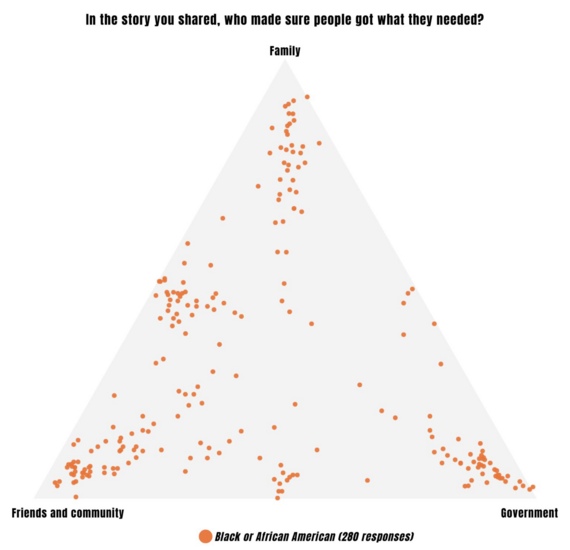
At the Strengthen Families Locally Retreat, the Our Tomorrows Story Project heled us with Sensemaking with the stories collected as part of the SFL project. One question they helped us answer was, where do people get what they need? And how does this differ across racial and ethnic groups? Here is one of the Sensemaking displays for how people who identifies as Black or African American answered that question. What patterns do you see? We discussed how lack of trust in systems because of racism and prejudice can shape where people go to seek help, and how our systems are still actively inequitable for members of racial and ethnic minorities.
Check here for news and opportunities specific to our Strengthen Families Locally communities. Send opportunities to strengtheningfamilies@dcyf.wa.gov
Peninsula: Join Olympic Community of Health and your fellow care coordinators (Community Health Workers, Navigators, etc.) for the the next Regional Care Coordinator convening on July 31 from 9-11am. This event is for the on-the-ground health and human services workforce who connect people with resources they need to lead healthy, thriving lives. Participants will engage in a collaborative environment to enhance care coordination, resource sharing, and workforce support. OCH will be hosting this event at the Jamestown S'Klallam Red Cedar Hall in Blyn. Registration and more information
Bremerton: Early Learning Resources Spring Fling. Join us for a community event for families with children ages birth to 5 who live in the Central Kitsap area! Spanish and Tagalog interpreters will be available! May 30, 3-5 p.m. at the Central Kitsap Teaching and Learning Center - 1400 NE McWilliams Road. Learn more here.
Check out these local resources on Facebook!
Connect (Events and Opportunities)
Intro to Liberatory Design for Educators | June 18, 2024. We are all living in challenging times that our past experience and training has not sufficiently prepared us for. Too often, well intentioned equity efforts do not succeed—and even produce unintended consequences. This can lead to frustration, hopelessness and cynicism. This workshop offers an introduction to our Liberatory Design approach. ($200) Register Here
2024 LGBTQIA2+ Families Then and Now series. Through conversations with a diverse range of panelists who identify as LGBTQIA2+ at different stages of family life, this free webinar series explores the changing landscape of LGBTQIA2+ parenting. Episode 3: Wendy Kramer & Ryan Kramer on the Doner Sibling Registry. Monday, June 3, 2024, 3 – 4:30 PM ET/ 12 – 1:30 PM PT | Register here
The Children's Trust Fund Alliance is excited to announce an upcoming Virtual Training of Trainers (TOT) for Bringing the Protective Factors Framework to Life in Your Work. Date: June 24-27, 2024. Registration Link: https://forms.gle/Ttv3ieUbvSrWbJ937 Additional Information: Please refer to the attached flyers for details. Tuition: $2,500.00, inclusive of materials, shipping and network membership upon completion of the TOT.
The Washington Office of Equity announces Equity Learning Series for State Employees: Each month during 2024, the Office of Equity will host one webinar focused on equity and belonging topics. These webinars will be geared towards increasing the knowledge, skills, and ability of us all within State Government. We do this to fulfill one of our main goals: delivering services equitably to meet the unique needs of every person in Washington. For more information, click and read through the links below associated with each event:
Learn (Educational Resources)
From Birth to Three Toolkit: A Guide to Washington Services for Infants and Toddlers (ages 0-3 with disabilities) from PAVE. New parents have a lot to manage. Concern about whether a child’s growth and development are on track can be confusing. This toolkit provides places to begin if caregivers suspect that a baby or young child may need services due to a developmental delay or disability. View and download here.
Family Initiated Treatment eLearning Modules: Family Initiated Treatment (FIT) is a service aimed at fostering collaboration between families and the healthcare system. Our FIT eLearning modules provide valuable insights into understanding the FIT process and equips families with the tools necessary to navigate the system successfully. View the materials here.
WA’s ‘one of a kind’ youth homelessness response shows big results: Over the last decade, Washington state has built from nearly nothing a uniquely robust youth homeless response system that is showing staggering results. By one count, there were 40% fewer homeless youths living on their own in 2023 than there were in 2016. View the full Seattle Times article here.
Act (Ways To Engage Right Now)
School’s out, but a new summer EBT program keeps kids fed: Millions of students nationwide are enrolled in free or reduced lunch programs during the school year, but the summer months can be difficult without this important food source. In 2022, the federal government authorized a new, permanent Summer EBT program called “SUN Bucks” to offer food benefits while school’s out. SNAP, TANF, or FDPIR beneficiaries are automatically enrolled in SUN Bucks, and those not automatically enrolled may still apply. Each eligible child will receive a one-time payment of $120 in food benefits on a dedicated SUN Bucks card.
WSHA + HCA Starts with One campaign needs your feedback: Starts with One is an educational campaign led by the Washington State Health Care Authority and supported by the Washington State Hospital Association, with resources on preventing opioid misuse for providers, patients, and their families. Provider toolkit website. To help inform future work and materials undertaken by the campaign, we are inviting providers to take a quick 5-minute survey on prescribing practices. Thank you in advance for your participation and feedback. Take the survey here. For questions, please contact Esther Brown.
Grow (Funding and Resources)
Civilian-military compatible infrastructure projects near military installations: Commerce is now accepting applications for Defense Community Compatibility Account (DCCA) funding for civilian-military compatible infrastructure projects near military installations in Washington. The purpose of the DCCA is to provide funds for development projects that affect the economy, environment, or quality-of-life opportunities for local communities located near military installations. DEADLINE TO APPLY: SEPT. 13. Materials posted on the DCCA webpage.
Service Expansion: On April 26, 2024, a Request for Applications (RFA) was launched to select three to six programs to pilot culturally responsive and specific prevention services to reduce entries into out-of-home care among Native children. Applications are due June 25, 2024 by 2 p.m. View the RFA on WEBS or contact Tessa Velasco for more information. Tribal governments, Recognized American Indian Organizations (RAIOs), and other community-based organizations that serve American Indian/Alaskan Native families are eligible to apply.
DCYF has launched a Request for Proposals (RFP) to expand the array of culturally responsive and specific prevention services for Black families in Washington state. Letter of Intent must be received by May 31 at 2 p.m., applications are due on June 10 by 2 p.m. Contact Tessa Velasco for more information. Through this pilot, DCYF hopes to safely reduce the number of Black children and youth entering out-of-home care, and address service gaps such as a lack of proximate providers providing in-home services, parent education, and other prevention-based interventions that may contribute to racial disproportionality in the child welfare system.
If you have suggestions for what to include in this newsletter, email Joy Lile.
|