Lakota Seasons & Moon Phases
Though calendar types vary from one American Indian tribe to the next, nearly all tribal calendars begin in the spring. To Native people, spring symbolizes the start of a new year through the birth of new plant and animal life.
The Lakota (Sioux) observed the changes occurring with each new moon. Each moon was identified in descriptive terms by the occurrences of that month. The name of the moon was never permanently set due to new moons gradually moving to a different time each winter. This explains why you might see alternate names for each moon.
Read more about the moon phases, the Lakota beliefs and traditions:
|
“Every time we carry an eagle feather, that’s sovereignty. Every time we pick berries, that’s sovereignty. Every time we dig roots, that’s sovereignty,”
-Billy Frank Jr. Nisqually, Nisqually, a Native American Elder, environmental leader and advocate for treaty rights.
Each week, DCYF ESIT Tribal Program Consultant, Brian Frisina, provides a key topic to help us get to know our Tribal Nation Partners better.
This week’s term is:
What is the relationship between the tribes and the United States?
The relationship between federally recognized tribes and the United States is one between sovereigns, i.e., between a government and a government. This “government-to-government” principle, which is grounded in the United States Constitution, has helped to shape the long history of relations between the federal government and these tribal nations.
What is the relationship between the tribes and the individual states?
Because the Constitution vested the Legislative Branch with plenary power over Indian Affairs, states have no authority over tribal governments unless expressly authorized by Congress. While federally recognized tribes generally are not subordinate to states, they can have a government-to-government relationship with these other sovereigns, as well.
Furthermore, federally recognized tribes possess both the right and the authority to regulate activities on their lands independently from state government control. They can enact and enforce stricter or more lenient laws and regulations than those of the surrounding or neighboring state(s) wherein they are located. Yet, tribes frequently collaborate and cooperate with states through compacts or other agreements on matters of mutual concern such as environmental protection and law enforcement.
Read more about Why Tribes Exist Today in the United States:
Sources
Frequently Asked Questions, Why Tribes Exist Today in the United States, U.S. Department of the Interior Indian Affairs, An official website of the U.S. Department of the Interior,

The April SICC meeting is just around the corner! Please join us virtually:
Wed., April 17
9 a.m. – 3 p.m.
Meeting link & agenda TBA
Teams
The ESIT State Leadership Team will be holding our upcoming SICC meetings via the Teams platform! You will not need to create a Teams account to join and participate in the meeting and you will be able to join from any device. Meeting link TBA.
For Review
The draft February SICC meeting minutes, Meeting Materials and presentations have been posted to ESIT's SICC Meetings page for review. If there are needed changes to the February meeting minutes, please send your edits to Will Moncrease Jr.
SICC Direct List
If you would like your email added to the SICC direct email list to receive the agenda and meeting materials in advance of upcoming SICC meetings, email Will Moncrease Jr., with the subject: Add me to SICC DL.
Questions?
Please contact DCYF ESIT Partnership & Collaboration Manager, Will Moncrease, Jr., at will.moncrease@dcyf.wa.gov.
|

Practice Guide Update: Pathways to Services for Infants and Toddlers with Blindness or Low Vision
The Pathways to Services for Infants and Toddlers with Blindness or Low Vison Practice Guide will be updated as of April 8, to include the following:
- Additional information regarding the role of ESIT BLV specialists,
- Adding Assistive Technology and Family, Training, Counseling and Home Visits to the list of Part C services a BLV specialist may be listed as providing on the IFSP.
You can find the current Practice Guide on the Practice Guidance page of the ESIT website under the dropdown titled, Blind/Low Vision and Deaf/Hard of Hearing Resources. The updated version will appear in the same location.
If you have questions, please contact your regional Technical Assistance Specialist: Diana Golovkin (diana.golovkin@dcyf.wa.gov), Michell Baker (michelle.baker@dcyf.wa.gov) or Iris Dunaway (iris.dunaway@dcyf.wa.gov).
|

DEVELOP - DCYF's New Training Portal
We are pleased to share that this summer, DCYF will be launching a new and improved training site, called DEVELOP. DEVELOP will combine the “Find Trainings” part of MERIT with the DCYF Training Portal, where ESIT professionals go to take online training.
When DEVELOP goes live this summer, ESIT professionals will be able to search, register for, and take trainings in DEVELOP, all in one location!
Before going live
DCYF will import the training history of ESIT professionals with training records in the current Training Portal into the new site. Your existing account and history of training information will move to DEVELOP.
As we begin the transition
In addition to monthly newsletter updates, DCYF will provide access to recorded demonstrations, written tutorials, and one-on-one office hours for technical assistance beginning 90 days before people begin using DEVELOP to find training.
For more information about DEVELOP, visit DCYF's New Training Site, or contact dcyf.esittraining@dcyf.wa.gov.
|

Washington State has adopted policies and procedures to ensure public participation in the annual grant application (including any policies, procedures, descriptions, methods, certifications, assurance, and other information submitted with the application) for the Individual with Disabilities Education Act (IDEA) Part C funds. The annual grant Application and related documents will be published in a manner to ensure circulation throughout the state for at least a 60-day period, with a 30-day opportunity for public comment and public hearings, as appropriate, during that period per 34 CFR § 303.208(b).
For Public Review
DCYF's ESIT State Leadership Office posted the following materials for public review:
Public Comment
Opportunities for public comment will begin April 1 and end May 1, including two virtual public hearings, to be held:
- April 18 | 1:05 p.m. – 2:05 p.m. | Join here
- April 23 | 9:30 a.m. – 10:30 a.m. | Join here
If you would like to receive this notification in an alternate format or language, please contact the ESIT Partnership & Collaboration Manager at 564-999-0449 or dcyf.esit@dcyf.wa.gov.
For questions, please contact Lauren Thompson, ESIT Resource Allocations Manager, at lauren.thompson@dcyf.wa.gov
|
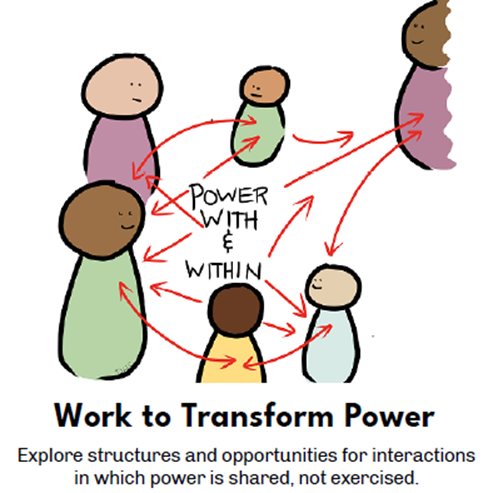 |
"Work to Transform Power: Explore structures and opportunities for interactions in which power is shared, not exercised." - Liberatory Design, Mindsets and Modes to Design for Equity
Why?
To have the opportunity to influence and support the drafting of equity-based metrics that can drive the local decision-making process for the use of the IDEA Part C Equity in Access Funding Set-Aside, totaling $500,000 statewide. Influencers will also have the opportunity to contribute to the content and format of a streamlined, mini-application to be used by local programs to describe their equity-based metrics and priority areas.
Who?
If you are interested in helping identify data and information necessary to ensure equitable services (both types and intensity) are provided for each child and their family regardless of race, language, social class, or place of residence, please volunteer. Working together, parents, practitioners, administrators, and finance leaders can influence how resources are allocated at the local level to break down barriers and reduce inequities in access to high-quality, family-centered, statewide early support services. To volunteer to join the EIA-TWG, email your request to Kali Wraspir, ESIT Resource Allocation Specialist at kali.wraspir@dcyf.wa.gov with “EIA-TWG Volunteer” in the subject line.
What is the Timeline & Commitment?
The 10-12 member EIA-TWG will meet up to three times for 60–90-minute segments between April-May 2024. Meeting dates and times will be determined after membership influencers are identified.
Questions?
Please feel free to contact Valerie (Val) Arnold, ESIT State Administrator, at valerie.arnold@dcyf.wa.gov or preferably at (360) 485-7773.

Do you work at a local ESIT Provider Agency and bill public and/or private health insurance for ESIT Services? You are invited to join a newly formed Insurance Billing Support Group!
What is the Insurance Billing Support Group?
This informal peer-to-peer collaborative space will be limited to those who are engaged in billing at the local ESIT program level, meeting the fourth Monday of each month. We hope to connect as peers, exchange ideas, and collaborate to find solutions to common challenge such as:
- What have you found to be the best coding to use for specific services?
- What strategies have worked for following up on denied claims?
- What procedures does your agency have in place to ensure timely filing?
A little about the facilitator
My name is Marsha Smith and I work for Steps, formerly Toddler Learning Center. We serve Island County, San Juan County and Anacortes. I have worked here for almost 6 years, and before this my experience came from the financial industry and working in the Island Hospital billing department. My love for numbers and money has helped me be a great advocate for families and staff. I enjoy sharing what I know, and most of all learning from my peers who do the same work.
Join us in April!
Mon., Apr 22 | 2 p.m.
Questions?
Can’t attend but interested in future events? Have questions? Email Marsha Smith, at Marsha.S@takingstepstogether.org.
|
 |
Mark Your Calendars!
Please make plans to attend the 2024 Infant and Early Childhood Conference (IECC), hosted completely virtual via Zoom!
May 6 – 10
For conference information please visit www.ieccwa.org.
IECC plans to offer STARS Credit and Clock Hours for this event.
The purpose of the IECC Conference is to provide opportunities for families and service providers to come together to learn, share and advocate on behalf of all young children, especially those with developmental delays, disabilities and/or other special health care needs.
IECC Partnership Opportunity
IECC is so thankful for its many community partners. Due to their support IECC has been able to shift its platform and offer the conference registration complimentary for all attendees the past few years. If your organization would be willing to partner with us please email the conference coordinator, Amanda Cardwell directly at amandacardwell@frontier.com.

The Washington State Department of Health, Early Hearing Detection, Diagnosis and Intervention (EHDDI) program worked with ESIT, family resources coordinators (FRCs), early support providers, deaf and hard and hard of hearing (DHH) adults, audiologists, and a family-to-family support organization to create three training modules. The training modules provide FRCs and early support providers with information and resources that are helpful when working with children identified as deaf or hard of hearing and their families. The trainings focus on the following topics:
-
Special Providers and Services: Discusses DHH specialized programs and supports, and special considerations when working with children who are DHH with additional disabilities.
-
Knowledge Building: Provides information about diversity in the DHH community, describes hearing levels, and technology options available.
-
Bias Awareness: Provides information about communication opportunities, recognizing biases, and ways to support diverse families.
To access the trainings, please visit the EHDDI WaPortal page:
|
 |
 |
Join us in person for the 2024 Fatherhood Summit where we will release findings from the State of Fathers in Washington Study and roll up our sleeves together to accelerate system transformation for fathers and families.
This year's event theme is Counting Fathers Because Kids Matter. We highly value the voices of fathers in this work, and some support for travel costs is available for dads to attend the event, including mileage, hotel, childcare expenses, meals for overnight attendees and compensation for lived experience for a limited number of fathers (contact us to learn more).
Overview
- This event is free.
- Doors open with continental breakfast at 7:30 a.m.
- Event begins at 8:30 a.m.
- Continental breakfast, lunch and refreshments will be provided.
- Visit our website for more details.
Keynote Speaker: Dr. David W. Willis, MD, FAPP
Dr. Willis is a senior fellow at the Center for the Study of Social Policy and a national expert in pediatrics, early childhood systems and early relational health.
Nurturing Connection for Fathers, Families and Communities:
“There is overwhelming research and understanding that makes it clear that all children and their families benefit from strong, positive and nurturing father and father-figure relationships to grow and thrive. To solve complex issues that often marginalize fathers’ roles, we must build bridges and listen to and trust one another. We will spend the day listening to one another and building bridges and connections around the findings in the State of Fathers in Washington Study to increase fathers’ access, equity and belonging.”
Fri., June 7 | 7:30 a.m. - 4:30 p.m.
The Greater Tacoma Convention Center
Register and learn more:

Join Washington Sensory Disabilities Service (WSDS) consultants representing Washington State School for the Blind (WSSB) and Center for Deaf and Hard of Hearing Youth (CDHY), with other sensory statewide partners, as they host monthly 1 hour drop-in sessions to share and discuss resources related to ESIT services for children who are blind/low vision, deaf/hard of hearing, or deafblind. Each drop-in session will have a topical focus and will offer opportunities for open questions on any topic. ASL interpretation and Live Captioning will be provided.
April 22 WSDS Drop-In Session
Kerianne Christie (CDHY) and Jessica Chandler, from WSSB, facilitate a FRC panel discussion and answer questions.
Mon., April 22 | 1 p.m.
May 13 WSDS Drop-In Session
Kerianne Christie (CDHY) and Jessica Chandler, from WSSB, and Nancy Hatfield, from the DeafBlind (DB) Program, to facilitate a conversation about working effectively with Blind-Low Vision/Deaf and Hard of Hearing/DB Specialist. Bring your questions, comments, and suggestions!
Mon., May 13 | 1 p.m.
|

Emergency Broadband Benefit Funds Available
The WA Office of Broadband has funds available to assist families with internet costs. More details on this benefit and how to apply are located here.
Discounted Internet Service Available to Low-Income Households
The federal Affordable Connectivity Program offers eligible households a high-speed internet plan for no more than $30 per month. More details on this program and how to apply are located here.
Digital Navigation Toolkit Available
Digital Health Navigators are individuals who address the whole digital inclusion process - connectivity, devices, and digital skills - to support community members and provide access to healthcare. The National Consortium of Telehealth Resource Centers (NCTRC) has released a new toolkit that provides helpful resource links relating to digital navigation.
|

Workshops offered by the Infant Early Childhood Mental Health (IECMH) Workforce Collaborative are free for professionals who serve or support children prenatal to five and their families enrolled in Apple Health (Medicaid).
- IECMH Clinical Workshops are designed for clinical professionals involved in mental health assessment and diagnosis for children birth to five.
-
IECMH Community Workshops are intended for all professionals who support the social-emotional well-being of babies, toddlers, preschoolers, and their families, as well as expecting families.
For more information visit:
CEUs and/or STARS hours are provided for most workshops.
Questions? Contact admin@wa-aimh.org.
|
For more updates, subscribe directly to these great newsletters:
|