- Data is never used to identify individuals. Personal identifying information or PII (e.g., first and last names, home address) for families that consented to share PII, is used only to understand what proportions of families were referred to Child Protective Services (CPS). Once DOH has this information, it is used only to establish a percentage of families who experienced child welfare involvement for the state as a whole to demonstrate that home visiting is likely preventing child abuse and neglect for many families in our state. This is done only through linking data sets outside of DCYF and DOH and is never shared for other purposes.
- When publishing reports, DOH follows a small numbers policy that prohibits us from reporting out counts below 10. We do not report data when any counts are below 10 to protect against someone using the results to potentially identify a family.
DOH uses MFT (Managed File Transfer) for sharing data and reports securely with LIAs. This is a new system that replaces the SFT or Secure File Transfer system. Use of MFT to transfer files between LIAs and DOH is particularly important when we are sharing client-level data to protect the privacy of clients and families, especially in regard to small numbers that could be identifiable (e.g., when there are less than 10 teenage clients). For this reason, DOH utilizes MFT and not email when transferring client or program files (e.g., Dashboards). Regular email is not secure since the messages are generally not encrypted.
At least one person from your agency should have access to your MFT account. When we post dashboards or other reports, please remember to download them within two weeks since they will be deleted after 14 days. The best practice is not to share the username and password of MFT. DOH recommends having two people on MFT account per LIA so that two people will be able to download the data.
Please contact DOH’s Home Visiting Unit Team at homevisiting@doh.wa.gov if you encounter issues accessing your MFT account or if you would like to add another person from your agency to MFT account. Instructions for setting up an MFT account can be found on the Data Collection & Reporting page, under “Sharing Data with the Washington State Department of Health (DOH).
Protecting the privacy and confidentiality of HVSA families is our top priority at DOH. Please contact the Home Visiting Unit team at DOH (homevisiting@doh.wa.gov) if you have any questions or concerns.
Get ready to connect! The Spring All-HVSA meeting will take place May 9-10, 2024. This will be in person, with hybrid options, at Cedarbrook Lodge in Seattle. We recognize that a Thursday/Friday is a different schedule in the past and recognize this impacts those who don't work on Fridays. And, we also recognize that Parent Child+ is having their national meeting on the 9th. Thank you for your participation in advance! We will be doing Supervisors Day 1 and the full group on Day 2, with hybrid options available. Our hope is next time to return to a plan of a mid week meetings, with the full group meeting on the first day, and the smaller, supervisor group the second, as a way to foster relationship and connection growth for the field. We thank you for your understanding.
 Thank you so much for celebrating Parent Recognition month with us this year! We were honored to celebrate families from across the state, including several home visiting families this year. You can read all the Unsung Hero nominations at https://www.seattleschild.com/category/community/.
Community Based Child Abuse Prevention Funding
Strengthening Families Washington, at the Department of Children, Youth, and Families (DCYF), is pleased to announce that funding will be available for organizations to provide community-based Child Abuse and Neglect prevention programs and to increase their program evaluation capacity.
The Request for Application instructions and access to an informational webinar will be available on March 1, 2024 at https://dcyf.wa.gov/services/child-dev-support-providers/home-visiting/funding-opportunities. An informational webinar will be hosted from noon to 1:30 p.m. on Friday March 15, 2024 and a letter of intent to apply will be due April 22, 2024. The full application will be due on May 1, 2024.
Successful applicants will be offered a maximum funding of $45,000.00 for the initial contract year with the possibility of continued funding for up to an additional two years with a base funding award of at least $45,000.00 per year.
Our next office hours will be March 21, 2024 3 p.m. Join here.
Please join us for the Virtual Home Visitor Training Series with presenters from a wonderful team of experienced and wise home visitors and WSCADV staff!
The Domestic Violence Assessment and Response training is followed by the Safety Planning with Families training.
Please register for each event you wish to attend.
DV Assessment and Response
April 4, 2024
April 5, 2024
10:00 - 11:30 am both days
Register here!
Safety Planning with Families
May 17, 2024
9:30 a.m. – 2:30 p.m.
(break from 12-1 p.m.)
In the Fall of 2023, Parents as Teachers launched Investing in the Power of Families. This three-pronged initiative will support affiliates in:
- Restoring families’ enrollment numbers
- Increase direct services of needed mental and physical health supports to families
- Grow opportunities within communities that can lead to systemic positive changes through engaged parent leaders.
PAT’s first activity was to award $1.75 million dollars in Challenge Grants to eligible affiliates. Nearly a third of the PAT affiliate network submitted applications for projects. The following Washington State programs were awarded the 2024 Parents as Teachers Challenge grants:
Suquamish Indian Tribe of the Port Madison Reservation
- The main goal of our proposed project is to host the first ever two/three (2-3) day, culturally appropriate, trauma informed, Parent Wellness Conference on the Port Madison Indian Reservation. Our home-visiting program will contract with community leaders, cultural bearers, and the Native Wellness Institute, a non-profit organization that exists to promote the well-being of native people through programs and training that embrace the teachings and traditions of our ancestors- to facilitate a space for learning and healing. Through treaties, residential schools, and policies aimed at assimilation, colonialism has impacted the practices of indigenous parenting. We were not meant to survive the forceful removal of our children and loss of parental power, or the loss of community, language, tribal traditions, or ceremonies. For many years, Indigenous parenting has been viewed with deficiencies, often deemed inferior in comparison to western ideologies. Parents and families in our community are self-aware of the trauma we carry through blood memory. Parents and families in our community seek the awaking of inherent knowledge and guidance to repair and restore teachings and practices. Parents and families in our community understand that the efforts we are making right now impact the next seven generations. It is not lost on us as home-visitors or Indigenous women, the important work that has taken place before us. We only hope to further the pathway of Indigenous parenting practices and trust that each individual will take what they need from this experience to have meaningful and fulfilling roles as mothers and fathers. This conference will be hosted on the traditional lands of the Suquamish People. Indigenous Conference organizers and training facilitators will engage current, potential, and previously enrolled Parents as Teachers participants, in addition to Indigenous and Suquamish tribal parents and families within our community. Meals provided will include traditionally harvested foods, and special efforts will be made to create a safe space for individual healing and community connection.
Institute for Family Development
- The Institute for Family Development (IFD) is a statewide behavioral health agency with locations in each region of Washington state. We are recognized as a leader in providing services designed to keep children safe, strengthen families, and reduce the need for placing children into state-funded care. IFD offers a wide range of innovative and cost-effective in-home services to children and families. All of IFD’s services are focused on strengthening family relationships and enhancing family resilience and self-sufficiency. IFD’s Parents As Teachers program is an important part of Pierce County’s home visiting network that supports vulnerable and ethnically diverse families with young children. IFD’s Challenge Grant project is focused on Program Quality Improvement and Marketing efforts. We will use grant funds to provide our PAT staff with a variety of in-depth training on relevant topics such as, Postpartum support and care, breast feeding, newborn and infant care and cues, infant and toddler sleep, etc. Our other area of focus, along with enhancing our marketing resources and materials, is enhancing family participation in Group Connection events. We will use some grant funds to incentivize family participation as well as making Group Connection events more dynamic. This may include paying for a guest speaker/presenter or purchasing curriculum. The grant will allow us to assist our families in creating additional support networks for themselves.
Grays Harbor Public Health and Social Services
- The main goal/objective of this project is to create a family resource center and space for parents to gather once a month to collect community resources, receive support and enjoy a play group. PAT staff as well as other public health professionals from WIC, the ABCD program, and a partnership with our local Kaleidoscope Play and Learn program (KPL) will be present. This space will create a setting for parents and their children to interact socially and engage with their peers. The play group will provide a drop in parent involved early learning setting that will include circle time, learning stations, snack, and a parenting topic and discussion with a guest speaker from the community. Providing a drop in space for all families with young children in our community to receive support will be extremely beneficial. After COVID many families have been isolated and are longing for opportunities to gather, connect, feel supported, share stories, and have the chance to build new friendships.
Lydia Place
- Lydia Place works with families with young children experiencing homelessness through a holistic, multi-generational approach. With the Challenge Grant through the Investing in the Power of Families Initiative, Lydia Place will provide parent educators and support staff with in-depth, interactive Diversity, Equity and Inclusion training that examines the roots of structural racism in the United States and how it impacts families today. BIPOC families experience health, social, economic and educational disparities, all influenced by determinants of health created and perpetuated through systemic and structural racism. To truly disrupt the cycles of homelessness and poverty, we need to be equipped to dismantle racism both through individual work with families and through systems advocacy. We need to show up as anti-racists throughout everything we do, and that takes time, effort, and intentionality. Providing training around the history of racism in this country will help all staff to establish a foundation and shared understanding of where we have come from, where we are, and how to move forward in the work we do. We will partner with the Racial Equity Institute (REI) to bring their two-day “Phase 1” training to our staff. This training is “designed to develop the capacity of participants to better understand racism in its institutional and structural forms” (https://racialequityinstitute.org/). The REI utilizes what they call the “Groundwater Approach” to teach about the creation and perpetuation of structural racism. As an essential part of our community’s network to support early childhood and family well-being, it is vital that we not only acknowledge these disparities but have the knowledge and tools to actively combat them. While our work is primarily in direct service to families, we are also engaged in systems advocacy in our county, state, and federal level. A better understanding of how these systems have been designed will deepen our impact as we work for meaningful change.
CONGRATULATIONS TO ALL THE AWARDEES!
Developmental Screening and Referrals
Early identification of developmental delays in important in improving wellbeing of
children. Research shows that early intervention treatment can greatly improve cognitive and academic performance, and decrease engagement in risky behaviors. An estimated 15% of children in the United States have at least one developmental delay, yet fewer than one-fifth of those children receive early intervention services before three years of age.
Developmental screening can reveal a child’s strengths as well as areas for additional support. When we activate parents in this process, we gain a richer snapshot of the child’s growth and smooth the way for successful referrals. Join this two-part training on parent-centered screening, featuring the Ages and Stages Questionnaire, 3rd edition (ASQ-3) -- a flexible tool you can adapt for your families’ context and your program’s logistics.
The HVSA’s developmental screening aligned measure evaluates whether each enrolled child between 9 and 30 months old received a timely screen for developmental delays using the ASQ-3.
Measuring Performance
Developmental Screening/Referral
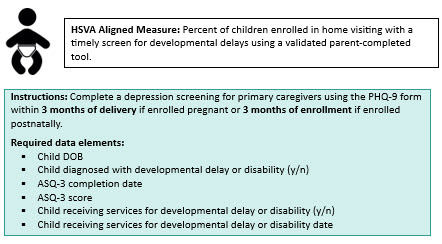  Home Visitors should screen index children for developmental delays at each AAP-recommended age interval. AAP recommends that, at a minimum, standardized developmental screening tools should be administered when the child is 9-months, 18-months, and 24- or 30-months of age.
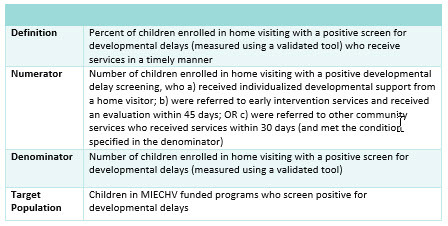
Enter the numerator, denominator, and missing data values in HVIS; any information that may help explain the data should be reported in the notes. Home Visitors should also enter a table note when the percentage of missing data is greater than or equal to 10% that addresses the reason for missing data, and if possible, plans to reduce the amount of missing data in future reporting.
Data are considered missing if one or more data elements needed to determine inclusion in the
numerator or denominator are unknown. All cases of missing data should be excluded from the
measure calculation.
 How to enter data?
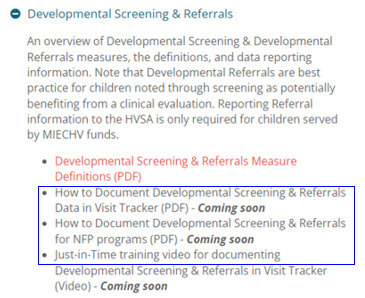
Instructions to enter data will be available soon. Please refer to the HVSA Aligned Measures section on the Data Collection & Reporting page for instructions on how to document Intimate Partner Violence Screening & Referrals on Visit Tracker and Flo.
 If you have any questions or suggestions on these documents, please contact us at homevisiting@doh.wa.gov
CQI Corner
January Webinar Summary: Mid-Year Review
In the latest CQI Webinar we reviewed CQI topics, including the chart below used to share the changing focus across topics within coaching calls. The group also used small breakout groups to reflect on experiences with challenges and success as well as ongoing and new PDSA implementations. Discussions included challenges in sustaining staff retention, sharing strategies in building connections, celebrating individuals, and effective feedback practices to inform priorities.
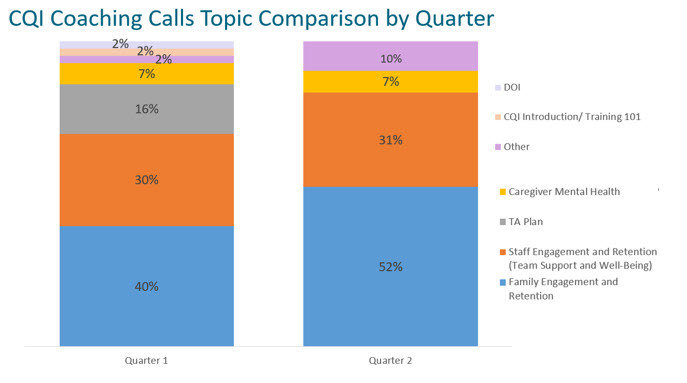 This chart shows the quarterly breakdown of topics/ focus areas in CQI Coaching Calls. Roughly the same number of conversations were held in quarter 1 (July – September) and quarter 2 (October – December) that centered on Staff Engagement and Retention as well as Caregiver Mental Health. While there was a 12% increase in conversations related to Family Engagement and Retention from Q1 to Q2.
Resources (found on Basecamp – CQI Project Folders)
Looking Ahead – February 28 (1:30-2:30 p.m.)
- Running PDSA “ramps” to scale up tests of change
For questions, support or to be added to CQI communications:
Camille Carlson: ccarlson@startearly.org
Peer Connections
The Start Early Washington team is excited to be offering home visitor peer connection opportunities, which provide a space for home visitors across Washington to connect with each other, share questions, strategies, and reflections on working with families.
Date: February 29 at 1 p.m.
Register for Home Visiting Peer Connections
For questions please contact HVStartEarlyWA@STARTEARLY.ORG
Each month, DCYF ESIT Tribal Program Consultant Brian Frisina will provide a key topic to help support us all in getting to know our Tribal Nations partners better.
This month’s topic is:
What Is Indigenous Self-Determination and When Does it Apply?
Self-determination is an expression often used in discussion of indigenous goals. However, the meaning of self-determination varies among Indigenous Peoples, scholars, international documents, and nation states.
The United Nations Declaration on the Rights of Indigenous peoples uses the expression of self-determination for Indigenous Peoples but qualifies the expression. The Declaration does not recognize the right of Indigenous Peoples to seek recognition as a nation state or to withdraw from the nation-state that is currently occupying indigenous territories. Most Indigenous Peoples are not ready or do not want to take on nation-state status, since most indigenous nations are small, not market-based, and cannot compete politically, economically, or militarily with nation states. Most Indigenous Peoples are not dreaming of taking over the nation-state, or even seceding from the nation-state, but they dislike that nation-states have considerable political, legal and economic control over their communities, territory, and cultural orientations.
Read more about What Is Indigenous Self-Determination and When Does it Apply?
What is Tribal Sovereignty?
Tribal sovereignty is a phrase we often hear, but what does it really mean? In this video created by Native Governance Center and the Minnesota Humanities Center, you'll learn about how Tribes exert their sovereignty to govern their citizens and why sovereignty matters (watch time 2:36):
Kids Explain Black History Month
Watch as kids give their thoughts on black history month (watch time 2:08):
13 Exceptional Kid Lit Books to Read for Black History Month
Using children’s literature to teach about Black history and the Black experience is a great way to open the door to discussions about these experiences and milestones. These books include important insights into Black history, culture, accomplishments, notable people, historical and current day injustice and how that injustice was and continues to be confronted and overcome. Our recommended books include picture books, chapter books and graphic novels. Each book comes with two discussion guides: one for educators and one for families.
News
How a maternal health program aims to prevent family separations in Montana (montanafreepress.org)
Fentanyl crisis warrants government intervention | Livingston, Federal Way Mirror
Finding a solution to the childcare crisis in Washington, My Northwest
Thinking Outside The Box: Washington State Program Visits IKEA for Inspiration
|