|
Angel Baby by Jahla Brown, DCYF ESIT Partnership & Collaboration Specialist. Illustrated re-imagining of the two cherubs featured in Raphael's Sistine Madonna painting.
"How curious a land is this, how full of untold story, of tragedy and laughter, and the rich legacy of human life; shadowed with a tragic past, and big with future promise!"
– W.E. B. Du Bois, American sociologist, socialist, historian, and Pan-Africanist civil rights activist, quote from The Souls of Black Folk, 1903

Debunking The Most Common Myths White People Tell About Race
Robin DiAngelo, author of White Fragility, unpacks common excuses white people make about race–and how to address them. Watch video here, from NBC News (watch time 3:47):
|
“Let us boldly implement what our ancestors practiced and take the time to bring forth the knowledge, values, ceremonies, social and political institutions that bring out the spirit of every human child, no matter what age.” - David Wilkins, Lumbee Nation, Lumbee Nation, political scientist specializing in federal Indian policy and law
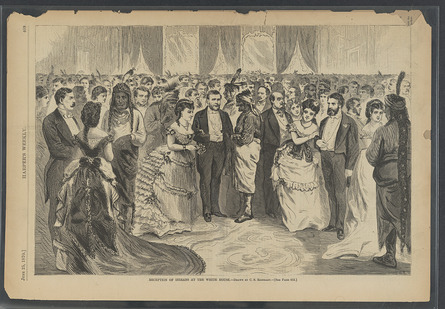
"Reception of Indians at the White House," drawn by C.S. Reinhart. Illustration showing "President Ulysses Grant holding a reception for Native Americans at the White House, on June 6, 1870. Among the attendees was Red Cloud, a signer of the 1868 Treaty of Laramie. The Euro-Americans and Indians, were mutually interested in each other's party clothes."
Each week, DCYF ESIT Tribal Program Specialist, Brian Frisina, provides a key topic to help us get to know our Tribal Nation Partners better.
This week’s term is:
Treaties—solemn agreements between sovereign nations—lie at the heart of the relationship between Indian Nations and the United States. Native Nations made treaties with one another long before Europeans came to the Western Hemisphere. The United States began making treaties with Native Peoples because they were independent nations. Often broken, sometimes coerced, treaties still define mutual obligations between the United States and Indian Nations. The treaties featured in Nation to Nation: Treaties Between the United States and American Indian Nations, on loan from the National Archives and Records Administration, are representative of the approximately 374 that were ratified between the United States and Native Nations.
See high quality scans of the physical treaties:
In this second webinar, in the Power to the People series from the Center for Civic Education, David Wilkins, E. Claiborne Robins, Distinguished Professor in Leadership Studies at the University of Richmond, discusses Native American sovereignty (watch time 1:31:49):
For more information mentioned in the webinar:
Sources
Image: Reinhart, Charles Stanley, Artist. Reception of Indians at the White House / drawn by C.S. Reinhart. Washington D.C, 1870. Photograph.
Nation to Nation, Treaties Between the United States and American Indian Nations, Smithsonian National Museum of the American Indian, © 2016 Smithsonian Institution.
The Power of Indian Sovereignty, posted to YouTube by Center for Civic Education, Sept. 25, 2020.
Native Sovereignty: A Potpourri of Definitions, Indigenous Defitions of Tribal Sovereignty, David Wilkins Handout.
McGirt v. Oklahoma (2020), David E. Wilkins, Last updated: September 2020.

We are looking for an ESIT Data Management System (DMS) Data Coordinator to join our ESIT State Leadership Team!
As the ESIT DMS Data Coordinator, you will be responsible for establishing and maintaining procedures that support systems, training, technical assistance related to data use and data systems that promote high quality, accurate, statistical reporting for state and federal compliance, and program accountability and ongoing quality improvement activities. This position closes Mon., Feb. 26.
Click below to learn more about this position and apply:
|

We are looking for an ACORN Training and Technical Assistance (TA) Coordinator (MA4) to join our ESIT State Leadership Team!
As the ACORN Training and TA Coordinator, you'll provide advanced professional analysis on complex data collections and report issues impacting early support services and ESIT program policies and procedures statewide. You'll ensure early intervention provider agencies comply with state and federal early intervention data-related laws and regulations. You'll coordinate and manage complex data management structures, co-create training materials, and lead process improvement procedures that support the ongoing and effective statewide use of ACORN. You'll also work with external organizations to monitor proposals and identify potential changes to data-related state policies and procedures. This position closes Tues., Feb. 20.
Click below to learn more about this position and apply:
|

The February SICC meeting is just around the corner! Please join us virtually:
Wed., Feb. 21 | 9 a.m. – 3 p.m. | Agenda TBA
For Review
The draft October 2023 and draft January APR 2024 meeting minutes have been posted to ESIT's SICC Meetings page for review. If there are needed edits to either the October or January meeting minutes, please email Will Moncrease Jr.
SICC Direct List
If you would like your email added to the SICC direct email list to receive the agenda and meeting materials in advance of upcoming SICC meetings, email Will Moncrease Jr., with the subject: Add me to SICC DL.
Questions?
Please contact DCYF ESIT Partnership & Collaboration Manager, Will Moncrease, Jr., at will.moncrease@dcyf.wa.gov.
|
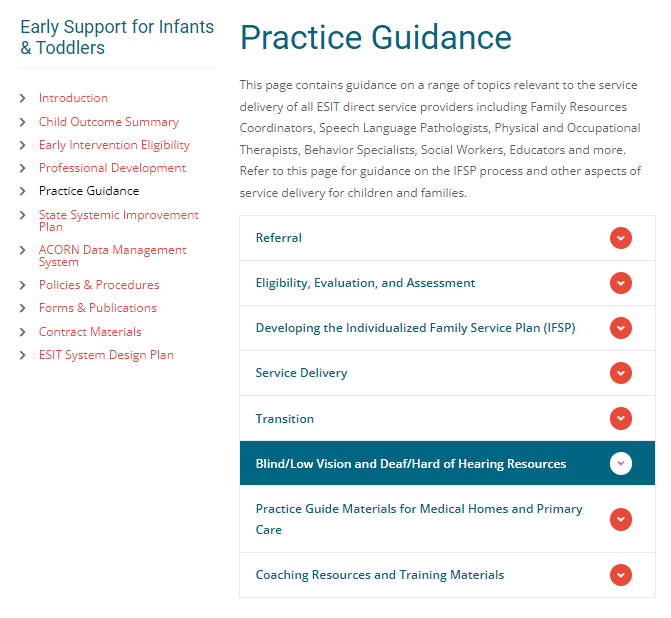
The Pathways to Services for Infants and Toddlers Who are Deaf or Hard of Hearing Practice Guide is now available on the Practice Guidance page of the ESIT website under the dropdown titled, “Blind/Low Vision and Deaf/Hard of Hearing Resources.”
This Practice Guide describes the roles of Deaf/Hard of Hearing (DHH) specialists in ESIT and explains pathways to providing ESIT DHH-related supports.
Past guidance on deaf/hard of hearing services was combined with information on deafblind services and blind/low vision services. Going forward, this guidance will be organized into three separate Practice Guides. On February 9, the 2016 Infants and Toddlers with Sensory Disabilities practice guidance will be removed from the ESIT website and archived.
Much gratitude goes to the following groups for their collaboration and feedback:
- WA Center for Deaf and Hard of Hearing Youth
- WA Sensory Disabilities Services DeafBlind Program
- WA State School for the Blind
- WA Department of Health Office of the Deaf and Hard of Hearing
- WA Department of Health Early Hearing Detection, Diagnosis and Intervention Program
- National Center on Deaf-Blindness
- FRCs, Early Childhood Educators, Teachers of the Deaf, and Teachers of Children with Visually Impairment from ESIT Provider Agencies across WA state
If you have questions or need more information, please contact your regional Technical Assistance Specialist: Diana Golovkin (diana.golovikin@dcyf.wa.gov), Michell Baker (michelle.baker@dcyf.wa.gov) or Iris Dunaway (iris.dunaway@dcyf.wa.gov.)

County Lead Agency (CLA) and Direct DCYF-Contracted ESIT Provider Representatives:
*CLAs, please share with your contractors*
During this webinar, we will review and answer questions about the new ESIT Practice Guide- Pathways to Services for Infants and Toddlers Who are Deaf or Hard of Hearing.
ESIT providers of deaf/hard of hearing supports will be in attendance to talk about their work and answer questions from attendees.
This will not be a training on how to work with children who are deaf or hard of hearing. We will be presenting an overview of ESIT DHH-related services and the ways to connect families to those services. We hope you can make it!
Wed., February 21 | 3 – 4:30 p.m.
American Sign Language interpretation and live transcription will be available during this event.
For questions, please contact Maia Thomas, at maia.thomas@dcyf.wa.gov or (360) 599-0794.
|

Do you work at a local ESIT Provider Agency and bill public and/or private health insurance for ESIT Services? You are invited to join a newly formed Insurance Billing Support Group!
What is the Insurance Billing Support Group?
This informal peer-to-peer collaborative space will be limited to those who are engaged in billing at the local ESIT program level, meeting the fourth Monday of each month. We hope to connect as peers, exchange ideas, and collaborate to find solutions to common challenge such as:
- What have you found to be the best coding to use for specific services?
- What strategies have worked for following up on denied claims?
- What procedures does your agency have in place to ensure timely filing?
A little about the facilitator
My name is Marsha Smith and I work for Steps, formerly Toddler Learning Center. We serve Island County, San Juan County and Anacortes. I have worked here for almost 6 years, and before this my experience came from the financial industry and working in the Island Hospital billing department. My love for numbers and money has helped me be a great advocate for families and staff. I enjoy sharing what I know, and most of all learning from my peers who do the same work.
Join us this month!
Mon., February 26 | 2 p.m.
Questions?
Can’t attend but interested in future events? Have questions? Email Marsha Smith, at Marsha.S@takingstepstogether.org.
|

In collaboration with the State Interagency Coordinating Council Personnel and Training Sub-Committee, the ESIT State Leadership Office is pleased to announce the soft roll out of the new ESIT Credential for Family Resources Coordinators (FRCs) beginning in February to introduce and field test the process. A firm roll out for the credential requirements is planned for July 1, following a 90-day communication cycle starting April 1.
Beginning February 1, newly hired Family Resources Coordinators (FRC) will receive an ESIT Credential once they complete all initial training requirements and submit a credential application.
This Initial ESIT Credential replaces the previous FRC registration and will signify all initial training requirements have been met and that the FRC is qualified to provide service coordination. Caseloads can continue to be assigned after FRCs complete Step 1 of the training requirements.
All other FRCs who have previously completed the training required at the time they were hired are encouraged to apply for the ESIT Credential. There is no need to complete additional training. Original FRC training completion will be verified as part of the application process.
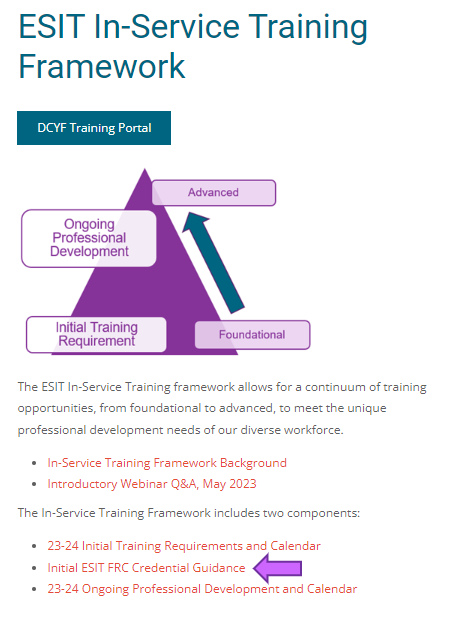
The Initial ESIT FRC Credential Guidance can be found on the ESIT In-Service Training Framework webpage.
|
 |
FRC ESIT Credential Webinar
Join us for a Q&A Webinar where you can learn more about the ESIT Credential for FRC’s!
March 11 | 2 – 3 p.m.
Questions?
Please contact ESIT's Workforce Development Specialist, Lori Holbrook, at dcyf.ESITtraining@dcyf.wa.gov.

Upcoming
Full descriptions of each training including registration information is available in the 23-24 Ongoing Professional Development and Calendar.
- Domestic Violence Safety Planning with Families | This training is now full
- Foundations of Reflective Practice | This training is now full
- Promoting First Relationships Drop-In Session | February 15
- Foundations of Infant and Early Childhood Mental Health | February 21 (5 sessions)
|

The Washington State Department of Health, Early Hearing Detection, Diagnosis and Intervention (EHDDI) program worked with ESIT, family resources coordinators (FRCs), early support providers, deaf and hard and hard of hearing (DHH) adults, audiologists, and a family-to-family support organization to create three training modules. The training modules provide FRCs and early support providers with information and resources that are helpful when working with children identified as deaf or hard of hearing and their families. The trainings focus on the following topics:
-
Special Providers and Services: Discusses DHH specialized programs and supports, and special considerations when working with children who are DHH with additional disabilities.
-
Knowledge Building: Provides information about diversity in the DHH community, describes hearing levels, and technology options available.
-
Bias Awareness: Provides information about communication opportunities, recognizing biases, and ways to support diverse families.
To access the trainings, please visit the EHDDI WaPortal page:
|

These drop-in sessions are for ESIT providers only. Providers must have received PFR Level 1, 2, or 3 training to attend.
Join ESIT providers from across Washington State and PFR Trainer Carol Good to discuss embedding the PFR consultation strategies into your everyday coaching practices.
Thurs., February 15| 10:30 a.m. – 12 p.m.
Upcoming Drop-in Sessions
- Tues., March 19| 9:30 – 11 a.m.| Register
- Mon., April 22| 9 – 10:30 a.m.| Register
- Tues., May 21| 2:30 – 4:00 p.m.| Register
- Thurs., June 27| 2:30 – 4:00 p.m.| Register
|

Check out the new professional development video detailing information about some of the wonderful training opportunities available at no cost for ESIT Service Providers and Professionals! In this video you’ll hear from leadership members from both the University of Washington (UW) and the Washington Association for Infant Mental Health (WA-AIMH) detailing important information about many training opportunities.
This video shares information about:
- Infant Family Relational Health (IFRH) and Infant and Early Childhood Mental Health (IECMH) training opportunities
- The benefits of gaining knowledge in these areas, including the WA-AIMH Endorsement and Reflective Consultation
- Where to go for more information
UW PFR and WA-AIMH Professional Development Opportunities (watch time 11:52):
For more information or to register for these training opportunities, please visit the 23-24 Ongoing Professional Development and Calendar Document.
Questions? Email dcyf.ESITtraining@dcyf.wa.gov.
|
 |
Mark Your Calendars!
Please make plans to attend the 2024 Infant and Early Childhood Conference (IECC), hosted completely virtual via Zoom!
May 6 – 10
For conference information please visit www.ieccwa.org.
IECC plans to offer STARS Credit and Clock Hours for this event.
The purpose of the IECC Conference is to provide opportunities for families and service providers to come together to learn, share and advocate on behalf of all young children, especially those with developmental delays, disabilities and/or other special health care needs.
IECC Partnership Opportunity
IECC is so thankful for its many community partners. Due to their support IECC has been able to shift its platform and offer the conference registration complimentary for all attendees the past few years. If your organization would be willing to partner with us please email the conference coordinator, Amanda Cardwell directly at amandacardwell@frontier.com.

DCYF ESIT has funding available for ESIT Service Providers to offer scholarships to assist with covering costs related to WA-AIMH endorsement registration, membership, processing fees, and annual renewal fees. There are limited scholarship opportunities available. Each application is reviewed on an individual basis and applying does not guarantee an award of funds. The Washington Association for Infant Mental Health offers different levels of endorsement credentials and provides recognition of specialized knowledge in professionals working with families and young children. It is an internationally recognized credential and is for anyone who works with families and young children in the fields of early care and education, prevention and early intervention, home visiting, the medical and behavioral health professions, child welfare, mental health, policy and advocacy, research and others. Learn more about the WA-AIMH endorsement here.
Scholarship funds must be accessed by June 30 or applicants will need to re-apply after July 1.
Scholarship Opportunities
If interested in applying for WA-AIMH endorsement scholarship opportunities:
Information Sessions
WA-AIMH offers information sessions in order to ask questions, gather details, and gain a better understanding of the endorsement process. To schedule time with the endorsement coordinator or for other endorsement inquiries, please contact endorsement@wa-aimh.org.
WA-AIMH has Spanish support available for applicants going through the endorsement process. Please contact Veronica Rosa at veronica@wa-aimh.org for additional information.
|
 |

Join us in learning and celebrating with Dr. Serena Wieder!
This free presentation with DIR® Co-Creator Dr. Serena Wieder will explain the Developmental, Individual Difference, Relationship-Based Model (DIR®) at a basic level, introducing the key concepts and foundations of this dynamic model and its application to addressing emotional and cognitive development.
Illustrating DIR’s multidisciplinary integration in educational, family, clinical, and research settings, Dr. Wieder provides a broad look at the importance and efficacy of the Model, in a way that no one else can: from the perspective of the Co-Creator. Join us for an unparalleled introduction to DIR®, and learn about all the opportunities that Profectum has to offer you on your DIR® journey.
Thurs., March 7 | 5 - 6:30 p.m. | Live Online via Zoom
|

For some of us, using puppets in our DIRFloortime work can be intimidating. Our own self-consciousness can sabotage our use of puppets in our therapeutic work. In this insightful Newsflash, André Zirnsak invites us to put down that self-conscious attitude and begin to use puppets to help individuals progress in their developmental journey through their Functional Emotional Developmental Capacities (FEDCs.)
Puppet Play as a Supporting Tool
To use puppets in DIRFloortime, we need to be aware of the fact that it is first about us and then about the puppet. That means, we need to make ourselves familiar with this tool before we can use it effectively. How can we do that? It can be useful to choose one puppet for yourself and consider these questions to guide your selection for self-reflection:
- Which puppet do I like and why?
- Which puppet feels good on my hand?
- Which puppet could embody some character traits as an exaggeration of myself?
- Which character traits do I want to exaggerate with my puppet (being a little cheeky, shy, grumpy etc.) and why?
- Which kind of voice do I want to choose for my puppet and why? Or do I need a puppet which is not able to speak and just make sounds?
After choosing a puppet for yourself, try it out in front of a mirror. Because if you are not into it, your play partner will not be either.
We can use puppets at different FEDCs. André Zirnsak, Diploma in Special Needs Education Play & Play-Therapist, invites us to take another look at puppets as the perfect tool to use in DIRFlootime, check out ICDL DIRFloortime® to learn more about André and Puppet Play, on Instagram:
Questions? Contact andre.zirnsak@gmx.de.
|
This course will be a mixture of video observation of infants, PowerPoint, and discussion to help participants define, observe, and reflect on ways to understand and support the infants who are growing and developing in their care. The course will be held on Zoom.
March 11 | 8 a.m. – 12 p.m. | $150
Keys to Infant Caregiving is a research-based program for professionals that provides essential information on newborn and infant behavior. Participants will learn about infants and their captivating ability to interact and engage in relationships with their parents, caregivers, childcare providers and how that impacts the care they receive. Participants will learn about how infants’ internal states influence their behavior and how to help infants regulate. They will learn how to read the very young infant’s cues and how to foster relationships in the childcare setting that promote the infant’s social, emotional, and cognitive growth while completing routine tasks like feeding and diapering an infant.
The course will be a mixture of video observation of infants, powerpoint, and discussion to help participants define, observe, and reflect on ways to understand and support how infants in their care are growing and developing within the daily interactions they are engaging in.
This course will help you:
- Describe the observable behaviors of the six infant states and how that impacts the care they receive,
- Identify state-related behaviors during routine caregiving activities,
- Demonstrate your knowledge of the infant’s regulatory capabilities through the identification of cues- both engagement and disengagement,
- Identify ways of interacting with infants to support emotion regulation, language, and social development.
Your fee covers tuition and Keys to Infant Caregiving study guide. This training is eligible for 3.75 Professional CEUs and STARS.
|

Join Washington Sensory Disabilities Service (WSDS) consultants (representing Washington State School for the Blind-WSSB and Center for Deaf and Hard of Hearing Youth-CDHY), and other sensory statewide partners, as they host monthly drop-in sessions to share and discuss resources related to ESIT services for children who are blind/low vision, deaf/hard of hearing, or deafblind. Each drop-in session will have a topical focus and will offer opportunities for open questions on any topic.
For those who may need accommodations for active participation, please complete this form to assure appropriate accommodations are arranged.
February Planned Topic
FRC/ESIT Service Provider Training Modules (created by EHDDI) and DHH Practice Guide with Julie Walker (EHDDI), Kerianne Christie (CDHY), and Kris Ching (CDHY):
Feb 12 | 1 p.m.
March Planned Topic
Effective teaming strategies when working with BLV and DHH specialists on IFSP teams with Kerianne Christie (CDHY) and Jessica Chandler (WSSB):
March 25 | 1 p.m.
|

Emergency Broadband Benefit Funds Available
The WA Office of Broadband has funds available to assist families with internet costs. More details on this benefit and how to apply are located here.
Discounted Internet Service Available to Low-Income Households
The federal Affordable Connectivity Program offers eligible households a high-speed internet plan for no more than $30 per month. More details on this program and how to apply are located here.
Digital Navigation Toolkit Available
Digital Health Navigators are individuals who address the whole digital inclusion process - connectivity, devices, and digital skills - to support community members and provide access to healthcare. The National Consortium of Telehealth Resource Centers (NCTRC) has released a new toolkit that provides helpful resource links relating to digital navigation.
|

Approximately $70 million in grants are available across three different facility types!
The Department of Commerce Behavioral Health Facilities (BHF) grant application is now open, with funding available for three categories:
- Regional Needs
- Children and Minor Youth
- Intensive Behavioral Health Treatment Facility (IBHTF)
Grant Fund Usage
Grant funds can be used for new construction, renovation, and acquisition. Funded capital projects must result in an increased number of beds or increased outpatient capacity, depending on facility type.
The competitive funding round is open to nonprofits, for-profit businesses, public entities, and Tribes who are either a community hospital or a community-based behavioral health provider.
Application Process
-
Applications opened: Tuesday, December 12, 2023
-
Pre-applications due: Monday, January 29, 2024, at midnight
-
Final application due: Monday, February 12, 2024, at midnight
Application must be submitted through ZoomGrants. Each category has its own ZoomGrants link, which can be found on the BHF website.
Before beginning an application, please review the Program Guidelines, Notice of Funding Opportunity, and Frequently Asked Questions documents found on the BHF webpage.
Questions?
Technical assistance available until Thurs., February 8, at: BHFInquiry@commerce.wa.gov.
|

Workshops offered by the Infant Early Childhood Mental Health (IECMH) Workforce Collaborative are free for professionals who serve or support children prenatal to five and their families enrolled in Apple Health (Medicaid).
- IECMH Clinical Workshops are designed for clinical professionals involved in mental health assessment and diagnosis for children birth to five.
-
IECMH Community Workshops are intended for all professionals who support the social-emotional well-being of babies, toddlers, preschoolers, and their families, as well as expecting families.
For more information visit:
CEUs and/or STARS hours are provided for most workshops.
Questions? Contact admin@wa-aimh.org.
|
For more updates, subscribe directly to these great newsletters:
|