 One of our favorite times of the year is approaching - - PARENT RECOGNITION MONTH - - in February!
As 2024 is quickly approaching, we are gearing up for our annual Unsung Hero campaign in honor of Parent Recognition month (February) and we are hoping you can help us spread the word far and wide.
Since 2011, with your help, we have honored 337 parents and caregivers in Washington for the roles they have taken with their families, schools and communities. They have been recognized because they have shown strength, courage and empathy in their communities. Parents and caregivers around Washington State are supporting their children, families, and communities in exceptional ways and we want to show our appreciation. Please help us in honoring 29 more in February 2024 by nominating a parent/primary caregiver/guardian for the Unsung Hero award. The nomination form is available in three languages (English, Spanish and Somali). A parent panel will select one honoree for each day in February and then all honorees (including their family or supporters) and their nominators will be invited to an in-person celebratory dinner event in Olympia.
All nominations must be submitted by January 5, 2024. The nominations can be emailed to strengtheningfamilies@dcyf.wa.gov.
Our next office hours are set for Nov. 16 from 3-4 p.m. Join here. In addition to regular updates, we WithinReach will be sharing to support referrals into home visiting programs.
The MIECHV (Maternal, Infant, & Early Childhood Home Visiting) Technical Assistance Resource Center has just released two new resources, Building a Diverse Home Visiting Workforce Recruitment Strategies and Building a Diverse Home Visiting Workforce Nurturing and Supporting, for supporting local agencies with hiring and retaining diverse home visiting staff. You don’t have to receive MIECHV funding to take advantage of this information and you can find additional free home visiting resources here: https://mchb.hrsa.gov/programs-impact/programs/home-visiting.
There are still spots available for Home Visiting Supervisors to participation in WA-AIMH’S Introduction to Reflective Supervision for Supervisors Training. This online learning series is open to Supervisors, Program Managers and Administrators from HVSA funded home visiting programs. It’s highly recommended for LIA leaders and home visiting supervisors new to Reflective Supervision Practices, and may be a pre-requisite for signing up for a Supervisory RSC Group. Facilitated by Martha Stebbins-Aguiniga, MA, LMHC, IMH-E4 this online series is scheduled for:
Jan 8, 11, 19, 22, 2024
9 a.m. to 12:30 p.m.
To claim one of the remaining spots, please contact Nina Evers @ nina.evers@dcyf.wa.gov or call 360.522.0982.
|
Please join us for the Virtual Home Visitor Training Series with presenters from a wonderful team of experienced and wise home visitors and WSCADV staff!
The Domestic Violence Assessment and Response training is followed by the Safety Planning with Families training.
Please register for each event you wish to attend.
|
|
Safety Planning with Families
Nov. 30, 2023
9:30 a.m. – 2:30 p.m.
(break from 12-1 p.m.)
|
|
DV Assessment and Response
Jan. 30, 2024
Jan. 31, 2024
10:00 - 11:30 am both days
Register here!
|
Additional trainings will continue throughout the fiscal year and we will continue to post registration links as we get closer to events.
We are excited to share news from DSHS that the Diaper Related Payment benefit begins Nov. 1, 2023. The Community Services Division at the Department of Social and Health Services, will automatically issue $100 each month to a TANF/SFA household that has an eligible child under 3 years old to support with child-related necessities such as diapers, pull-ups and wipes. The passage of SB 5838 (2022 session) and subsequent funding under ESSB 5187 (2023 session) has made the creation and implementation of the Diaper Related Payment benefit possible.
This payment issues $100 each month using the same payment method (EBT, EFT or warrant) and on the same day as the client’s TANF/SFA cash benefit, making access to this payment seamless and automatic. It is important to note that this additional payment is countable income for other CSD benefits, including Supplemental Nutrition Assistance Program (SNAP) benefits, known as Basic Food. All TANF/SFA families with children under age 3 will experience a positive net increase of unrestricted cash of at least $40 a month to help with necessities. Each household eligible for this payment will receive a letter in October to inform it of its new eligibility and any impact to its other benefits.
Intimate Partner Violence (IPV) Screenings and Referrals
IPV refers to physical violence, sexual violence, stalking and psychological aggression (including coercive acts) by a current or former intimate partner. An intimate partner is a person with whom one has a close personal relationship characterized by the following: emotional connectedness, regular contact, ongoing physical contact and sexual behavior, identity as a couple, and familiarity and knowledge about each other’s lives. Almost 12 percent of children under age 6 have been exposed to IPV, either by witnessing acts of violence, observing caregivers’ physical injuries, or seeing damage to their home or property (Hamby et al., 2011; Child Welfare Information Gateway, 2016). IPV exposure can adversely affect a child’s mental health and social, physical, and cognitive development throughout childhood and later in life (Howell et al., 2016).
Measuring Performance
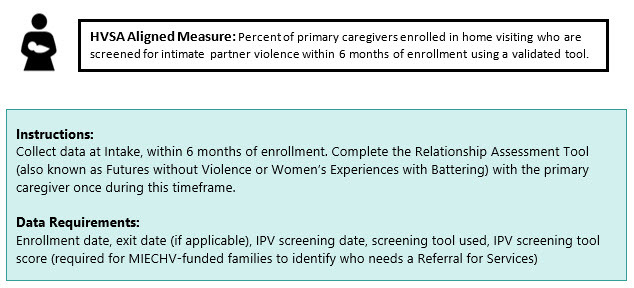
IPV Screenings (Aligned Measure)
Home visiting models encourage multiple screenings for IPV and referrals depending on the situation of the family and caregiver. To uniformly capture screening across the HVSA, IPV screening is considered an aligned measure, required for all programs. The Relationship Assessment Tool, also known as Women’s Experiences with Battering or FUTURES, is the validated tool used for IPV screening across the HVSA.
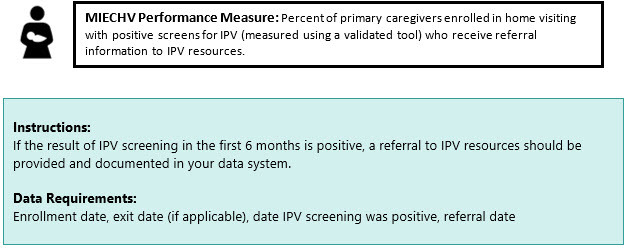
 IPV Referrals (MIECHV Measure)
When caregivers were experiencing IPV at intake, home visitors are asked by MIECHV and the HVSA to provide a referral to IPV resources and ensure that these families have the information and motivation to seek help. If a screening occurs after a referral has been given, please ensure to revisit the referral with the client and document this interaction. Determining a “positive” screen, that the caregiver is experiencing IPV, often relies on the best judgement of the home visitor. At minimum, referrals should be provided when a caregiver has a score of 20 or above on the screening tool. However, a caregiver may benefit from a referral and services even without a high IPV score, depending on the individual situation, which is at the discretion of the home visitor.
 How to enter data?
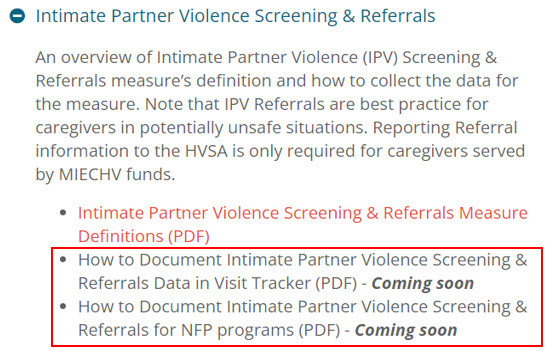
Instructions to enter data will soon be available for programs. Please refer to the HVSA Aligned Measures section on the Data Collection & Reporting page for instructions on how to document Intimate Partner Violence Screening & Referrals on Visit Tracker and Flo.
 If you have any questions or suggestions on these documents, please contact us at homevisiting@doh.wa.gov!
References:
Intimate Partner Violence |Violence Prevention|Injury Center|CDC
The National Intimate Partner and Sexual Violence Survey: 2016/2017 Report on Sexual Identity (cdc.gov)
On September 18, 2023, the Washington State Department of Health launched a new Respiratory Illness Data Dashboard. With this launch, the Department retired the COVID-19 Data Dashboard.
You can read the news release here:
Department of Health launches new Respiratory Illness Data Dashboard, retires COVID-19 Data Dashboard | Washington State Department of Health
Respiratory Illness Data Dashboard | Washington State Department of Health
For additional COVID-19 resources check out the Department’s COVID-19 webpage.
COVID-19 | Washington State Department of Health
For more information and the latest news, please visit our the DOH Newsroom where you can subscribe to DOH News Releases.
Newsroom | Washington State Department of Health
Measurement Checklist
- Do you have an outcome measure(s) that ties directly to your aim statement? Do you have a process measure(s) that reflects the progress with the key changes you must make to achieve the aim?
- Is it easy and practical to collect these measures?
- Do they help you understand how you are doing (the base of improvement)?
- Can you graph it as a line chart or run chart over time?
- Can you annotate the chart with key changes you made?
September Webinar Summary – Measures for Improvement
In last month’s CQI webinar participants defined the types of measures used in quality improvement, the role, and benefits of reviewing project data over time with the use of run charts. In small group breakouts topic groups reflected on measurements used in quality improvement and discussed current and future PDSA cycles for SMART aims.
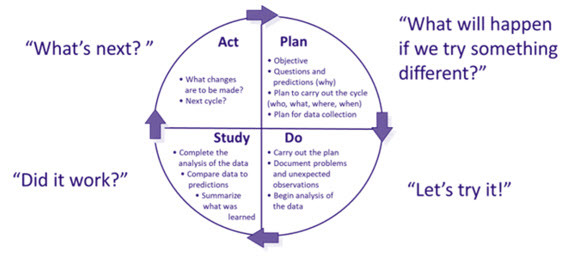
Plan, Do, Study, Act: What change can we make that will result in improvement?
 Resources (found on Basecamp – CQI Project Folders)
Looking Ahead - SFY24 Webinar Structure
October 25th, 2023
- Identifying changes to test
- Tips for PDSA cycles
For questions or support or to be added to CQI listservs:
Camille Carlson: ccarlson@startearly.org
October celebrates Indigenous Peoples Day, honoring Indigenous People’s legacy, traditions and invaluable contributions.
In the rich tapestry of Indigenous coastal communities of the Pacific Northwest, Canada and Alaska, the timeless art of canoeing embodies more than just transportation — it represents profound journeys that symbolize unity, resilience, and a deep connection to the land and the water.
Start Early Washington’s Training and Technical Assistance Specialist Alex Patricelli shared how she reclaimed her Native culture and traditions with her young boys Mateo (6) and Kulani (4) through the celebration of intertribal canoe journeys at the 2023 Paddle to Muckleshoot.
For generations, coastal tribal communities relied on canoes for daily life. However, cultural ties were severed when canoeing was banned in the U.S. and Canada in the 20th century. More than 100 years passed before this restriction was lifted. In 1989, coastal communities reclaimed the canoe with an intertribal canoe journey to symbolize the resilience and survival of traditional practices against colonization and Western assimilation challenges.
In preparation for the 2023 epic canoe journey, Alex wanted to make her boys custom drums. The drum is regarded as the heartbeat of Indigenous culture in ceremonies, celebrations and spiritual gatherings.
Alex’s vision for the drums was clear: to harmoniously blend her son’s multifaceted cultural identities, uniting them as brothers while also preserving their individuality. She soaked the deer hide, skillfully assembled the drum kits and hand-painted each drum. The drums serve as a canvas for symbolism, where a turtle and manta ray take center stage through distinct imagery.
Alex elaborated on the origins of her art designs, “The outer ring symbolizes the boys’ Native heritage, inspired by the ‘formline’ design of Coastal Native artwork. Within the lines, both drums bear the symbols of a turtle and manta ray, which hold cultural significance to our Chamorro and Filipino heritage and represent qualities of persistence, wisdom, patience, good fortune, power and protection.”
Alex further emphasized, “drums are regarded as living entities and not just musical instruments; before a drum can be used, we awaken their spirit by burning sage and infusing them with good thoughts, energy and blessings. Mateo and Kulani are learning to respect and understand the hand drum’s cultural significance, a vital part of our families’ cultural teachings and identity that we’ve worked hard to reclaim for our family.”
For more blog postings, including photos from this blog posting, visit
https://www.startearly.org/where-we-work/washington/#publications
Each month, DCYF ESIT Tribal Program Consultant Brian Frisina will provide a key topic to help support us all in getting to know our Tribal Nations partners better.
This month’s topic is:
How to Talk About Native Nations: A Guide
Using appropriate terminology to talk about Native nations shows respect for nations’ sovereignty. It also contributes toward Native narrative change. Because language is so important, we decided to create an online guide:
Terminology is ever-changing. We love this quote from Elements of Indigenous Style: “The process of decolonizing language surrounding Indigenous peoples is not finished; terms, names, and styles continue to evolve.” Check in with Indigenous organizations and individuals from time to time to get a pulse on the current conversation. Don’t assume that your learning around terminology is complete.
Should I say Native American, Indigenous, or American Indian? Is it ok to use the term Indian Country? How do I know what name to use to refer to a Native nation in my area? Do you have questions about how to talk about Native nations? We have answers! This one-hour event from Native Governance Center covers terminology basics and showcases the wide range of opinions on terminology in Indian Country. Presented by: Apryl Deel-McKenzie, Dr. Twyla Baker, Wizipan Little Elk, Margaret YellowBird, and Bryan Pollard:
Terminology Style Guide
This is a version of the style guide that Native Governance Center uses to guide our communications so we are respectful and consistent in talking about Native nations.
Art by Indigenous Artists: These artworks in Washington's State Art Collection were created by artists who are Native American, Alaska Native, First Nations, Indigenous Mexican, and more. They represent over one hundred artists, more than twenty tribes in Washington State, and more than fifty tribes and cultures in total, in the U.S., Canada, Mexico, and more.
Cultural Appropriation vs. Appreciation: It's almost Halloween, have you picked a costume yet? It seems like every year certain costumes get everyone talking, so with that in mind, here's how we can all do a little more appreciating and a little less appropriating (watch time 3:46):
Improving Our Response to Families Experiencing Domestic Violence
October 26, 2023, 02:00 PM, EDT This Digital Dialogue focuses on understanding the challenges child welfare systems face in effectively responding to families experiencing domestic violence and ideas for reform that enhance children's safety, stability, well-being, and healing in connection with their families and communities. Learn from two survivors and an attorney who has worked to support multiple families who experienced child welfare interventions related to domestic violence histories. Through this engaging discussion, attendees will gain concrete action steps that can be implemented to improve child welfare systems' responses to families experiencing domestic violence.
Register here.
News
Washington state child care providers are struggling to survive. Sen. Murray calls for feds to help, KUOW.org
Homeless housing taskforce searching for candidates, Wenatchee World
|