|
According to the National Institute on Aging the health risks of prolonged isolation are equivalent to smoking 15 cigarettes a day. Social isolation and loneliness have even been estimated to shorten a person’s life span by as many as 15 years.
Oftentimes parents, especially new parents or parents of young children can struggle to find time or energy to seek out social connections, and it’s easy to feel isolated as you embark on a new chapter in your life that may be entirely different than your previous life.
However, a study by Harvard University found that people need only to connect once every three weeks to counter the social isolation and receive all the psychological and/or emotional benefit.
By engaging in social connections, parents can gain a multitude of positive experiences, including sharing resources, trading child care, seeing other parents in action, venting of frustrations, sharing joys and challenges and seeing other parents in action.
Social Connections can look different for everyone. For some it may be their family while for others it may be the family they have chosen. It may be a community or religious organization or friends new or old. Social connections help parents build networks of support that serve multiple purposes: they can help parents develop and reinforce community norms around child-rearing, provide assistance in times of need and serve as a resource for parenting.
Think about it: Who is your person or persons? Can you make a list of your support people that you can call in an emergency? At 2 a.m. when the baby is crying and you just need a minute? Or the person who can always cheer you up? How are they connected to you?
Our next office hours are set for Sept. 21 from 3-4 p.m. Join here.
If your home visiting program is funded by the HVSA, check out these upcoming trainings/series from WA-AIMH to deepen your understanding of the power of caregiver-child relationships and how to support them. Sign up using this Survey Monkey link: https://www.surveymonkey.com/r/ZHWYBZC for the trainings listed below:
The Growing Brain: From Birth to Five Years Old (seven-week online series)
Tuesdays | September 12, 19, 26 and October 3, 10, 17, 24 | 1-4 p.m.
Foundations of Infant and Early Childhood Mental Health (five-week online series)
Wednesdays | October 4, 11, 18, 25, November 1 | 9 a.m. - noon
Foundations of Reflective Practice Online
Tuesday | November 14 | 1-4 p.m.
Questions? Email nina.evers@dcyf.wa.gov
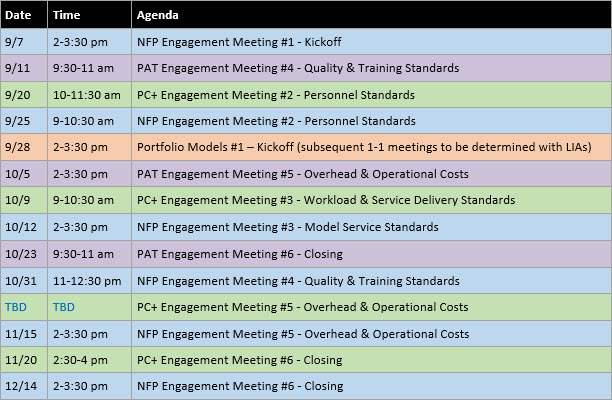
We have scheduled out several upcoming meetings regarding the rate setting work. Please connect with your program specialist if you have any questions or need links for the meetings.
As a MIECHV Awardee, Washington state’s use of data to support workforce retention was spotlighted this past July. Two other MIECHV-funded resources are provided here for the benefit of all programs in our state, a research roundup and using data to increase staff retention.
The Washington Fatherhood Council, has commissioned Camber Collective to conduct the WA Fatherhood: State of the State study, a nine-month project (June 2023 – February 2024). The study will include a landscape of current policies, funding, programs, and experiences of fathers and fatherhood figures in Washington state, with a focus on identifying gaps and needs to inform strategic and policy recommendations.
The Camber Collective team was chosen to produce this work through a formal procurement process by the Washington State Department of Social and Health Services. Camber Collective is a strategy consultancy that equips purpose-driven organizations with insights to optimally serve the systems, societies, and staff to which they are accountable. Camber’s expertise in human-centered, equity-rooted approaches paired with analytical and graphical representations allows programs and systems to identify where and how they can evolve for the greatest impact.
The WA Fatherhood: State of the State project objectives are:
- To develop an initial fact base and landscape with graphical and narrative representation of the ecosystem for fathers and fatherhood figures in Washington state, including bright spots, successes, challenges, and opportunities.
- To create a sustainable process for data sharing and maintaining, updating, and utilizing the dashboards, scorecards, and visualizations to continue making strategic and policy-related decisions.
- To develop a final report to be submitted to the Washington State Legislature and other key state agencies and partners detailing key opportunities, and areas of needs, and gaps to inform policies and funding decisions.
Call to Action!
We need input from fathers and service providers across the state!
- If you are an organization or program that provides fatherhood or father-specific services, supports, or programming, please take this survey.
- Our dad survey will be ready late September 2023. Please Email us to be notified when the survey is ready or check back.
Reach out to Tina Liang at tina@cambercollective.com with any feedback, questions, or for more information about the project.
MIECHV Reporting: Updates & Reminders
It is that time of the year when we ask all programs who receive MIECHV funding to ensure that reporting on all MIECHV-funded families is complete for the federal fiscal year (October 1, 2022 – September 30, 2023). Here are some requirements to keep in mind as you see families over the next few weeks.
Reminders for annual reporting
- Please review all of your reporting data for MIECHV families, including demographics, consent, service use, and benchmark measures. Make sure that all the data is recorded in your data system by end of September. For Consents, please make sure that information is updated and reported to DOH by the end of August.
- For those benchmark measures required annually, please be sure to complete the assessment before the end of September. Specifically, please complete:
-
Safe Sleep questions for children under 1 year of age;
-
Parent-Child Interaction assessment – at minimum 1 assessment per primary caregiver;
-
Early Language and Literacy questions for all children served;
-
Educational Attainment for the primary caregiver and Educational Status for primary caregivers that reported less than a high school degree or equivalent at enrollment;
-
Breastfeeding Status for all children who were between 6 and 12 months old during the fiscal year (October 1, 2022-September 30, 2023).
- A few measures require data collection over the reporting year to ensure that the most recent information is available at the end of the year. Specifically, please note:
-
Well Child Visit dates are one measure of the routine receipt of care from a primary care provider. Please report dates for well child visits routinely over the year, with a focus on collecting this information at minimum in April/May and Aug/Sept.
-
Continuity of Insurance Coverage, as noted above, please ask about the most recent 6 months of coverage.
-
Behavioral Concern question must be asked at every postnatal home visit.
- For key screening measures, be sure to document referrals given and completed as needed per the screening results, including:
-
Developmental Screenings – to be completed at minimum, at ages 9 or 10 months, 18 months, and 24 or 30 months. If a child has a positive screening result, please report services provided, referred to, and received.
-
Depression Screenings – to be completed with the primary caregiver within 3 months of enrollment or within 3 months of delivery if the caregiver enrolled pregnant. If the caregiver’s PHQ9 screening score is 10 or above, or notes suicidal ideation, then please record the referral made by the home visitor and completed by the caregiver.
-
Intimate Partner Violence Screenings – to be completed with the primary caregiver within 6 months of enrollment. If the screening result suggests a referral is needed, please record the referral made by the home visitor. Note that a referral given without a documented IPV screening will not be counted towards this benchmark measure.
- Keep an eye out for Measures QA reports to be released in the coming weeks. We hope these reports will be a valuable tool to focus your data cleanup efforts.
- Missing Demographic Data Reports can be created using Visit Tracker’s “Form 1” tool. Guidance in creating the report will be posted in the coming weeks on the DCYF Data Collection & Reporting page.
Thank you for your work serving families and reporting all the required data!
Need Assistance or Have Questions for DOH?
DOH HVU staff asks that communications be directed to our staff at HomeVisiting@doh.wa.gov so that we can track of inquiries and data-related requests and determine which staff can best to assist you.
Our goal is to confirm receipt and assign a specialist to all incoming emails within 2 business days, Monday through Thursday.
Based on the complexity of the question, the designated specialist will respond to your inquiry as soon as possible and will let you know the process and anticipated time needed to fill your request.
In FFY 2022, there was a slight decrease in primary caregivers that reported tobacco use at enrollment and received a tobacco cessation referral within three months of enrollment. Nationally the mean performance among all MIECHV programs was 55% in FFY 2021 and FFY 2022.
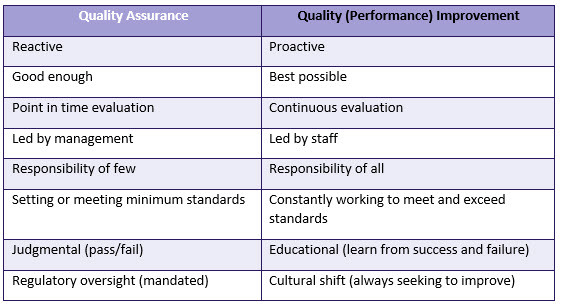
Quality Assurance vs. Quality Improvement
 July Webinar Summary – SFY24 Webinar Series Introduction
In this session participants described the role and advantages of CQI including quality improvement principles and the Model for Improvement. During the session participants chose breakout rooms pertaining to the CQI topic they were most interested in pursuing and identified areas of improvement. In order to create an aim statement, the group identified and assessed the components of SMART and SMARTIE aims.
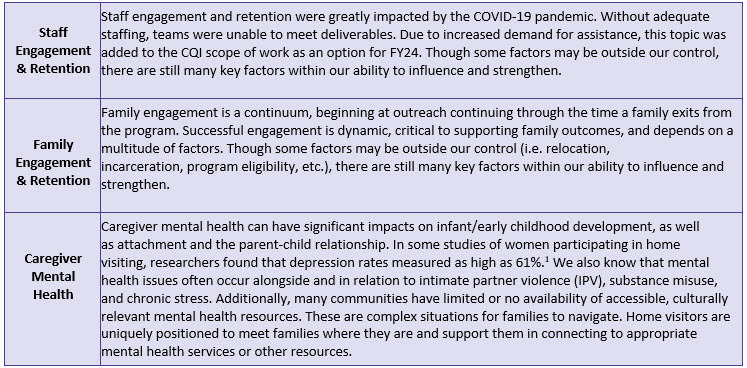
SFY24 CQI Topics
 Resources (found on Basecamp – CQI Project Folders)
Looking Ahead - SFY24 Webinar Structure
In the next session participants will begin drafting aim statements with the support of these topic groups. The breakout groups will continue to be integrated in webinar sessions where participants are able to share work and receive feedback from one another.
For questions or support or to be added to CQI listservs:
Camille Carlson: ccarlson@startearly.org
Each month, DCYF ESIT Tribal Program Consultant Brian Frisina will provide a key topic to help support us all in getting to know our Tribal Nations partners better.
This month’s topic is:
American Indian or Native American?
American Indian, Indian, Native American, or Native are acceptable and often used interchangeably in the United States; however, Native Peoples often have individual preferences on how they would like to be addressed. To find out which term is best, ask the person or group which term they prefer. When talking about Native groups or people, use the terminology the members of the community use to describe themselves collectively. There are also several terms used to refer to Native Peoples in other regions of the Western Hemisphere. The Inuit, Yup'ik, and Aleut Peoples in the Arctic see themselves as culturally separate from Indians. In Canada, people refer to themselves as First Nations, First Peoples, or Aboriginal. In Mexico, Central America, and South America,the direct translation for Indian can have negative connotations. As a result, they prefer the Spanish word indígena (Indigenous), comunidad (community), and pueblo (people).
Tribe or Nation, and Why So Many Names?
American Indian people describe their own cultures and the places they come from in many ways. The word tribe and nation are used interchangeably but hold very different meanings for many Native people. Tribes often have more than one name because when Europeans arrived in the Americas, they used inaccurate pronunciations of the tribal names or renamed the tribes with European names. Many tribal groups are known officially by names that include nation. Every community has a distinct perspective on how they describe themselves. Not all individuals from one community many agree on terminology. There is no single American Indian culture or language.
The best term is always what an individual person or tribal community uses to describe themselves. Replicate the terminology they use or ask what terms they prefer.
Sources
Image: Honor and Respect for Our Edlers - Indigenous Peoples Literature, posted to Wordpress by Glenn Welker, Jan. 2017.
Oren Lyons on the Two Row Wampum, uploaded to YouTube by Syracuse Peace Council, Oct 3, 2012.
The Impact of Words and Tips for Using Appropriate Terminology: Am I Using the Right Word? | Helpful Handout Educator Resource, © 2023 Smithsonian Institution.
August is National Black Business Month
August is National Black Business Month, and we recognize the Black-owned businesses across the country.... Black business owners account for about 10 percent of U.S. businesses and about 30 percent of all minority-owned businesses. Learn more, a brief history and how to observe.
Discover more on the Black Business Month website:
Digital Dialogue: Redressing the Wrongs of History
For generations, the U.S. government pursued policies that were explicitly designed to destroy Native families and communities. The Indian Child Welfare Act (ICWA), designed to stop the removal of Native American children, took a fundamental step toward respecting their human rights, Tribal sovereignty, and culture. Join us for a discussion on how child welfare in the states can help to redress the wrongs of history by taking action and implementing ICWA effectively.
Watch Now
The WSDA Farm to School Purchasing Grant is a competitive reimbursement grant available to schools and childcare centers for the purchase and use of Washington-grown foods in child nutrition programs.
Applications are due by Sept. 25, 2023, by 5 p.m.
For information and to apply, visit Grants | Washington State Department of Agriculture.
Diaper Bank Grant – Request for Applications
The Washington State Department of Commerce is initiating this Request for Applications (RFA) to collect applications for grants, which will be administered via reimbursable grant agreements, to organizations for the purpose of purchasing diapers, wipes, and other essential baby products for distribution to families in need.
Applications are due by Sept. 13, 2023, at 11:59 p.m.
For information and to apply, visit Request for Applications – Diaper Bank Grant - Washington State Department of Commerce.
WA Family Resource Center Program Request for Applications
For organizations to provide new services in order to meet the statutory requirements of a family resource center, as defined in RCW 43.216.010; to increase capacity or enhance service provision at current family resource centers, including but not limited to direct staffing and administrative costs; and to conduct data collection, evaluation, and continuous quality improvement activities. The grant period is from Oct. 17, 2023, to June 30, 2025.
Applications are due by Sept. 5, 2023, at 5 p.m.
For information and to apply, visit WA Family Resource Center Grant | Office of Minority and Women's Business Enterprises.
News
Dolly Parton performs, speaks about Imagination Library's expansion across Washington, KOMO News
Washington plans to end hotel stays for foster kids by late next year, The Columbian
|