|
Over the next several newsletters we plan on highlighting a Strengthening Families Protective Factor that support families to stay strong and prevent child abuse and neglect. For more information, see the Protective Factors brief on our website, or visit the Center for the Study of Social Policy website.
Taking a break and walking outside, joining a parenting class, connecting with a friend, having diapers brought to your door, or finding a daily routine that helps your child and their needs thrive. These are all ways families and parents utilize the protective factors every day.
During the next few months we will be taking some time to focus on the protective factors framework. Many, if not all of you, are familiar with Center for the Study of Social Policy’s Strengthening Families Protective Factors, and those who aren’t familiar with the terms, are certainly familiar with the ideas, motives and practices behind it.
The goals of the framework are simple:
- Strengthen Families
- Optimal Child Development
- Reduce the Likelihood of Child Abuse and Neglect
This edition we are going to focus on Social Connections as a protective factor.
What are Social Connections? Simply put, Social Connections are the antidotes to social isolation. Oftentimes, social isolation and loneliness are used interchangeably. The two are connected, but different.
- Social isolation is the lack of social contacts and having few people to interact with regularly. An individual can live alone and not feel lonely or socially isolated, just as someone can feel lonely while being with other people.
- Loneliness is the feeling of being alone, regardless of the amount of social contact.
Oftentimes parents, especially new parents or parents of young children can struggle to find time or energy to seek out social connections, and it’s easy to feel isolated as you embark on a new chapter in your life that may be entirely different than your previous life.
However, a study by Harvard University found that people need only to connect once every three weeks to counter the social isolation and receive all the psychological and/or emotional benefit.
By engaging in social connections, parents can gain a multitude of positive experiences, including sharing resources, trading child care, seeing other parents in action, venting of frustrations, sharing joys and challenges and seeing other parents in action.
Social Connections can look different for everyone. For some it may be their family while for others it may be the family they have chosen. It may be a community or religious organization or friends new or old. Social connections help parents build networks of support that serve multiple purposes: they can help parents develop and reinforce community norms around child-rearing, provide assistance in times of need and serve as a resource for parenting.
Think about it: Who is your person or persons? Can you make a list of your support people that you can call in an emergency? At 2 a.m. when the baby is crying and you just need a minute? Or the person who can always cheer you up? How are they connected to you?
The Strengthening Families Washington team at the Department of Children, Youth, and Families is excited to announce several newly funded programs as part of our Community Based Child Abuse Prevention (CBCAP) work.
These programs were chosen by an independent panel, including parents and community members, to receive funding over the next year.
Community Enrichment for Klickitat/Skamania Counties (Klickitat), Joyce L Sobel Family Support Center (San Juan), NAMI Kittitas (Kittitas), Okanogan County Child Development Association (Okanogan) and Roots on the Road (Stevens) all have been selected to receive funding as part of the Perinatal Mental Health Initiative. They will be mentored by Perinatal Support Washington.
Five other programs were selected for our capacity building funding and will also be funded for the next year, and receive mentoring from an evaluation consultant as they start up new programming in their community. They are:
- East African Community Services (King) starting a Wadajir Conscious Parenting class.
- Esperanza Mobil Family Resource Center (Pierce) starting Group Based Café Parent Circles.
- First Step Family Support Center (Clallam) starting a Supporting Strong Tribal Families program.
- Lower Elwha Klallam Tribe (Clallam) starting a Family Preservation Services program.
- Perinatal Support Washington (statewide) will be starting a Parent Education and Resilience Collaborative (PERC) program.
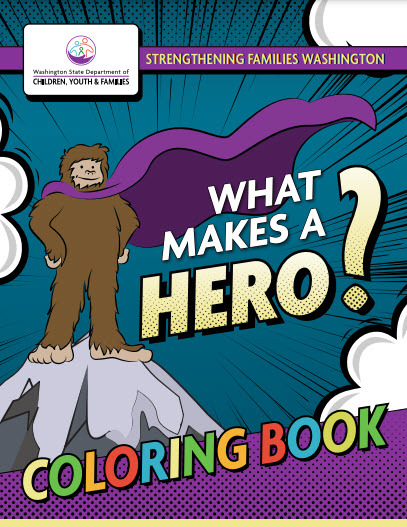
The Strengthening Families Washington team is excited to announce our coloring books are now available to order from the DES website, MyPrint. You can order both the What Makes a Hero and the Strengthening Families coloring book here, along with other DCYF publications. They are available in both English and Spanish, you can order up to 500 at a time and they are free.
Diaper need has been called an “invisible public health crisis” that impacts 1 in 3 children in the US. Diaper need impacts the physical, mental and economic health of families. Diaper banks address families’ need for diapers and other critical items by collecting, warehousing and distributing diapers and other products in a service area. They are embedded in their communities and coordinate with networks of community partners to respond to the needs of their communities. Some diaper banks are co-located with food banks.
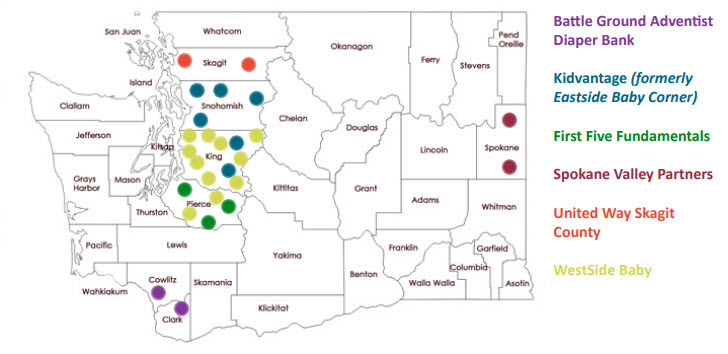
In late 2022 the Strengthening Families Washington (SFWA) contracted with six diaper banks that provide services in communities served by Home Visiting Services Account home visiting programs. Each diaper bank was assigned home visiting programs in their area and funded to provide diapers and supplies to those home visiting programs for their families. These partnerships are supported with federal American Rescue Plan Act funds and state concrete goods funds. SFWA has also funded these six diaper banks to provide products to all families in need in their community, not just home visiting families.
Diapers and Basic Supplies are Concrete Supports
Having access to tangible goods and services help families cope with stress, particularly in times of crisis or intensified need. They have been shown to reduce or buffer the effects of risk, stress or trauma. When families can provide the basics, they are better able to focus on other essential aspects of family life.
Six diaper banks are partnered with 23 home visiting programs in the Puget Sound area (Pierce, King, and Snohomish Counties), Southwest Washington (Clark and Cowlitz counties), Skagit and Spokane County. Together, they have been providing diapers and other critical supplies to over 700 Washington families per quarter.
These contracts ended in July 2023, with all funds being spent. Some items were provided to families after June 30. We ended on a high note, providing diapers and supplies to 965 home visiting families this past quarter, which is the largest number of families served since we started this program. The six diaper banks purchased about 300,000 diapers and pullups for home visiting families this quarter as well as other supplies.
2023 Juvenile Rehabilitation Annual Report
|
We are excited to share the 2023 Juvenile Rehabilitation Annual Report, which includes insights into operations, safety and security, facilities, programs, transitions and youth services, clinical programs, strategic initiatives, training, and administrative areas. Within this report, you will see the hard work of the JR staff, successful programs, and ongoing actions, including the following:
- The creation of the Critical Incident Review Team (CIRT) to build a safety culture in JR.
- A significant number of employments and graduations among residents at all community and secure facilities.
- Youth participation in programs such as Community Assisted Reentry (CAR), Community Transition Services (CTS), Homeless Prevention, and Community Support for All Youth (CSAY).
- 100% of JR youth and young adults have participated in a Reentry Team Meeting before their release.
- The formation of the Assessment Management Team in partnership with the Office of Innovation, Accountability, and Alignment to oversee the implementation of the IDEA and to ensure quality assessment processes in JR.
For more details on the great work from JR, please review the 2023 Juvenile Rehabilitation Annual Report posted on our website.
|
Materials
Connecting With and Serving Dads – Three Successful Approaches: Dad Allies Provider Learning Series event participants have expressed a desire to dig more deeply into how we successfully meet the unique needs of dad/father figures to become the father’s they aspire to be for their children and families. Three successful fatherhood leaders will share their passions, learnings, and strategies for positive outcomes and how to avoid the mistakes we often make when expanding services to fathers. Spokane Fatherhood Initiative Executive Director Ron Hauenstein, Dads M.O.V.E. Executive Director Nelson Rascon, and FELLAS Program Manager Kevin Cox will all reflect on their amazing work with fathers. Attendees will leave the session with new ideas on how to successfully expand their services and connect with fathers to provide the support they need to fully embrace their role in their child’s success.
Thursday, August 17
11:30 a.m. to 1 p.m.
Register Here
In the News
WA is taking a new approach to caring for newborns exposed to drugs, The Columbian
Treehouse Expands Programs for Youth in Foster Care Throughout Washington, San Juan Islander
Expert appointed to oversee Oregon agency that has been housing foster kids in hotels, The Seattle Times
Racial Equity Resources
Below are resources and opportunities to engage:
What is Health Equity? Episode 2 of "That's Public Health"
July was national minority mental health awareness month. Health equity is a public health approach that tackles health differences that are avoidable, unnecessary and unjust, and works to improve everyone’s health. Learn how in this second episode of the "That's Public Health" web series from American Public Health Association and Complexly (watch time 3:53):
Learn More
Read more about the current water inequity public health crisis within the Navajo Nation:
|
Ethnicity and Mental Health Review on the Universities of Bristol, Glasgow and Keele
Why do people from ethnic minority communities continue to have poorer access, experiences and outcomes in mental health care, despite 40 years of evidence highlighting inequalities? Researchers from the Universities of Bristol, Glasgow and Keele reviewed all the published and unpublished evidence on experiences of communities, service users and mental health professionals. This video explains the findings (watch time 4:32):
We The People | Mark Charles
Mark Charles explains the fundamental design of the founding documents of the United States of America that allows white, landowning men to flourish and maintain power. He examines how the United States Constitution and Declaration of Independence did not recognize all the people as having full human rights. From this understanding, we can clearly see why it has been so difficult to overcome the problems of inequality within the system that was designed to keep white, landowning men in the seat of power and control (watch time 5:44):
We The People | Mark Charles
|